15 Best Single Board Computers Under $100, Compared
As an Amazon Associate we earn from qualifying purchases. Links on this page are affiliate links.
Finding the best single board computers under $100 requires balancing memory, processor architecture, and connectivity. You will find 15 models compared here based strictly on the specifications published on their listings. The Libre Computer Tritium 1GB Quad-Core Board takes the top spot because its quad-core design, GPIO connectivity, and 1GB of RAM provide a reliable base for basic Linux appliances.
This guide helps you decide which board fits your deployment, whether you require integrated wireless networking or wired Gigabit Ethernet.
Quick picks
The best fit for you
- You need an open-source board for basic Linux appliances Libre Computer Tritium 1GB Quad-Core Board This quad-core board provides 1GB of RAM and upstream Linux support for lightweight workloads.
- You want an integrated display for portable Python projects DFRobot UNIHIKER ARM Single Board Computer The quad-core ARM platform includes an onboard touchscreen display in a compact form factor.
- You need high-speed wireless networking with ample memory Orange Pi Zero 3W 6GB LPDDR5 SBC This model pairs integrated Wi-Fi 6 connectivity with 6GB of LPDDR5 memory.
- You want multi-port networking for an Ubuntu gateway Orange Pi R2S RISC-V Single Board Computer The unit features quad Ethernet ports and 4GB of memory on a RISC-V processor.
Our 15 picks

Libre Computer Tritium 1GB Quad-Core Board
Best for: open-source IoT development and basic Linux appliances
- RAM Capacity
- 1GB
- Operating System Support
- Ubuntu, Debian, Raspbian, Armbian
The Libre Computer Tritium Quad-Core 1GB SBC is an open-source development board designed for IoT applications. You get a quad-core processor paired with 1GB of RAM, upstream Linux and u-boot support, and a Raspberry Pi-compatible GPIO interface. It boots without proprietary software blobs and runs standard distributions including Ubuntu, Debian, and Armbian. This board fits your needs if you build basic network appliances, lightweight automation tools, or open-source software projects.
Pros
- Upstream Linux and u-boot support without proprietary boot blobs
- 1GB RAM paired with a quad-core processor
- Raspberry Pi-compatible GPIO interface form factor
- First-party OS images for Ubuntu, Debian, Raspbian, and Armbian
Cons
- 1GB RAM capacity limits heavy multitasking
- No integrated Wi-Fi or Bluetooth listed
- Hardware availability spec lists support through 2023
Good fit if
- You need upstream Linux kernel and u-boot support without binary blobs.
- You run lightweight headless Linux distributions like Debian, Ubuntu, or Armbian.
- You want a standard GPIO layout for basic IoT appliance projects.
Skip if
- You require more than 1GB of system memory for modern desktop workloads.
- You need onboard wireless networking without adding external adapters.
Verdict: Libre Computer Tritium Quad-Core 1GB SBC delivers clean upstream open-source software support and familiar GPIO connectivity for lightweight development. It gives you a reliable base for standard Linux distributions when 1GB of RAM fits your workload.

Taidacent Rock Pi S with Shell
Best for: voice-activated IoT and lightweight headless projects
- Processor
- Rockchip RK3308 Quad A35 64bit
- RAM Capacity
- 256MB
- Storage
- 1GB NAND
- Ethernet
- RJ45 10/100Mbit Ethernet
- Use
- IoT
The Taidacent Rock Pi S is a compact single-board computer built specifically for lightweight IoT deployments. You get a Rockchip RK3308 quad-core 64-bit processor featuring a built-in voice activity detector, paired with 256MB of RAM and 1GB of onboard NAND storage. Wired networking is handled via a 10/100Mbit Ethernet port, alongside USB Type-A and Type-C OTG ports. It suits you if you need a dedicated headless audio or sensor node.
Pros
- Rockchip RK3308 quad-core 64-bit processor with built-in VAD
- Includes protective shell and 1GB onboard NAND storage
- USB 2.0 Type-A host and USB 2.0 Type-C OTG ports
- Supports optional PoE expansion via an add-on HAT
Cons
- Limited to 256MB of RAM and 10/100Mbit Ethernet
- Lacks integrated Bluetooth connectivity
- Requires an additional HAT for PoE operation
Good fit if
- You need an embedded board with a built-in voice activity detector.
- You run lightweight IoT automation projects requiring minimal memory.
- You want onboard NAND storage and an included enclosure.
Skip if
- You require Gigabit Ethernet or built-in Bluetooth.
- You need more than 256MB of RAM for multitasking.
Verdict: Taidacent Rock Pi S Board with Shell offers a focused set of hardware features for dedicated IoT and voice detection tasks. Its small memory footprint and 10/100Mbit Ethernet suit low-bandwidth embedded applications rather than full desktop computing.

MiiElAOD Raspberry Pi Compute Module 4 Wi-Fi
Best for: Lightweight wireless embedded projects
- RAM Capacity
- 1GB
- Storage
- No eMMC
- Wireless Connectivity
- 2.4/5.0GHz Wi-Fi
View on Amazon: MiiElAOD Raspberry Pi Compute Module 4 Wi-Fi
The MiiElAOD Raspberry Pi Compute Module 4 1GB Wi-Fi is an embedded single board computing module designed for custom carrier boards. You get 1GB of onboard RAM alongside integrated dual-band 2.4/5.0GHz Wi-Fi for wireless connectivity. It features no built-in eMMC flash storage, requiring you to provide external boot media through a baseboard. This bare-bones module suits you if you need a compact wireless core for embedded IoT or DIY hardware projects.
Pros
- Integrated 2.4/5.0GHz dual-band Wi-Fi connectivity
- Compact Compute Module 4 form factor
- Package includes the CM4 board ready for carrier integration
Cons
- No integrated eMMC flash storage
- Limited to 1GB onboard RAM
Good fit if
- You need integrated 2.4/5.0GHz Wi-Fi for wireless communication.
- You plan to supply external storage instead of onboard eMMC.
- You run lightweight embedded applications requiring only 1GB RAM.
Skip if
- You need built-in eMMC flash storage on the board.
- You require more than 1GB of memory for complex workloads.
Verdict: MiiElAOD Raspberry Pi Compute Module 4 1GB Wi-Fi provides essential dual-band wireless networking in a minimal compute footprint. Its lack of onboard eMMC storage and 1GB RAM make it best suited for lightweight embedded designs.

DFRobot UNIHIKER ARM Single Board Computer
Best for: portable Python and interactive IoT projects
- Processor
- Quad-Core ARM
- Storage
- 16GB Flash
- Wireless Connectivity
- Wi-Fi, Bluetooth
- Operating System Support
- Debian Linux
- Use
- IoT
- Dimensions
- 3.27 × 2.03 × 0.51 inches
The DFRobot UNIHIKER Touchscreen ARM SBC is an all-in-one development board built around a quad-core ARM processor and 16GB of onboard flash storage. It features an integrated 2.8-inch color touchscreen, built-in Wi-Fi, Bluetooth, and pre-installed Debian Linux with a Python environment. If you want a compact single board computer for handheld Internet of Things projects without wiring separate display screens or sensors, this setup gives you an immediate standalone coding platform.
Pros
- Integrated 2.8-inch color touchscreen display
- Built-in microphone, light sensor, accelerometer, gyroscope, and buzzer
- Pre-installed Debian Linux and Python environment
- 16GB onboard flash storage
- Integrated Wi-Fi and Bluetooth connectivity
Cons
- No HDMI port listed for external monitor output
- No wired Ethernet port listed
Good fit if
- You need an integrated touchscreen and onboard sensors without external wiring.
- You prefer pre-installed Debian Linux ready for Python development out of the box.
- You build portable IoT devices using Wi-Fi, Bluetooth, or micro:bit edge accessories.
Skip if
- You require an HDMI port to connect standard external desktop displays.
- You need a wired Ethernet connection for network communication.
Verdict: DFRobot UNIHIKER Touchscreen ARM SBC delivers a quad-core ARM platform complete with an onboard display and pre-configured Debian environment. It provides a self-contained hardware solution for compact Python and IoT projects.

Libre Computer Le Potato 128GB Starter Kit
Best for: 4K media playback and standalone Linux projects
- Processor
- AML-S905X-CC
- RAM Capacity
- 2GB
- RAM Type
- DDR3
- Storage
- 128GB eMMC
- Wireless Connectivity
- WiFi 5 BT
- Video Resolution
- 4K 60FPS
This single board computer starter kit equips you with a quad-core 1.5GHz ARM Cortex-A53 processor, 2GB of DDR3 memory, and 128GB of eMMC storage. It includes built-in WiFi 5 and Bluetooth connectivity alongside 4K 60FPS hardware decoding for VP9 and H.265. If you need a complete media-ready board with standard 40-pin expansion headers and UEFI bootloader support, this package provides dependable hardware for local Linux servers and video playback.
Pros
- Includes 128GB eMMC onboard storage and WiFi 5 with Bluetooth
- Hardware-accelerated 4K 60FPS decoding for H.265, H.264, and VP9
- 40-pin expansion header maintaining Raspberry Pi alternate pin functions
- Standardized bootloader with UEFI support for upstream Linux kernels
Cons
- Raspberry Pi software images require conversion and do not run out of the box
- Uses DDR3 memory standard rather than newer DDR4
- Total RAM capacity is limited to 2GB
Good fit if
- You need 128GB of high-speed eMMC storage included directly in the kit.
- You run 4K 60FPS video playback or media workloads using standard Linux distributions.
- You want a Raspberry Pi form-factor board with standard 40-pin GPIO pinout support.
Skip if
- You need plug-and-play compatibility with unmodifed Raspberry Pi operating system images.
- You require more than 2GB of memory for memory-intensive workloads.
- You require faster LPDDR4 or DDR4 memory bandwidth.
Verdict: Libre Computer Le Potato Starter Kit with 128GB eMMC delivers a ready-to-use development platform with fast onboard storage and reliable 4K video decoding. It serves well for dedicated media and standard Linux tasks, provided 2GB of DDR3 RAM meets your workload requirements.

Libre Computer Le Potato Kit with WiFi 5
Best for: low-power Linux projects and 4K media playback
- Processor
- AML-S905X-CC
- RAM Capacity
- 2GB
- RAM Type
- DDR3
- Wireless Connectivity
- WiFi 5 BT
- Video Resolution
- 4K 60FPS
- Operating System Support
- Ubuntu, Debian 12, Raspbian 11
The Libre Computer Le Potato 2GB SBC Kit is a single-board computer built around a quad-core 1.5GHz ARM Cortex-A53 processor and 2GB of DDR3 RAM. It delivers 4K 60FPS video decoding alongside standard WiFi 5 and Bluetooth connectivity. Its 40-pin header and board dimensions match the Raspberry Pi 3 layout. It fits you well if you want a low-power Linux system for media playback, lightweight server tasks, or hardware prototyping.
Pros
- Quad-core 1.5GHz Cortex-A53 CPU with 2GB DDR3 memory
- 4K 60FPS hardware decoding for H.265, H.264, and VP9
- Raspberry Pi 3 form-factor compatibility with a 40-pin GPIO header
- Includes WiFi 5 and Bluetooth connectivity
Cons
- Raspberry Pi software requires conversion tools before booting
- Limited to 2GB of DDR3 memory
- Requires an add-on module for eMMC storage
Good fit if
- You want a Raspberry Pi 3 alternative with 4K HDR video decoding.
- You need a low-power board with standard 40-pin header expansion.
- You prefer running standard upstream Linux distributions like Debian or Ubuntu.
Skip if
- You need more than 2GB of RAM for memory-intensive workloads.
- You want out-of-the-box compatibility with native Raspberry Pi OS images.
Verdict: Libre Computer Le Potato 2GB SBC Kit pairs a quad-core processor with 4K video decoding in a familiar Raspberry Pi form factor. It gives you an efficient foundation for headless servers, retro projects, and media setups.

Libre Computer Renegade 4GB SBC
Best for: Gigabit networking and lightweight Linux server builds
- Processor
- ROC-RK3328-CC
- RAM Capacity
- 4GB
- RAM Type
- DDR4
- Ethernet
- Gigabit Ethernet
- Wireless Connectivity
- WiFi 5 BT4
- Video Resolution
- 4K 60FPS
This single board computer features a quad-core 1.4GHz ARM Cortex-A53 processor paired with 4GB of DDR4 memory and 4K 60FPS video decoding. You get Gigabit Ethernet and a 5Gbps USB 3 port for high-speed networking and external storage. It provides a standard 40-pin header for hardware expansion. This board suits you if you need a compact Linux system for network storage, media playback, or headless server tasks.
Pros
- Gigabit Ethernet and 5Gbps USB 3 port
- 4GB DDR4 memory
- Hardware-accelerated 4K 60FPS video decoding
- Raspberry Pi compatible 40-pin expansion header
Cons
- No onboard Wi-Fi or Bluetooth hardware integrated on the PCB
- Raspberry Pi software images require conversion tools to boot
Good fit if
- You want a compact board with Gigabit Ethernet and USB 3 for networking projects.
- You plan to run standard upstream Linux distributions like Ubuntu or Debian.
Skip if
- You require built-in wireless hardware directly integrated on the board.
- You need out-of-the-box compatibility with native Raspberry Pi OS images.
Verdict: Libre Computer Renegade 4GB SBC delivers reliable Gigabit Ethernet, USB 3 connectivity, and 4K media decoding on an open Linux platform. It serves as an effective foundation for headless server tasks or lightweight media setups.

Orange Pi 3B 4GB Single Board Computer
Best for: edge AI projects and media playback
- Processor
- Rockchip RK3566
- RAM Capacity
- 4GB
- RAM Type
- LPDDR4/4X
- Ethernet
- Gigabit LAN
- Wireless Connectivity
- Wi-Fi5, BT5.0
- Operating System Support
- Android, Ubuntu, Debian, OpenHarmony
The Orange Pi 3B is a quad-core single board computer powered by the 1.8GHz Rockchip RK3566 processor and 4GB of LPDDR4/4X memory. It features Gigabit Ethernet, integrated Wi-Fi 5, Bluetooth 5.0, and an M.2 M-KEY slot for storage expansion. If you need a compact board for lightweight edge computing, media decoding up to 4K at 60fps, or running Linux and Android distributions, this unit delivers flexible hardware connectivity.
Pros
- Integrated 0.8 TOPS NPU for AI acceleration tasks
- M.2 M-KEY slot alongside eMMC support and TF card expansion
- Onboard Wi-Fi 5, Bluetooth 5.0, and Gigabit Ethernet
- Hardware decoding for 4K video at 60fps across H.265, H.264, and VP9
Cons
- eMMC flash storage module is not included on the board
- NPU capacity is limited to 0.8 TOPS
Good fit if
- You need an M.2 M-KEY connector for solid-state storage expansion.
- You run operating systems such as Ubuntu, Debian, OpenHarmony, or Android.
- You require 4K at 60fps video playback paired with Gigabit networking.
Skip if
- You need built-in eMMC storage included directly on the board.
- You require more than 4GB of system memory for demanding applications.
Verdict: Orange Pi 3B 4GB Single Board Computer provides balanced RK3566 quad-core performance, versatile display interfaces, and an M.2 expansion slot. It delivers reliable wired and wireless connectivity for media tasks and embedded Linux deployments.

Radxa Rock 4A+ 6-Core Single Board Computer
Best for: wired network projects needing 4K display output
- Processor
- Rockchip OP1
- RAM Capacity
- 2GB
- Storage
- 16GB eMMC
- Ethernet
- Gigabit Ethernet
- Video Resolution
- 4K
The Radxa Rock 4A+ is a single-board computer built around a 6-core Rockchip OP1 processor. You get 2GB of RAM, 16GB of onboard eMMC storage, and an M.2 M-key connector supporting PCIe 2.1 4-lane storage expansion. It features Gigabit Ethernet for wired networking and handles HDMI displays at up to 4K resolution. This board suits you if you need compact 6-core computing with integrated onboard flash and high-speed wired connectivity.
Pros
- Rockchip OP1 6-core processor
- Gigabit Ethernet port for wired connectivity
- M.2 M Key connector with PCIe 2.1 4-lane support
- HDMI output supporting up to 4K resolution
- 16GB integrated eMMC flash storage
Cons
- 2GB RAM capacity limits memory-heavy tasks
- No wireless networking hardware listed
Good fit if
- You need reliable Gigabit Ethernet for wired network setups.
- You want integrated 16GB eMMC storage out of the box.
- You plan to add an NVMe SSD via the PCIe 2.1 M.2 slot.
Skip if
- You require onboard Wi-Fi or Bluetooth connectivity.
- You need more than 2GB of system memory.
Verdict: Radxa Rock 4A+ 6-Core Single Board Computer delivers reliable Gigabit Ethernet networking, onboard eMMC storage, and PCIe 2.1 expansion in a compact footprint. It handles 4K video output smoothly while maintaining fast wired data throughput.

WayPonDEV Banana Pi WiFi 7 NIC Module
Best for: tri-band Wi-Fi 7 router and gateway builds
- Processor
- MediaTek MT7995AV
- Ethernet
- 2x 10Gbe SFP, 4x Gbe
- Wireless Connectivity
- Wi-Fi 7
- Operating System Support
- OpenWRT
- Architecture
- RISC-V
- Dimensions
- 5.9 × 4.01 × 0.78 inches
This add-on expansion card equips your router board with tri-band Wi-Fi 7 networking. Powered by the MediaTek MT7995AV chip and a 32-bit RISC-V microcontroller, it supports 2.4GHz, 5GHz, and 6GHz bands along with 320-MHz channel bandwidth. Because it runs OpenWRT and offloads network tasks via hardware accelerators, you get a specialized solution for building your own wireless gateway, access point, or router.
Pros
- Tri-band Wi-Fi 7 support across 2.4GHz, 5GHz, and 6GHz bands
- MediaTek MT7995AV processor with hardware offload engine
- Supports 320-MHz channel bandwidth and 4096-QAM
- Compatible with OpenWRT operating system
Cons
- Requires a compatible host router board to function
- No onboard display outputs like HDMI
- No built-in storage or pre-installed operating system
Good fit if
- You need tri-band Wi-Fi 7 capabilities on a compatible router board.
- You plan to run OpenWRT for a custom network gateway or router.
- You want hardware-accelerated Wi-Fi offloading to reduce host CPU load.
Skip if
- You need a standalone single board computer with direct display output.
- You want general-purpose desktop operating systems rather than OpenWRT.
- You do not already own a compatible host board with miniPCIe slots.
Verdict: WayPonDEV Tri-Band Wi-Fi 7 Module delivers cutting-edge tri-band wireless networking and hardware offloading for OpenWRT network builds. It is a specialized upgrade that requires a compatible host router board rather than acting as an independent computer.

Orange Pi RV2 4GB RISC-V SBC
Best for: RISC-V edge computing and AI development
- Processor
- RISC-V octa-core
- RAM Capacity
- 4GB
- RAM Type
- LPDDR4X
- Ethernet
- Gigabit Ethernet
- Wireless Connectivity
- Wi-Fi 5, BT 5 with BLE
- Operating System Support
- Ubuntu24.04
The Orange Pi RV2 is an octa-core RISC-V single-board computer built with 4GB of LPDDR4X memory and an integrated 2 TOPS neural processing unit. It gives you dual M.2 M-Key slots for NVMe solid-state storage, Gigabit Ethernet, and onboard Wi-Fi 5 with Bluetooth 5.0. This board suits you if you want to deploy lightweight artificial intelligence workloads or develop software on the open RISC-V architecture using Ubuntu 24.04.
Pros
- RISC-V octa-core processor with 2 TOPS AI compute capacity
- Two M.2 M-Key slots supporting NVMe solid-state drives
- Dual wireless connectivity with Wi-Fi 5 and Bluetooth 5.0 BLE
- 4GB LPDDR4X system memory
Cons
- Only officially lists support for Ubuntu 24.04
- eMMC flash storage module is optional and not included onboard
- PCIe bus performance is limited to PCIe 2.0 speeds
Good fit if
- You need an open-source RISC-V platform with 4GB of RAM for development.
- You plan to run local AI workloads utilizing an integrated 2 TOPS NPU.
- You want high-speed storage via dual NVMe M.2 expansion slots.
Skip if
- You need out-of-the-box support for operating systems other than Ubuntu 24.04.
- You require built-in eMMC storage included directly on the board.
Verdict: Orange Pi RV2 4GB RISC-V Board delivers efficient octa-core processing, 2 TOPS AI acceleration, and dual NVMe slots for advanced open-architecture projects. It provides a capable foundation if you want to build and test edge applications on Ubuntu 24.04.
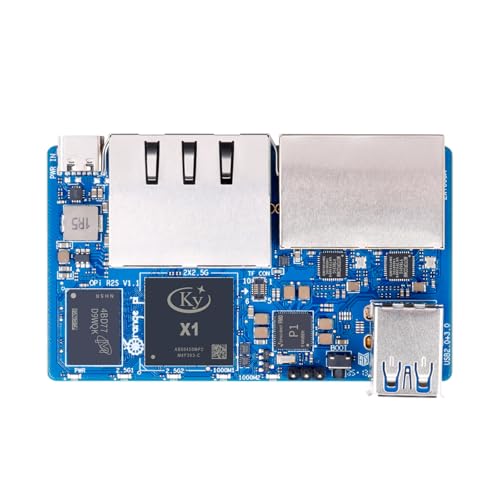
Orange Pi R2S RISC-V Single Board Computer
Best for: Ubuntu edge routing and network gateways
- Processor
- Ky X1
- RAM Capacity
- 4GB
- RAM Type
- LPDDR4X
- Storage
- 8GB eMMC
- Ethernet
- Dual 2.5G, Dual Gigabit Ethernet
- Operating System Support
- OpenWrt, Ubuntu
The Orange Pi R2S 4GB RISC-V SBC is a compact single-board computer built around an 8-core Ky X1 RISC-V processor with 2TOPS of integrated AI compute. You get 4GB of LPDDR4X RAM, 8GB of onboard eMMC flash, dual 2.5G network ports, and dual Gigabit Ethernet ports. It supports Ubuntu and OpenWrt, making it a capable choice if you need a multi-port networking gateway or edge AI device.
Pros
- Dual 2.5G and dual Gigabit Ethernet ports
- 8-core Ky X1 RISC-V processor with 2TOPS AI compute
- Includes 8GB onboard eMMC storage and TF card expansion
- Official OS support for Ubuntu and OpenWrt
Cons
- Onboard eMMC capacity is limited to 8GB
- No built-in Wi-Fi or Bluetooth listed in specifications
- No onboard display outputs listed
Good fit if
- You need multiple high-speed wired network interfaces for an edge gateway or router.
- You plan to run Ubuntu or OpenWrt on RISC-V architecture.
- You require integrated AI acceleration for edge workloads.
Skip if
- You require native wireless connectivity such as Wi-Fi.
- You need direct display outputs for a desktop setup.
Verdict: Orange Pi R2S 4GB RISC-V SBC delivers quad Ethernet ports and dedicated AI compute for multi-gigabit networking on Ubuntu. Its RISC-V architecture and compact dimensions make it an efficient headless edge device.

Orange Pi Zero 3 Allwinner H618 SBC
Best for: compact embedded IoT and edge computing projects
- Processor
- Allwinner H618
- RAM Capacity
- 4GB
- RAM Type
- LPDDR4
- Wireless Connectivity
- WiFi 5.0, Bluetooth 5.0
- Operating System Support
- Linux, Debian, Ubuntu, Android
- Dimensions
- 10 × 2 × 50 inches
The Orange Pi Zero 3 is a compact single board computer powered by a quad-core Allwinner H618 64-bit processor. You get 4GB of LPDDR4 memory alongside dual-band Wi-Fi 5 and Bluetooth 5.0 for wireless setups. It supports multiple operating systems, including Android, Ubuntu, Debian, and Linux. This board suits your embedded projects, smart devices, and lightweight edge computing needs where multi-OS compatibility is essential.
Pros
- 4GB LPDDR4 memory
- Allwinner H618 quad-core 64-bit processor
- Dual-band 2.4G/5G Wi-Fi and Bluetooth 5.0
- Support for Linux, Debian, Ubuntu, and Android
Cons
- AI acceleration capped at 0.8 TOPS INT8
- Board-to-board connectors require an optional base board for expansion
Good fit if
- You need 4GB LPDDR4 memory and wireless networking on a small footprint.
- You plan to run Debian, Ubuntu, Linux, or Android for IoT applications.
- You want built-in Wi-Fi 5 and Bluetooth 5.0 without adding USB adapters.
Skip if
- You require more than 0.8 TOPS of AI compute power for heavy machine learning.
- You want standard full-size ports directly on the board without using expansion interfaces.
Verdict: Orange Pi Zero 3 4GB SBC provides an Allwinner H618 processor with 4GB LPDDR4 memory for low-power embedded builds. Its built-in dual-band wireless and broad OS support make it a versatile platform for compact hardware projects.

Orange Pi Zero 3 Allwinner H618 SBC
Best for: compact 4K streaming and miniature Linux servers
- Processor
- Allwinner H618
- RAM Capacity
- 4GB
- RAM Type
- LPDDR4
- Storage
- 16MB SPI flash
- Ethernet
- Gigabit Ethernet
- Wireless Connectivity
- WiFi 5, Bluetooth 5.0
The Orange Pi Zero 3 is a compact single board computer built around an Allwinner H618 quad-core processor. It features 4GB of LPDDR4 memory, Gigabit Ethernet, WiFi 5, and micro HDMI supporting 4K video output. You also get 16MB onboard SPI flash and expansion pin headers. This setup suits you if you need a tiny media streamer running Android 12 TV or a small Linux utility server.
Pros
- Gigabit Ethernet interface
- Micro HDMI port with 4K display output
- Integrated WiFi 5 and Bluetooth 5.0 wireless
- 4GB LPDDR4 memory configuration
Cons
- Only one built-in USB 2.0 port on the board
- Requires micro HDMI adapter or cable for standard displays
- TV-out and extra USB ports require a separate expansion board
Good fit if
- You need 4K video playback with Android 12 TV support
- You require Gigabit Ethernet and WiFi 5 on a tiny footprint
- You run Debian or Ubuntu for compact network services
Skip if
- You need multiple onboard USB ports without adding an expansion board
- You require a full-size HDMI port
Verdict: Orange Pi Zero 3 4GB Single Board Computer provides high-speed networking, 4K video output, and 4GB memory on a miniature footprint. It serves well as a dedicated media streamer or compact headless Linux node.

Orange Pi Zero 3W 6GB LPDDR5 SBC
Best for: compact Wi-Fi 6 edge AI projects
- Processor
- Allwinner A733
- RAM Capacity
- 6GB
- RAM Type
- LPDDR5
- Wireless Connectivity
- Wi-Fi 6, Bluetooth 5.4
- Video Resolution
- 4K@60fps
- Operating System Support
- Android, Debian, Ubuntu, OpenHarmony
The Orange Pi Zero 3W 6GB LPDDR5 SBC is an eight-core single-board computer built for edge computing and wireless tasks. It pairs an Allwinner A733 processor with 6GB of fast LPDDR5 memory and an integrated 3 TOPS NPU. You get Wi-Fi 6, Bluetooth 5.4, and dual-display capability via Mini HDMI and USB Type-C. It suits developers building compact AI applications.
Pros
- Wi-Fi 6 and Bluetooth 5.4 wireless networking
- 6GB LPDDR5 system memory
- Octa-core Allwinner A733 CPU with 3 TOPS NPU
- Dual 4K video output via Mini HDMI 2.0 and USB Type-C Alt Mode
Cons
- Onboard eMMC and UFS storage sockets are unpopulated by default
- TF card slot is limited to 128GB maximum capacity
- Requires Mini HDMI cables or adapters rather than full-size HDMI
Good fit if
- You need fast Wi-Fi 6 and Bluetooth 5.4 wireless connectivity.
- You run machine learning workloads utilizing up to 3 TOPS mixed-precision compute.
- You want independent dual-screen display setups from a compact board.
Skip if
- You need ready-to-use onboard flash storage without supplying a TF card.
- You prefer standard full-size display ports over Mini HDMI and Type-C.
Verdict: Orange Pi Zero 3W 6GB LPDDR5 SBC delivers modern Wi-Fi 6 connectivity alongside fast LPDDR5 RAM and dedicated NPU hardware. It is an effective option when your embedded build requires fast networking and local AI acceleration.
Specifications side by side
| Spec | Libre Computer Tritium 1GB Quad-Core Board | Taidacent Rock Pi S with Shell | MiiElAOD Raspberry Pi Compute Module 4 Wi-Fi | DFRobot UNIHIKER ARM Single Board Computer | Libre Computer Le Potato 128GB Starter Kit | Libre Computer Le Potato Kit with WiFi 5 | Libre Computer Renegade 4GB SBC | Orange Pi 3B 4GB Single Board Computer | Radxa Rock 4A+ 6-Core Single Board Computer | WayPonDEV Banana Pi WiFi 7 NIC Module | Orange Pi RV2 4GB RISC-V SBC | Orange Pi R2S RISC-V Single Board Computer | Orange Pi Zero 3 Allwinner H618 SBC | Orange Pi Zero 3 Allwinner H618 SBC | Orange Pi Zero 3W 6GB LPDDR5 SBC |
|---|---|---|---|---|---|---|---|---|---|---|---|---|---|---|---|
| Processor | not specified | Rockchip RK3308 Quad A35 64bit | not specified | Quad-Core ARM | AML-S905X-CC | AML-S905X-CC | ROC-RK3328-CC | Rockchip RK3566 | Rockchip OP1 | MediaTek MT7995AV | RISC-V octa-core | Ky X1 | Allwinner H618 | Allwinner H618 | Allwinner A733 |
| RAM Capacity | 1GB | 256MB | 1GB | not specified | 2GB | 2GB | 4GB | 4GB | 2GB | not specified | 4GB | 4GB | 4GB | 4GB | 6GB |
| RAM Type | not specified | not specified | not specified | not specified | DDR3 | DDR3 | DDR4 | LPDDR4/4X | not specified | not specified | LPDDR4X | LPDDR4X | LPDDR4 | LPDDR4 | LPDDR5 |
| Storage | not specified | 1GB NAND | No eMMC | 16GB Flash | 128GB eMMC | not specified | not specified | not specified | 16GB eMMC | not specified | not specified | 8GB eMMC | not specified | 16MB SPI flash | not specified |
| Ethernet | not specified | RJ45 10/100Mbit Ethernet | not specified | not specified | not specified | not specified | Gigabit Ethernet | Gigabit LAN | Gigabit Ethernet | 2x 10Gbe SFP, 4x Gbe | Gigabit Ethernet | Dual 2.5G, Dual Gigabit Ethernet | not specified | Gigabit Ethernet | not specified |
| Wireless Connectivity | not specified | not specified | 2.4/5.0GHz Wi-Fi | Wi-Fi, Bluetooth | WiFi 5 BT | WiFi 5 BT | WiFi 5 BT4 | Wi-Fi5, BT5.0 | not specified | Wi-Fi 7 | Wi-Fi 5, BT 5 with BLE | not specified | WiFi 5.0, Bluetooth 5.0 | WiFi 5, Bluetooth 5.0 | Wi-Fi 6, Bluetooth 5.4 |
| Video Resolution | not specified | not specified | not specified | not specified | 4K 60FPS | 4K 60FPS | 4K 60FPS | not specified | 4K | not specified | not specified | not specified | not specified | 4K | 4K@60fps |
| Operating System Support | Ubuntu, Debian, Raspbian, Armbian | not specified | not specified | Debian Linux | Ubuntu, Debian 12, Raspbian 11 | Ubuntu, Debian 12, Raspbian 11 | Ubuntu, Debian 12, Raspbian 11 | Android, Ubuntu, Debian, OpenHarmony | not specified | OpenWRT | Ubuntu24.04 | OpenWrt, Ubuntu | Linux, Debian, Ubuntu, Android | Android 12 TV, Debian, Ubuntu | Android, Debian, Ubuntu, OpenHarmony |
| Memory | not specified | not specified | not specified | not specified | not specified | not specified | not specified | not specified | not specified | not specified | 4GB RAM | not specified | not specified | not specified | not specified |
| Operating System | not specified | not specified | not specified | not specified | not specified | not specified | not specified | Android | not specified | not specified | not specified | Ubuntu | Android | Android | Android |
| Use | not specified | IoT | not specified | IoT | not specified | not specified | not specified | not specified | not specified | not specified | not specified | not specified | not specified | not specified | not specified |
| Networking | not specified | not specified | not specified | not specified | not specified | not specified | not specified | not specified | Gigabit Ethernet | not specified | not specified | not specified | not specified | not specified | WiFi 6 |
| Architecture | not specified | not specified | not specified | ARM | not specified | not specified | not specified | not specified | not specified | RISC-V | RISC-V | RISC-V | not specified | not specified | not specified |
| Connectivity | not specified | not specified | not specified | not specified | WiFi 5 | WiFi 5 | WiFi 5 | not specified | not specified | not specified | WiFi 5 | not specified | WiFi 5, Bluetooth 5.0 | WiFi 5, Bluetooth 5.0 | not specified |
| Dimensions | not specified | not specified | not specified | 3.27 × 2.03 × 0.51 inches | not specified | 7.6 × 5.6 × 2.4 inches | 4.75 × 3 × 1 inches | not specified | not specified | 5.9 × 4.01 × 0.78 inches | 3.5 × 2.2 × 0.5 inches | not specified | 10 × 2 × 50 inches | not specified | not specified |
| Weight | not specified | not specified | not specified | not specified | not specified | not specified | not specified | not specified | not specified | 8.82 ounces | 2 ounces | not specified | not specified | not specified | not specified |
| Size | H3 1GB | With Shell | not specified | not specified | 128GB eMMC | not specified | 4GB | not specified | not specified | 32-bit RISC-V MCU | not specified | not specified | not specified | 4GB+Power Supply | not specified |
| Color | not specified | 256MB Without Bluetooth With 1GB NAND | CM4101000 | Black | WiFi 5 BT | WiFi 5 BT | WiFi 5 BT4 | Pi 3B 4GB | not specified | WiFi7 NIC Module | 4GB | not specified | not specified | 1GB+Power Supply | Zero 3W 6GB |
| Model | not specified | not specified | not specified | DFR0706-EN | not specified | not specified | not specified | not specified | Radxa ROCK 4AP 2GB 16GB | BPI-R4 NIC BE14 Wi-Fi 7 Module | Orange Pi RV2 | 4GB | XTD-US-PZ304GNEW | Orange Pi Zero 3 | Orange Pi Zero 3W |
If you also want compact coffee hardware for your workspace, the breakdown of best single serve brewers under 100 compares specifications for kitchen machines.
How to Choose a Single Board Computer
-
Compare Processor Architectures
Check whether your target software supports ARM or RISC-V instruction sets before buying. Standard ARM processors run most general Linux packages and development tools without extra recompilation. RISC-V models, such as the Orange Pi RV2, provide an open architecture suited for experimental testing, edge computing, and specific AI workloads. Choosing RISC-V requires you to verify that your planned tools and software packages compile cleanly on the architecture. Select ARM for proven software ecosystems and broad utility. Select RISC-V if you explicitly develop for open-standard processor platforms.
-
Evaluate Onboard Storage Options
Examine how the board handles primary storage and read-write throughput. MicroSD cards offer flexible swaps but slower sustained transfer rates. Onboard eMMC flash provides faster system boot times and higher endurance for continuous read and write tasks. The Libre Computer Le Potato Starter Kit includes 128GB of eMMC storage, which eliminates the need for separate flash media. Other units rely on raw NAND or external NVMe expansion. Review your data requirements. Pick integrated eMMC or NVMe options if you host active databases, high-frequency logging services, or local media files.
-
Verify Wired and Wireless Speed
Inspect the specific Ethernet generation and wireless networking standards on the board. Basic appliances run adequately on 10/100Mbit Ethernet, but network storage or streaming setups demand full Gigabit Ethernet to avoid bottlenecks. For wireless installations, compare the Wi-Fi generation. A board like the Orange Pi Zero 3W integrates Wi-Fi 6, which delivers faster wireless transfer speeds and better network density than older Wi-Fi 5 radios. Choose Gigabit Ethernet if your setup relies on constant wired transfers, and choose Wi-Fi 6 or dual-band wireless when running cable is impractical.
-
Check Operating System Support
Confirm which operating systems supply official images for your board before you deploy hardware. While many boards boot custom Linux kernels, distributions vary widely in maintenance and driver support. The Orange Pi R2S lists Ubuntu compatibility, making it practical if you rely on standard Canonical repository packages and familiar system tools. Other boards focus on Android or custom OpenWRT builds for networking. Review the distribution requirements of your software stack. Choosing a board with official support for your target operating system avoids manual kernel patching and unstable peripheral drivers.
-
Distinguish Modules from Standalone Boards
Identify whether the product operates independently or requires an external carrier board. Standard single board computers include integrated USB, HDMI, and power input jacks directly on the circuit board. Compute modules and specialized network cards lack standard external ports. For example, the MiiElAOD Raspberry Pi Compute Module 4 provides processor and wireless hardware but requires a separate baseboard to expose USB or display interfaces. If you want a quick setup, pick a standalone board. If you design custom industrial enclosures or carrier hardware, select a compute module.
Frequently asked questions
Can single board computers handle 4K video playback?
Yes, select single board computers include dedicated hardware decoding for 4K media streams. For example, boards such as the Radxa Rock 4A+ and the Libre Computer Le Potato natively handle 4K video output. These options allow you to build media players or digital signage platforms, provided you match the board with adequate system memory and supported operating systems like Android or Linux.
What is the advantage of choosing a board with onboard eMMC storage?
Onboard eMMC storage offers faster read and write speeds alongside greater long-term data reliability compared to standard microSD cards. Units like the Radxa Rock 4A+ provide integrated eMMC storage, while the Libre Computer Le Potato Starter Kit includes a 128GB eMMC module. This setup reduces system boot times, improves file transfer efficiency, and prevents storage degradation during continuous, read-heavy operations.
Can you run edge AI and machine learning workloads on compact boards?
Yes, certain models feature dedicated neural processing units engineered specifically for local machine learning inference. The Orange Pi RV2 includes 2 TOPS of AI acceleration on an octa-core platform, while the Orange Pi Zero 3W integrates a dedicated NPU alongside 6GB of LPDDR5 memory. These components let you deploy lightweight computer vision, voice detection, and sensor models locally without external cloud connectivity.
Do you need additional carrier boards to use compute modules?
Yes, compute modules require a separate carrier baseboard to break out essential physical interfaces like USB, HDMI, and power connections. The MiiElAOD Raspberry Pi Compute Module 4 provides core processing and dual-band wireless hardware on a compact board, but it lacks standard peripheral ports. You must connect it to a compatible baseboard to access display outputs, storage interfaces, and power inputs.
Which network connectivity options are available on these single board computers?
Network capabilities vary from basic 10/100Mbit Ethernet up to multi-gigabit wired interfaces and advanced wireless standards. While compact boards like the Taidacent Rock Pi S feature 10/100Mbit ports, boards like the Libre Computer Renegade offer Gigabit Ethernet. For wireless networking, options range from WiFi 5 on the Orange Pi Zero 3 to modern Wi-Fi 6 on the Orange Pi Zero 3W.
What operating systems can you run on these single board computers?
Most boards support open-source Linux distributions, though specific system availability depends on board architecture and manufacturer images. Boards like the Orange Pi RV2 and Orange Pi R2S run Ubuntu, while the DFRobot UNIHIKER comes pre-configured with Debian. Other boards, such as the Orange Pi 3B and Orange Pi Zero 3, list Android compatibility, allowing you to choose between desktop environments, mobile platforms, or headless server operating systems.
Can a single board computer function as a dedicated router or network gateway?
Yes, specific single board computers feature multi-port network layouts built directly for routing and gateway applications. The Orange Pi R2S provides quad Ethernet ports alongside RISC-V processing for multi-gigabit network tasks under Ubuntu. Additionally, modular components like the WayPonDEV Banana Pi WiFi 7 module integrate with host router boards using OpenWRT to deliver high-speed wireless routing for custom network gateways.