Orange Pi Single Board Computers: 15 Picks Ranked by Specs
As an Amazon Associate we earn from qualifying purchases. Links on this page are affiliate links.
Selecting the proper orange pi single board computer depends on your project requirements. Orange Pi offers compact and miniature boards running Rockchip, Allwinner, or RISC-V hardware. The Orange Pi Zero LTS Single Board Computer takes the top position because it delivers quad-core processing and wired networking for compact embedded projects needing basic networking.
We compared 15 models based strictly on the specifications published on their product listings. Choices range from low-overhead 512MB controllers to advanced units featuring up to 16GB memory, dual 2.5GbE ports, and integrated AI compute.
Quick picks
Our 15 picks

Orange Pi Zero LTS Single Board Computer
Best for: compact embedded projects needing basic networking
- Processor
- Allwinner H3 Quad-core Cortex-A7
- RAM Capacity
- 512MB
- Ethernet
- 100M
- Video Resolution
- 4K
- Operating System Support
- Android, Ubuntu, Debian
The Orange Pi Zero LTS is a compact single-board computer powered by an Allwinner H3 quad-core Cortex-A7 processor. It includes 512MB of onboard memory, an integrated 100M Ethernet jack, one USB 2.0 host port, and a dedicated serial debugging interface. This board suits you if you need small, low-power hardware for space-constrained embedded setups running lightweight builds of Android, Ubuntu, or Debian.
Pros
- Allwinner H3 quad-core Cortex-A7 processor
- Integrated 100M Ethernet port
- Raspberry Pi-compatible GPIO header
- Dedicated serial debugging port
Cons
- 512MB RAM limits demanding multitasking
- 100M network port lacks Gigabit speeds
- No integrated video display output listed
Good fit if
- You need a minimal board for space-constrained embedded projects.
- You require wired 100M Ethernet and USB OTG power.
- You run lightweight builds of Debian, Ubuntu, or Android.
Skip if
- You need more than 512MB of system memory.
- You require Gigabit Ethernet or USB 3.0 data speeds.
- You need dedicated video output ports for standard monitors.
Verdict: Orange Pi Zero LTS Quad-Core SBC delivers essential processing and wired networking in a compact footprint for embedded applications. Its 512MB memory and quad-core processor suit simple, low-overhead headless tasks.

Orange Pi 5 Plus Single Board Computer
Best for: dual 2.5GbE networking and home server builds
- Processor
- Rockchip RK3588
- RAM Capacity
- 4GB
- RAM Type
- LPDDR4/4x
- Ethernet
- 2x 2.5G Ethernet
- Video Resolution
- 8K@60Hz
- Operating System Support
- Orange Pi OS, Ubuntu, Debian, Android
The Orange Pi 5 Plus is a single-board computer powered by an eight-core Rockchip RK3588 processor with up to 16GB of LPDDR4 or LPDDR4x RAM. It features dual 2.5G Ethernet ports, dual HDMI outputs, an HDMI input, and M.2 slots for NVMe storage and wireless expansion. This board suits you if you need multi-gigabit networking, 8K video decoding, and flexible storage options for server or media tasks.
Pros
- Dual 2.5G PCIe Ethernet ports
- Rockchip RK3588 8-core CPU clocked up to 2.4GHz
- Dual HDMI output ports and one HDMI input port
- M.2 M-Key NVMe slot and eMMC socket for storage expansion
- Configurable with 4GB, 8GB, or 16GB RAM
Cons
- Requires a separate M.2 E-Key card for Wi-Fi and Bluetooth
- Uses LPDDR4/4x rather than faster LPDDR5 memory
Good fit if
- You need dual 2.5G wired network ports for firewall, routing, or NAS setups.
- You want HDMI video input along with dual HDMI outputs supporting 8K decoding.
- You require fast local storage via an M.2 NVMe SSD or eMMC module.
Skip if
- You want built-in Wi-Fi and Bluetooth without purchasing an add-in card.
- You specifically require faster LPDDR5 memory architecture.
Verdict: Orange Pi 5 Plus RK3588 SBC delivers high compute and networking throughput with its dual 2.5G ports, M.2 expandability, and RK3588 processor. It functions effectively as a base for advanced local networking, media playback, and compact server builds.

Orange Pi 3B 8GB Single Board Computer
Best for: Lightweight edge computing and 4K media playback
- Processor
- Rockchip RK3566
- RAM Capacity
- 8GB
- RAM Type
- LPDDR4/4X
- Ethernet
- Gigabit LAN
- Wireless Connectivity
- Wi-Fi 5, BT 5.0
- Video Resolution
- 4K@60fps
The Orange Pi 3B is a compact single-board computer powered by a Rockchip RK3566 quad-core processor and 8GB of LPDDR4/4X memory. You get integrated Wi-Fi 5, Gigabit Ethernet, an M.2 M-Key slot, and a 0.8 TOPS NPU. It handles 4K video decoding at 60 fps and supports multiple Linux distributions and Android. You will find it well suited for lightweight home servers, edge AI tasks, and media playback.
Pros
- 8GB LPDDR4/4X memory for multitasking
- Rockchip RK3566 quad-core CPU with 0.8 TOPS NPU
- M.2 M-Key slot and TF card reader for storage
- Supports 4K at 60 fps H.265/H.264/VP9 decoding
- Broad OS support including Android 11, Ubuntu, and Debian
Cons
- Uses older Wi-Fi 5 standard instead of Wi-Fi 6
- NPU compute capability is limited to 0.8 TOPS
- eMMC storage module is not included on board
Good fit if
- You need 8GB RAM on a low-power quad-core board.
- You plan to run Android, Ubuntu, or Debian from an M.2 drive or microSD card.
- You want 4K video playback with HDMI, eDP, or MIPI DSI display outputs.
Skip if
- You need high-performance AI processing exceeding 0.8 TOPS.
- You require Wi-Fi 6 wireless networking out of the box.
Verdict: Orange Pi 3B 8GB Single Board Computer delivers balanced quad-core computing and generous memory for general-purpose DIY builds and media playback. It offers flexible display and storage interfaces without excessive power demands.

Orange Pi RV2 4GB RISC-V SBC
Best for: RISC-V edge AI and compact NAS projects
- Processor
- RISC-V octa-core
- RAM Capacity
- 4GB
- RAM Type
- LPDDR4X
- Ethernet
- Gigabit Ethernet
- Wireless Connectivity
- Wi-Fi 5, BT 5 with BLE
- Operating System Support
- Ubuntu24.04
The Orange Pi RV2 is an 8-core RISC-V single-board computer built with 4GB of LPDDR4X memory and 2 TOPS of integrated AI arithmetic power. It includes dual M.2 M-Key PCIe 2.0 slots for NVMe storage, Gigabit Ethernet, and Wi-Fi 5 connectivity. This board fits developers and hobbyists building low-power edge computing devices, local AI projects, or compact NAS setups running Ubuntu 24.04.
Pros
- 8-core RISC-V processor with 2 TOPS integrated AI acceleration
- Dual M.2 M-Key slots for NVMe SSD storage
- Gigabit Ethernet alongside Wi-Fi 5 and Bluetooth 5.0
- Support for optional eMMC modules up to 128GB
Cons
- Wireless connectivity limited to Wi-Fi 5
- M.2 slots run at PCIe 2.0 2-lane bandwidth
Good fit if
- You want a 4GB RISC-V development platform with hardware AI acceleration.
- You plan to connect dual NVMe SSDs for high-speed local storage or NAS tasks.
- You target deployments using Ubuntu 24.04 on RISC-V hardware.
Skip if
- You require standard ARM architecture software compatibility.
- You need faster Wi-Fi 6 wireless networking.
Verdict: Orange Pi RV2 4GB RISC-V SBC delivers balanced memory capacity, dual NVMe expansion, and integrated AI compute for RISC-V edge deployments.
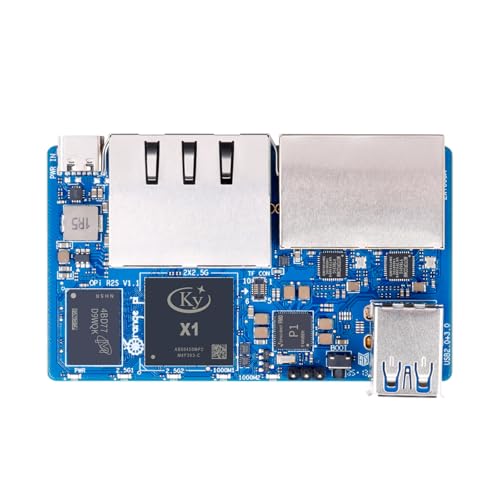
Orange Pi R2S RISC-V Single Board Computer
Best for: compact multi-gigabit edge networking projects
- Processor
- Ky X1
- RAM Capacity
- 4GB
- RAM Type
- LPDDR4X
- Storage
- 8GB eMMC
- Ethernet
- Dual 2.5G, Dual Gigabit Ethernet
- Operating System Support
- OpenWrt, Ubuntu
The Orange Pi R2S is a compact single-board computer built around an 8-core Ky X1 RISC-V processor with 2TOPS of integrated AI processing. You get 4GB of LPDDR4X memory, 8GB of onboard eMMC storage, and an array of four network jacks, including dual 2.5G and dual Gigabit Ethernet ports. It suits you if you need a dedicated edge router or network gateway running OpenWrt or Ubuntu.
Pros
- Dual 2.5G Ethernet and dual Gigabit Ethernet ports
- Ky X1 8-core RISC-V processor with 2TOPS AI power
- Compact form factor measuring 79.2mm by 46mm
- Onboard 8GB eMMC storage plus TF card slot
Cons
- No integrated Wi-Fi or Bluetooth interfaces listed
- No display or video output ports provided
- Modest 8GB onboard eMMC storage capacity
Good fit if
- You need quad Ethernet ports for router or gateway deployments.
- You run network workloads on OpenWrt or Ubuntu systems.
- You want RISC-V hardware with onboard AI acceleration.
Skip if
- You require display outputs for desktop monitor setups.
- You need built-in wireless networking out of the box.
- You depend on traditional x86 or ARM software ecosystems.
Verdict: Orange Pi R2S RISC-V Single Board Computer provides high-density Ethernet connectivity and hardware AI acceleration in a miniature form factor. It serves as an effective platform for OpenWrt routing and edge computing tasks.

Orange Pi 4 Pro 12GB Single Board Computer
Best for: Edge AI inference and memory-heavy robotics
- Processor
- Allwinner A733
- RAM Capacity
- 12GB
- RAM Type
- LPDDR5
- Ethernet
- Gigabit Ethernet
- Wireless Connectivity
- Wi-Fi 6, Bluetooth 5.4
- Operating System Support
- Android, Debian, Ubuntu, OpenHarmony
The Orange Pi 4 Pro is an octa-core single board computer equipped with 12GB of LPDDR5 memory and an Allwinner A733 processor reaching up to 2.0GHz. It features an integrated 3 TOPS NPU for AI inference, alongside a RISC-V co-processor. With Wi-Fi 6, Bluetooth 5.4, and Gigabit Ethernet supporting PoE, this board suits you if you build smart gateways, robotics, or computer vision projects needing substantial RAM.
Pros
- 12GB of high-speed LPDDR5 RAM
- 3 TOPS NPU supporting INT8, INT16, FP16, and BF16
- Wi-Fi 6, Bluetooth 5.4, and Gigabit Ethernet with PoE
- Octa-core CPU paired with an integrated RISC-V co-processor
Cons
- Processor clock speed peaks at 2.0GHz
- No onboard storage capacity listed in specifications
Good fit if
- You need 12GB of RAM for edge AI tasks or multitasking.
- You run frameworks like TensorFlow, PyTorch, or ONNX using hardware acceleration.
- You want PoE support to deliver power and data over one Ethernet cable.
Skip if
- You require processor clock frequencies higher than 2.0GHz.
- You need integrated eMMC or NVMe storage included out of the box.
Verdict: Orange Pi 4 Pro 12GB LPDDR5 SBC delivers substantial memory and a 3 TOPS NPU for edge AI workloads. Its combination of an Allwinner A733 chip, Wi-Fi 6, and PoE makes it a versatile platform for connected projects.

Orange Pi 5 Ultra RK3588 SBC
Best for: AI development and 8K video capture projects
- Processor
- Rockchip RK3588
- RAM Capacity
- 8GB
- RAM Type
- LPDDR5
- Wireless Connectivity
- Wi-Fi 6E, Bluetooth 5.3
- Video Resolution
- 8K@60FPS
- Operating System Support
- Linux, Ubuntu, Debian, Android
The Orange Pi 5 Ultra is an 8-core single-board computer powered by the Rockchip RK3588 processor and LPDDR5 memory. It features an integrated 6TOPS neural processing unit, Wi-Fi 6E, Bluetooth 5.3, and an HDMI 2.1 video output handling up to 8K at 60Hz alongside an HDMI 2.0 input port. This setup suits you if you build advanced artificial intelligence workloads, machine vision systems, or high-resolution multimedia capture setups requiring fast local processing.
Pros
- Rockchip RK3588 8-core 64-bit processor with fast LPDDR5 memory
- Built-in 6TOPS NPU supporting INT4, INT8, and INT16 computation
- HDMI 2.1 output up to 8K at 60fps plus HDMI 2.0 input port
- Wi-Fi 6E and Bluetooth 5.3 wireless connectivity
Cons
- Provides only one HDMI video output port
- Onboard eMMC storage module sold separately
Good fit if
- You need onboard NPU hardware acceleration for AI or machine learning tasks.
- You require an HDMI 2.0 video input port for signal capture alongside an 8K output.
- You want fast Wi-Fi 6E connectivity and LPDDR5 memory on an SBC.
Skip if
- You need dual native HDMI display outputs instead of an HDMI input.
- You prefer an SBC with pre-soldered onboard eMMC flash storage included.
Verdict: Orange Pi 5 Ultra RK3588 SBC delivers top-tier edge computing power with its 6TOPS NPU, LPDDR5 RAM, and rare HDMI input port. It is a capable platform for advanced AI development and video capture projects.

Orange Pi 5 Pro RK3588S SBC
Best for: edge computing and high-resolution media playback
- Processor
- Rockchip RK3588S
- RAM Capacity
- 8GB
- RAM Type
- LPDDR5
- Ethernet
- Gigabit Ethernet
- Wireless Connectivity
- Wi-Fi 5, Bluetooth 5.0
- Video Resolution
- 8K
The Orange Pi 5 Pro is a compact single-board computer powered by an eight-core Rockchip RK3588S processor paired with fast LPDDR5 memory. It supports up to 8K video output alongside onboard Wi-Fi 5, Bluetooth 5.0, and Gigabit Ethernet with PoE support. Storage expansion includes an M.2 M-Key slot for NVMe or SATA drives and an eMMC socket. It suits you if you need high-bandwidth memory and versatile storage for edge computing or automation projects.
Pros
- Eight-core Rockchip RK3588S processor clocked up to 2.4GHz
- Fast LPDDR5 memory standard
- M.2 M-Key slot supporting NVMe and SATA SSDs
- Gigabit Ethernet with PoE support
- Up to 8K display processing with HDMI and MIPI DSI outputs
Cons
- Wireless connectivity limited to Wi-Fi 5 rather than newer standards
- Bluetooth version capped at Bluetooth 5.0
Good fit if
- You need an eight-core RK3588S board with LPDDR5 memory.
- You want M.2 NVMe or SATA expansion options for high-speed storage.
- You deploy networked edge hardware using PoE-capable Gigabit Ethernet.
Skip if
- You require integrated Wi-Fi 6 or newer wireless hardware.
- You need the standard RK3588 processor rather than the RK3588S variant.
Verdict: Orange Pi 5 Pro RK3588S SBC delivers strong edge-processing capability with LPDDR5 memory, 8K display support, and flexible M.2 NVMe storage. It serves as a versatile hardware base for automation setups and compact development builds.

Orange Pi 5 Max RK3588 Single Board Computer
Best for: edge AI and dual 8K display setups
- Processor
- Rockchip RK3588
- RAM Capacity
- 16GB
- RAM Type
- LPDDR5
- Wireless Connectivity
- Wi-Fi 6E, Bluetooth 5.3
- Video Resolution
- 8K@60FPS
- Operating System Support
- Linux, Ubuntu, Debian, Android
View on Amazon: Orange Pi 5 Max RK3588 Single Board Computer
The Orange Pi 5 Max is a high-performance single board computer running an eight-core Rockchip RK3588 processor and fast LPDDR5 memory. You get dual HDMI 2.1 display outputs supporting 8K resolution at 60 frames per second, integrated Wi-Fi 6E, and an onboard 6TOPS neural processing unit. It fits your setup if you build advanced computer vision pipelines, edge machine learning projects, or multi-display media stations needing heavy processing throughput.
Pros
- Rockchip RK3588 8-core processor with 6TOPS NPU
- Dual HDMI 2.1 ports supporting up to 8K at 60FPS
- Fast LPDDR5 memory and integrated Wi-Fi 6E with Bluetooth 5.3
- Dual 4-lane MIPI CSI camera interfaces and MIPI DSI display port
Cons
- eMMC storage module sold separately from onboard socket
- Base configuration option does not include a power supply
Good fit if
- You need 6TOPS of onboard NPU performance for local machine learning tasks.
- You want dual 8K display outputs via HDMI 2.1.
- You require fast Wi-Fi 6E and Bluetooth 5.3 wireless connectivity.
Skip if
- You want built-in eMMC storage included out of the box.
- You only require basic processing power for lightweight, simple tasks.
Verdict: Orange Pi 5 Max RK3588 Single Board Computer delivers serious edge computing power with its 6TOPS NPU and dual 8K HDMI outputs. It gives you top-tier connectivity whenever your workload demands fast LPDDR5 memory and Wi-Fi 6E.

Orange Pi Zero 2W Quad-Core SBC
Best for: compact IoT and smart home projects
- Processor
- Allwinner H618
- RAM Capacity
- 4GB
- RAM Type
- LPDDR4
- Storage
- 16MB SPI Flash
- Wireless Connectivity
- Wi-Fi 5, Bluetooth 5.0
- Operating System Support
- Android 12 TV, Debian, Ubuntu
The Orange Pi Zero 2W is a compact single-board computer built around an Allwinner H618 quad-core Arm Cortex-A53 processor. Measuring just 30mm by 65mm, it offers up to 4GB of LPDDR4 memory, Wi-Fi 5, Bluetooth 5.0, and a Micro HDMI port. You also get a 40-pin header for hardware projects. It suits you if you need a tiny board for smart home setups, IoT gateways, or basic Android 12 TV installations.
Pros
- Compact 30mm by 65mm board dimensions
- Allwinner H618 quad-core CPU with up to 4GB LPDDR4 RAM
- Onboard Wi-Fi 5 and Bluetooth 5.0 connectivity
- 40-pin expansion header plus 24-pin functional interface
Cons
- Requires an adapter board for wired Ethernet and audio output
- Uses Micro HDMI instead of a full-size display connector
- Limited to USB 2.0 transfer speeds
Good fit if
- You need a 30mm by 65mm form factor for space-limited enclosures.
- You want built-in Wi-Fi 5 and Bluetooth 5.0 without USB adapters.
- You plan to deploy lightweight IoT services or Android 12 TV.
Skip if
- You require onboard Ethernet without buying an expansion board.
- You need native full-size USB ports or USB 3.0 speeds.
Verdict: Orange Pi Zero 2W Quad-Core SBC packs practical processing and dual-band wireless into an ultra-small footprint. It is a capable choice for embedded builds, provided you do not need native wired ports.

Orange Pi 4A Allwinner T527 SBC
Best for: Edge AI robotics and industrial control projects
- Processor
- Allwinner T527
- RAM Capacity
- 4GB
- RAM Type
- LPDDR4/4X
- Ethernet
- Gigabit Ethernet
- Wireless Connectivity
- WiFi 5, BT 5.0
- Operating System Support
- Ubuntu, Debian, Android 13
The Orange Pi 4A Allwinner T527 SBC gives you an octa-core Cortex-A55 processor paired with dedicated RISC-V co-processors and a 2TOPS NPU for edge AI tasks. You get memory options up to 4GB LPDDR4/4X, an eMMC socket, and dual MIPI camera and display interfaces. It suits you if you build robotics, edge computing setups, or industrial control hardware running Ubuntu, Debian, or Android 13.
Pros
- Allwinner T527 octa-core Cortex-A55 with RISC-V co-processors
- Integrated 2TOPS NPU for edge AI acceleration
- Dual MIPI-CSI and MIPI-DSI interfaces
- Gigabit Ethernet and WiFi 5 connectivity
- Onboard eMMC socket and 40-pin expansion header
Cons
- USB connectivity limited to USB 2.0 speeds
- System memory capped at 4GB LPDDR4/4X
- PCIe expansion limited to PCIe 2.0
Good fit if
- You need an onboard 2TOPS NPU and RISC-V co-processors for edge AI or robotics.
- You require dual MIPI camera and display ports for vision projects.
- You plan to run systems on Ubuntu, Debian, or Android 13.
Skip if
- You require faster USB 3.0 ports for high-speed peripherals.
- You need more than 4GB of RAM for heavy workloads.
- You need expansion bus throughput beyond PCIe 2.0.
Verdict: Orange Pi 4A Allwinner T527 SBC delivers balanced edge AI acceleration and multi-core processing for embedded robotics and control tasks. It provides versatile MIPI and network connectivity when 4GB RAM and USB 2.0 speeds meet your requirements.

Orange Pi RV RISC-V Single Board Computer
Best for: Linux RISC-V development and edge video tasks
- Processor
- StarFive JH-7110
- RAM Capacity
- 2GB
- RAM Type
- LPDDR4
- Ethernet
- Gigabit Ethernet
- Wireless Connectivity
- Wi-Fi 5.0, Bluetooth 5.0
- Video Resolution
- 4K@30fps
The Orange Pi RV is a RISC-V single board computer powered by a quad-core 64-bit processor running at 1.5GHz. It includes integrated graphics, 4K at 30 frames per second video decoding, Gigabit Ethernet, Wi-Fi 5, and an M.2 M-Key 2280 slot. Running Linux, this board suits you if you need a dedicated open-standard hardware platform for edge video decoding or embedded Linux software development.
Pros
- Quad-core 64-bit RISC-V processor clocked at 1.5GHz
- Onboard M.2 M-Key 2280 slot and PCIe 2.0 interface
- Dual wireless support with Wi-Fi 5 and Bluetooth 5.0
- Hardware decoding for H.264 and H.265 video up to 4K at 30fps
- Extensive I/O including Gigabit Ethernet, USB 3.0, MIPI-CSI, and MIPI-DSI
Cons
- Video decoding tops out at 4K at 30fps rather than 60fps
- Requires a 5V 4A Type-C power supply
- Data bus speeds limited to PCIe 2.0
Good fit if
- You need a 64-bit RISC-V architecture board running Linux.
- You want standard M.2 2280 storage expansion alongside Gigabit Ethernet.
- You deploy edge visual workloads using H.264 or H.265 decoding.
Skip if
- You require 4K video playback output at 60fps.
- You lack a 5V 4A power delivery adapter.
Verdict: Orange Pi RV RISC-V Single Board Computer delivers functional 64-bit RISC-V computing with expansive physical interfaces and Linux support. It provides capable 4K decoding and standard storage expansion for embedded development tasks.

Orange Pi Zero 3 Allwinner H618 SBC
Best for: compact edge AI and embedded Android tasks
- Processor
- Allwinner H618
- RAM Capacity
- 4GB
- RAM Type
- LPDDR4
- Wireless Connectivity
- WiFi 5.0, Bluetooth 5.0
- Operating System Support
- Linux, Debian, Ubuntu, Android
- Dimensions
- 10 × 2 × 50 inches
The Orange Pi Zero 3 is a compact single-board computer powered by an Allwinner H618 4-core 64-bit processor. You get integrated wireless connectivity with dual-band 2.4 GHz and 5 GHz Wi-Fi 5 alongside Bluetooth 5.0. It supports LPDDR4 RAM configurations up to 4 GB and runs Android. This board suits you if you need a tiny platform for edge computing or embedded systems without requiring desktop-tier hardware.
Pros
- Allwinner H618 4-core 64-bit processor
- Dual-band 2.4G/5G Wi-Fi 5 and Bluetooth 5.0 onboard
- Up to 4 GB of LPDDR4 memory supported
- Integrated NPU providing up to 0.8 TOPS AI computing power
Cons
- Operating system specification lists only Android
- Memory capacity caps at 4 GB
Good fit if
- You need dual-band Wi-Fi 5 and Bluetooth 5.0 integrated directly on the board.
- You run lightweight Android or edge AI workloads requiring up to 4 GB RAM.
Skip if
- You require more than 4 GB of memory for heavy multitasking.
- You need an out-of-the-box Linux operating system listed in specifications.
Verdict: Orange Pi Zero 3 Allwinner H618 SBC provides a balanced mix of quad-core processing and dual-band wireless networking for compact projects. It serves reliably when your setup calls for modest memory and Android compatibility.

Orange Pi Zero 3 Allwinner H618 SBC
Best for: compact network appliances and lightweight media servers
- Processor
- Allwinner H618
- RAM Capacity
- 4GB
- RAM Type
- LPDDR4
- Storage
- 16MB SPI flash
- Ethernet
- Gigabit Ethernet
- Wireless Connectivity
- WiFi 5, Bluetooth 5.0
The Orange Pi Zero 3 is a compact single-board computer powered by an Allwinner H618 quad-core Cortex-A53 processor. It pairs up to 4GB of LPDDR4 memory with Gigabit Ethernet, WiFi 5, and Bluetooth 5.0 networking. You get a micro HDMI port supporting 4K video alongside 13-pin and 26-pin expansion headers. This board fits you if you need a tiny, low-power platform for basic Linux server tasks, TV streaming, or lightweight embedded projects.
Pros
- Gigabit Ethernet alongside onboard WiFi 5 and Bluetooth 5.0
- Supports up to 4GB LPDDR4 memory and 16MB SPI flash
- Micro HDMI port delivers up to 4K video output
- Includes 26-pin and 13-pin expansion headers for added interfaces
Cons
- Only one standard onboard USB 2.0 port
- Micro HDMI port requires an adapter or specialized cable for full-size displays
- Analog audio and extra USB ports require a separate expansion board
Good fit if
- You need a small board with Gigabit Ethernet and WiFi 5 connectivity.
- You plan to run lightweight Linux distributions or Android 12 TV.
- You want 4K video display output from a compact quad-core board.
Skip if
- You need multiple full-size USB ports without adding an expansion board.
- You require standard full-size HDMI output for direct monitor connections.
- You need higher processing power beyond Cortex-A53 cores.
Verdict: Orange Pi Zero 3 Allwinner H618 SBC delivers reliable Gigabit networking, dual-band wireless, and 4K output in an ultra-compact footprint. It offers a solid balance of memory and essential connectivity for lightweight server and media tasks.

Orange Pi Zero 3W 6GB LPDDR5 SBC
Best for: Compact edge AI and dual-display projects
- Processor
- Allwinner A733
- RAM Capacity
- 6GB
- RAM Type
- LPDDR5
- Wireless Connectivity
- Wi-Fi 6, Bluetooth 5.4
- Video Resolution
- 4K@60fps
- Operating System Support
- Android, Debian, Ubuntu, OpenHarmony
The Orange Pi Zero 3W pairs an Allwinner A733 8-core processor with 6GB of LPDDR5 memory and a 3 TOPS neural processing unit. It gives you dual-screen support using Mini HDMI and USB Type-C DisplayPort Alt Mode, alongside Wi-Fi 6 and Bluetooth 5.4. This compact single-board computer suits you if you need lightweight edge computing, real-time control via its secondary core, or local AI inference using modern machine learning frameworks.
Pros
- Allwinner A733 8-core CPU with dedicated 3 TOPS AI accelerator
- Fast 6GB LPDDR5 memory
- Dual display output via Mini HDMI and USB Type-C DisplayPort
- Wi-Fi 6 and Bluetooth 5.4 wireless connectivity
Cons
- Onboard eMMC and UFS storage unpopulated by default
- Uses Mini HDMI instead of a full-size HDMI port
- TF card slot capped at 128GB capacity
Good fit if
- You need on-device AI inference with 3 TOPS of compute.
- You want dual-monitor output via Mini HDMI and Type-C DisplayPort.
- You plan to run Android, Debian, Ubuntu, or OpenHarmony.
Skip if
- You require built-in out-of-the-box eMMC or UFS flash storage.
- You need standard full-size HDMI video connections without adapters.
Verdict: Orange Pi Zero 3W 6GB LPDDR5 SBC delivers an 8-core Allwinner CPU and 3 TOPS AI acceleration in a compact form factor. It provides a capable platform for edge computing and dual-display setups that run from a microSD card.
Specifications side by side
| Spec | Orange Pi Zero LTS Single Board Computer | Orange Pi 5 Plus Single Board Computer | Orange Pi 3B 8GB Single Board Computer | Orange Pi RV2 4GB RISC-V SBC | Orange Pi R2S RISC-V Single Board Computer | Orange Pi 4 Pro 12GB Single Board Computer | Orange Pi 5 Ultra RK3588 SBC | Orange Pi 5 Pro RK3588S SBC | Orange Pi 5 Max RK3588 Single Board Computer | Orange Pi Zero 2W Quad-Core SBC | Orange Pi 4A Allwinner T527 SBC | Orange Pi RV RISC-V Single Board Computer | Orange Pi Zero 3 Allwinner H618 SBC | Orange Pi Zero 3 Allwinner H618 SBC | Orange Pi Zero 3W 6GB LPDDR5 SBC |
|---|---|---|---|---|---|---|---|---|---|---|---|---|---|---|---|
| Processor | Allwinner H3 Quad-core Cortex-A7 | Rockchip RK3588 | Rockchip RK3566 | RISC-V octa-core | Ky X1 | Allwinner A733 | Rockchip RK3588 | Rockchip RK3588S | Rockchip RK3588 | Allwinner H618 | Allwinner T527 | StarFive JH-7110 | Allwinner H618 | Allwinner H618 | Allwinner A733 |
| RAM Capacity | 512MB | 4GB | 8GB | 4GB | 4GB | 12GB | 8GB | 8GB | 16GB | 4GB | 4GB | 2GB | 4GB | 4GB | 6GB |
| RAM Type | not specified | LPDDR4/4x | LPDDR4/4X | LPDDR4X | LPDDR4X | LPDDR5 | LPDDR5 | LPDDR5 | LPDDR5 | LPDDR4 | LPDDR4/4X | LPDDR4 | LPDDR4 | LPDDR4 | LPDDR5 |
| Storage | not specified | not specified | not specified | not specified | 8GB eMMC | not specified | not specified | not specified | not specified | 16MB SPI Flash | not specified | not specified | not specified | 16MB SPI flash | not specified |
| Ethernet | 100M | 2x 2.5G Ethernet | Gigabit LAN | Gigabit Ethernet | Dual 2.5G, Dual Gigabit Ethernet | Gigabit Ethernet | not specified | Gigabit Ethernet | not specified | not specified | Gigabit Ethernet | Gigabit Ethernet | not specified | Gigabit Ethernet | not specified |
| Wireless Connectivity | not specified | not specified | Wi-Fi 5, BT 5.0 | Wi-Fi 5, BT 5 with BLE | not specified | Wi-Fi 6, Bluetooth 5.4 | Wi-Fi 6E, Bluetooth 5.3 | Wi-Fi 5, Bluetooth 5.0 | Wi-Fi 6E, Bluetooth 5.3 | Wi-Fi 5, Bluetooth 5.0 | WiFi 5, BT 5.0 | Wi-Fi 5.0, Bluetooth 5.0 | WiFi 5.0, Bluetooth 5.0 | WiFi 5, Bluetooth 5.0 | Wi-Fi 6, Bluetooth 5.4 |
| Video Resolution | 4K | 8K@60Hz | 4K@60fps | not specified | not specified | not specified | 8K@60FPS | 8K | 8K@60FPS | not specified | not specified | 4K@30fps | not specified | 4K | 4K@60fps |
| Operating System Support | Android, Ubuntu, Debian | Orange Pi OS, Ubuntu, Debian, Android | Orange Pi OS, Android, Debian, Ubuntu | Ubuntu24.04 | OpenWrt, Ubuntu | Android, Debian, Ubuntu, OpenHarmony | Linux, Ubuntu, Debian, Android | Orange Pi OS, Ubuntu, Debian, Android 12 | Linux, Ubuntu, Debian, Android | Android 12 TV, Debian, Ubuntu | Ubuntu, Debian, Android 13 | Linux, Debian | Linux, Debian, Ubuntu, Android | Android 12 TV, Debian, Ubuntu | Android, Debian, Ubuntu, OpenHarmony |
| Memory | not specified | not specified | not specified | 4GB RAM | not specified | not specified | not specified | not specified | not specified | not specified | not specified | not specified | not specified | not specified | not specified |
| Operating System | Android | Android | Android | not specified | Ubuntu | Android | Android | Android | Android | Android | Android | Linux | Android | Android | Android |
| Networking | not specified | not specified | not specified | not specified | not specified | WiFi 6 | WiFi 6E | not specified | WiFi 6E | not specified | not specified | not specified | not specified | not specified | WiFi 6 |
| Architecture | not specified | not specified | not specified | RISC-V | RISC-V | not specified | not specified | not specified | not specified | not specified | RISC-V | RISC-V | not specified | not specified | not specified |
| Connectivity | not specified | not specified | not specified | WiFi 5 | not specified | not specified | not specified | WiFi 5, Bluetooth 5.0 | not specified | not specified | WiFi 5 | WiFi 5, Bluetooth 5.0 | WiFi 5, Bluetooth 5.0 | WiFi 5, Bluetooth 5.0 | not specified |
| Dimensions | not specified | not specified | not specified | 3.5 × 2.2 × 0.5 inches | not specified | 3.5 × 2.2 × 0.5 inches | not specified | not specified | not specified | 2.56 × 2.56 × 0.47 inches | 10 × 2 × 50 inches | 10 × 2 × 50 inches | 10 × 2 × 50 inches | not specified | not specified |
| Weight | not specified | not specified | not specified | 2 ounces | not specified | 2 ounces | not specified | not specified | not specified | not specified | not specified | not specified | not specified | not specified | not specified |
| Size | Pi Zero Lts | not specified | not specified | not specified | not specified | not specified | 8GB+Power Supply | not specified | 16GB | not specified | not specified | not specified | not specified | 4GB+Power Supply | not specified |
| Model | Orange Pi Zero LTS | Orange Pi 5 Plus | not specified | Orange Pi RV2 | 4GB | Orange Pi 4 Pro | not specified | 4GB | not specified | not specified | XTD-US-4A4G | XTD-US-RV2G | XTD-US-PZ304GNEW | Orange Pi Zero 3 | Orange Pi Zero 3W |
| Color | not specified | 4GB+Power Supply | Pi 3B 8GB | 4GB | not specified | 12GB | 8GB | 8GB | 8GB | not specified | not specified | not specified | not specified | 1GB+Power Supply | Zero 3W 6GB |
The Orange Pi Lineup at a Glance
Orange Pi divides its boards by processor architecture and physical footprint. The high-performance tier features Rockchip RK3588 processors, LPDDR5 memory, and fast networking like Wi-Fi 6E or dual 2.5GbE ports. Models like the Orange Pi 5 Plus and Orange Pi 5 Max suit you if you need local server throughput or multi-display edge AI compute.
For embedded projects, miniature boards like the Orange Pi Zero 2W rely on Allwinner processors for compact smart home tasks. If you need alternative hardware, RISC-V models like the Orange Pi RV2 provide dual NVMe expansion and onboard AI acceleration. These suit you when developing on open architectures.
Where the Orange Pi Range Fits
The catalog suits you if you build custom hardware projects requiring bare circuit boards. Form factors range from square boards measuring 2.56 inches across up to 10-inch rectangular boards. Memory configurations span from 512MB on the Zero LTS up to 16GB on the Orange Pi 5 Max. Across the entire selection, every device is an uncased circuit board. You will not find integrated cases or decorative lighting hardware in this lineup. Operating system specifications remain limited to Android, Ubuntu, and Linux, leaving out ready-to-run boxed systems.
How to Choose an Orange Pi Board
-
Select the Processor Architecture
Evaluate the processor type against your software pipeline. Standard Arm options like the Allwinner H618 handle lightweight home automation and typical Linux server utilities without architectural friction. For experimental development or specific open-source instruction sets, RISC-V boards like the Orange Pi RV2 provide dedicated hardware environments. Check the processor specification before purchasing. Most community software packages compile directly for 64-bit Arm, whereas RISC-V may require compiling tools from source or validating specialized software libraries for your setup.
-
Calculate Required Memory Capacity
Match onboard system memory to the concurrent services you plan to host. A compact setup running minimal headless monitoring scripts operates reliably on 512MB to 1GB of RAM. Intermediate edge tasks and media streaming generally require 4GB. High-throughput edge inference and multitasking demand 8GB or more. For intensive model deployment, the Orange Pi 4 Pro delivers 12GB of LPDDR5 memory. Confirm memory cannot be upgraded after purchase, because RAM chips are soldered directly onto the single board computer PCB.
-
Evaluate Storage Interface Speeds
Consider how fast your applications need to access storage. MicroSD card slots provide a standard method for flashing operating system images, but cards have lower transfer rates and finite write cycles. If you build a home server or compile software locally, verify that the board includes an M.2 NVMe slot for high-speed solid-state drives. The Orange Pi 5 Pro features an M.2 slot for NVMe storage. Choosing NVMe expansion over basic flash storage prevents input and output bottlenecks during data-heavy operations.
-
Check Networking Port Configuration
Check the physical networking ports to match your deployment environment. If you want to build a firewall, gateway, or network appliance, look for boards with two dedicated wired network interfaces. The Orange Pi 5 Plus provides dual 2.5GbE Ethernet jacks for high-throughput routing between networks. For wireless nodes installed in remote locations, check whether the board supports Wi-Fi 5, Wi-Fi 6, or Wi-Fi 6E. Single-port and wireless-only boards suit client endpoints, while multi-gigabit dual-port boards suit routing infrastructure.
-
Match Display Output Specs
Verify the video output and input specifications if your build requires external monitors or video feeds. Basic IoT nodes do not require video outputs, functioning completely headless. For media centers and monitoring kiosks, inspect the HDMI resolution caps. Boards running entry-level chips typically top out at 4K resolution. Advanced options like the Orange Pi 5 Max support dual 8K display outputs for multi-monitor workstations. Make sure you match the native video resolution and connector types to your display hardware.
-
Verify Operating System Support
Inspect which operating systems each board supports out of the box. Many Orange Pi models list official compatibility with Android, while others offer Debian or Ubuntu images. The Orange Pi R2S lists Ubuntu compatibility, which provides standard package management via apt and broad command-line utility support. Check whether your software dependencies run properly on Android or need a full Linux distribution. Choosing a board with verified operating system images ensures you can deploy your software without compiling a custom kernel.
Frequently asked questions
Which Orange Pi model offers multi-gigabit Ethernet networking?
The Orange Pi 5 Plus is built specifically for high-throughput networking with its dual 2.5GbE Ethernet ports. Powered by the Rockchip RK3588 processor and expandable via M.2 slots, it handles high-bandwidth local traffic easily. This makes the board suitable for home server setups, network appliances, and media routing where standard Gigabit connections might create a bottleneck.
Can you run Ubuntu or Linux on an Orange Pi board?
Yes, several Orange Pi boards natively support Linux distributions like Ubuntu. For example, the Orange Pi R2S lists Ubuntu compatibility for edge routing tasks, and the Orange Pi RV explicitly operates under Linux for 64-bit RISC-V software development. While many other models default to Android, the underlying hardware supports standard embedded Linux environments depending on your build requirements.
Which Orange Pi models include dedicated NPU hardware for AI?
Several Orange Pi models provide on-chip neural processing units for edge artificial intelligence. The Orange Pi 5 Ultra and Orange Pi 5 Max feature a 6 TOPS NPU paired with Rockchip RK3588 processors for intensive vision tasks. For lighter workloads, the Orange Pi 4 Pro and Orange Pi Zero 3W provide 3 TOPS of integrated AI acceleration alongside LPDDR5 memory.
Can an Orange Pi output 8K video?
Yes, select Rockchip-based models support 8K resolution video. The Orange Pi 5 Max includes dual 8K HDMI outputs driven by its RK3588 processor, making it capable of running high-resolution dual-screen displays. In addition, the Orange Pi 5 Pro features 8K display support via its RK3588S chip alongside LPDDR5 memory, letting you stream or play ultra-high-definition media reliably.
Does Orange Pi make RISC-V single board computers?
Yes, Orange Pi produces boards built on the open-standard RISC-V architecture alongside traditional Arm models. Options like the Orange Pi RV, Orange Pi RV2, and Orange Pi R2S use RISC-V processing cores. These boards provide dual NVMe expansion, hardware AI compute, and multi-gigabit networking options designed for experimental software compilation, edge routing, and specialized open-architecture development.
What is the most compact Orange Pi for headless projects?
The Orange Pi Zero LTS is tailored specifically for compact, headless embedded installations. It pairs a quad-core processor with 512MB of memory and essential wired networking in a low-profile board. Because it avoids power-heavy components, high-speed display engines, and multi-gigabit ports, it operates efficiently as an always-on micro-controller or simple network sensor node.
Which Orange Pi single board computers support Wi-Fi 6 or 6E?
High-end models including the Orange Pi 5 Ultra and Orange Pi 5 Max come equipped with Wi-Fi 6E for high-speed wireless throughput. If you need standard Wi-Fi 6, the Orange Pi 4 Pro and Orange Pi Zero 3W integrate Wi-Fi 6 connectivity alongside LPDDR5 memory. These standards ensure lower latency and faster local network data transfers for wireless edge builds.