9 Best Risc-V Single Board Computers, Compared
As an Amazon Associate we earn from qualifying purchases. Links on this page are affiliate links.
Finding the right RISC-V single board computer depends on your processing requirements, memory, and connectivity needs. We compared 9 products based strictly on the specifications published on their listings.
The WayPonDEV Banana Pi WiFi 7 NIC Module leads the list because its 32-bit RISC-V MCU adds tri-band Wi-Fi 7 capability to compatible hardware. Whether you need integrated NPU acceleration, multi-gigabit Ethernet routing, or specific operating systems like Linux and Android, this guide helps you select the best hardware setup for your project.
Quick picks
The best fit for you
- You want Wi-Fi 7 networking for your router build WayPonDEV Banana Pi WiFi 7 NIC Module This module includes a 32-bit RISC-V MCU and provides tri-band Wi-Fi 7 networking capabilities.
- You need dedicated NVMe storage and onboard AI compute Orange Pi RV2 4GB RISC-V SBC It features 4GB RAM, dual NVMe storage expansion slots, and 2 TOPS AI acceleration.
- You need multiple network ports running on Ubuntu Orange Pi R2S RISC-V Single Board Computer It runs Ubuntu and features four dedicated Ethernet ports alongside 2 TOPS AI compute.
- You want an Android-compatible board with AI acceleration Orange Pi 4A Allwinner T527 SBC This model runs Android and provides 2 TOPS of integrated machine learning acceleration.
Our 9 picks

WayPonDEV Banana Pi WiFi 7 NIC Module
Best for: Tri-band Wi-Fi 7 router builds
- Architecture
- RISC-V (what this guide is about)
- Processor
- MediaTek MT7995AV
- Ethernet
- 2x 10Gbe SFP, 4x Gbe
- Wireless Connectivity
- Wi-Fi 7
- Operating System Support
- OpenWRT
- Dimensions
- 5.9 × 4.01 × 0.78 inches
If you need high-bandwidth networking on a RISC-V platform, this add-on module delivers tri-band Wi-Fi 7 capabilities. It features a MediaTek chip with a 32-bit RISC-V MCU and connects through a PCIe 3.0 two-lane miniPCIe interface. You get support for 2.4GHz, 5GHz, and 6GHz bands with up to 320-MHz channel bandwidth. It is tailored for router and gateway builds using a compatible host board.
Pros
- Tri-band Wi-Fi 7 support covering 2.4GHz, 5GHz, and 6GHz bands
- Dedicated 32-bit RISC-V MCU with intelligent MAC offload engine
- PCIe 3.0 two-lane miniPCIe interface with up to 320-MHz bandwidth
- Compliant with 4096-QAM, MLO, MRU, and AFC standards
Cons
- Functions as an add-on NIC module requiring a compatible host board
- Lacks onboard display outputs or general-purpose audio ports
Good fit if
- You are assembling a high-speed Wi-Fi 7 router or network gateway.
- You have a compatible host board with a PCIe 3.0 miniPCIe slot.
- You want hardware-accelerated Wi-Fi offloading via a 32-bit RISC-V subsystem.
Skip if
- You require a standalone single-board computer with display and USB outputs.
- You need a plug-and-play desktop operating environment out of the box.
Verdict: WayPonDEV Banana Pi WiFi 7 NIC Module adds modern tri-band Wi-Fi 7 capability to compatible RISC-V routing hardware. It provides robust offloading and wide bandwidth for custom networking setups.
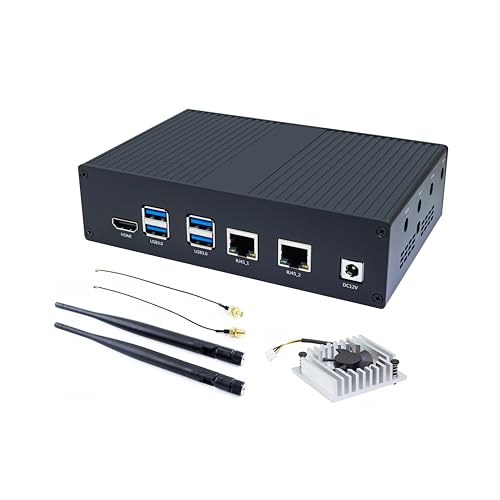
WayPonDEV Banana Pi Aluminum Case with Fan
Best for: cooling and protecting Banana Pi BPI-F3 boards
- Architecture
- RISC-V (what this guide is about)
This is a protective enclosure designed specifically for the Banana Pi BPI-F3 8-core RISC-V board. It features a 2.0mm thick aluminum plate body with an oxidized lacquer finish and includes a dedicated cooling fan rated for 10,000 hours of operation. You also get screw-fastened assembly to secure the bare board without movement. This enclosure suits you if you already own this specific RISC-V computer and need active cooling and physical protection.
Pros
- 2.0mm thick aluminum plate construction
- Integrated cooling fan rated for 10,000 hours
- Includes mounting screws for secure board assembly
- Interface openings provide access to board expansion ports
Cons
- Does not include the single board computer
- Requires manual screw assembly
Good fit if
- You already own or plan to buy a Banana Pi BPI-F3 board.
- You need a 2.0mm aluminum shell with an active cooling fan.
Skip if
- You need an operational RISC-V computer out of the box.
- You are using a different RISC-V board model that will not fit this shell.
Verdict: WayPonDEV Banana Pi BPI-F3 Metal Case provides durable 2.0mm aluminum protection and active fan cooling for your compatible board. It delivers a secure physical enclosure, provided you already have the required single board computer.

EC Buying Luckfox Pico Mini B Linux AI Board
Best for: fast-booting edge vision and low-power AI projects
- Architecture
- RISC-V (what this guide is about)
- Processor
- RV1103
- RAM Capacity
- 64MB
- RAM Type
- DDR2
- Storage
- 128MB Flash
- Operating System Support
- Linux
View on Amazon: EC Buying Luckfox Pico Mini B Linux AI Board
This micro-sized development board pairs a 32-bit ARM Cortex-A7 processor with a dedicated RISC-V MCU for rapid startup. It integrates a built-in neural processing unit offering up to 1.0 TOPS of computing power alongside an image signal processor capable of handling four-megapixel camera feeds. If you need a compact Linux-driven platform for vision-based edge AI workloads, facial recognition, or low-power sensor integration, this hybrid micro board fits your setup.
Pros
- Built-in NPU delivers up to 1.0 TOPS for int4 and 0.5 TOPS for int8
- Integrated RISC-V MCU enables 250ms fast capture and quick boot
- ISP3.2 handles up to 4 million pixels with HDR and WDR support
- Intelligent scene encoding cuts bit rates by over 50% compared to CBR
Cons
- Single-core 32-bit main CPU limits general computing performance
- No built-in wireless connectivity specified in hardware details
Good fit if
- You need rapid image capture and edge facial recognition under one second
- You build embedded camera applications requiring hardware HDR and WDR
- You want a low-power Linux board with integrated NPU acceleration
Skip if
- You require a multi-core processor for heavier general-purpose computing
- You need integrated Wi-Fi or Bluetooth out of the box
Verdict: EC Buying Luckfox Pico Mini AI Board combines a dedicated RISC-V MCU and a 1.0 TOPS NPU on a single Linux micro module. It provides a focused hardware foundation for compact edge vision and fast-capture machine learning tasks.

EC Buying Luckfox Pico Linux AI Board
Best for: budget embedded vision and AI projects
- Architecture
- RISC-V (what this guide is about)
- Processor
- RV1103
- Operating System Support
- Linux
This micro development board runs Linux using an ARM Cortex-A7 core alongside a RISC-V microcontroller unit. It features an onboard neural processing unit delivering up to 1.0 TOPS at int4, plus an integrated image signal processor with HDR, WDR, and noise reduction. You get peripheral connections via USB-C, UART, SPI, and I2C. It suits you if you need a compact Linux-driven board for low-power vision or embedded edge computing projects.
Pros
- Integrated NPU providing up to 1.0 TOPS computing precision at int4
- Hardware ISP with HDR, WDR, and noise reduction support
- USB-C, UART, SPI, and I2C interfaces for peripheral connections
- Dual architecture combining ARM Cortex-A7 and a RISC-V MCU
Cons
- RAM capacity not listed in specifications
- No onboard Wi-Fi or Bluetooth networking specified
Good fit if
- You need an embedded board with an integrated NPU for AI edge tasks.
- You require hardware camera processing with HDR, WDR, and noise reduction.
- You connect external sensors via UART, SPI, or I2C headers.
Skip if
- You require built-in wireless networking such as Wi-Fi or Bluetooth.
- You need standard full-size display ports like HDMI or DisplayPort.
Verdict: EC Buying Luckfox Pico Linux AI Board combines a RISC-V MCU, an ARM Cortex-A7 core, and a 1.0 TOPS NPU for specialized vision workloads. It provides essential hardware interfaces for embedded development in a compact format.

EC Buying Luckfox Pico Plus Linux Board
Best for: compact edge vision and micro AI development
- Architecture
- RISC-V (what this guide is about)
- Processor
- RV1103
- RAM Capacity
- 64MB
- RAM Type
- DDR2
- Storage
- 128MB SPI NAND FLASH
- Ethernet
- 10/100M Ethernet
The EC Buying Luckfox Pico Plus Linux Board is a micro development platform featuring an integrated RISC-V MCU and Cortex-A7 processor. You get a built-in neural processing unit delivering up to 1.0 TOPS for int4 workloads, a 2-lane MIPI CSI camera interface, and 10/100M Ethernet. With 64MB DDR2 memory and 128MB SPI NAND flash, it provides a compact setup if you develop edge vision and lightweight AI applications.
Pros
- Integrated NPU providing up to 1.0 TOPS int4 and 0.5 TOPS int8 computing power
- Onboard 10/100M Ethernet controller with embedded PHY
- MIPI CSI 2-lane camera interface with 4MP ISP3.2 image processor
- 25 GPIO pins supporting UART, SPI, and I2C interfaces
Cons
- Limited 64MB DDR2 system memory
- 128MB SPI NAND flash restricts local onboard storage
- Ethernet speed capped at 10/100M rather than gigabit
Good fit if
- You need a compact development board with dedicated NPU hardware for basic AI tasks.
- You connect camera sensors using a 2-lane MIPI CSI interface.
- You require 10/100M wired Ethernet alongside 25 GPIO pins.
Skip if
- You need more than 64MB of system memory for heavy workloads.
- You require gigabit Ethernet networking.
- You want large onboard storage beyond the included 128MB SPI NAND flash.
Verdict: EC Buying Luckfox Pico Plus Linux Board delivers focused machine vision capabilities in an ultra-compact footprint with its onboard NPU, ISP, and Ethernet. Its 64MB memory limit means it suits specialized micro AI tasks rather than general-purpose computing.

Orange Pi RV2 4GB RISC-V SBC
Best for: edge AI projects needing dual NVMe storage
- Architecture
- RISC-V (what this guide is about)
- Processor
- RISC-V octa-core
- RAM Capacity
- 4GB
- RAM Type
- LPDDR4X
- Ethernet
- Gigabit Ethernet
- Wireless Connectivity
- Wi-Fi 5, BT 5 with BLE
The Orange Pi RV2 is a compact single-board computer powered by an eight-core RISC-V processor with 2 TOPS of integrated AI performance. You get 4GB of LPDDR4X memory, dual M.2 M-Key slots for NVMe SSD storage, and wireless support via Wi-Fi 5 and Bluetooth 5.0. It suits developers who need capable edge AI processing and dual NVMe expansion in a pocket-sized board running Ubuntu 24.04.
Pros
- Eight-core RISC-V processor with 2 TOPS AI acceleration
- Two M.2 M-Key PCIe 2.0 2-lane slots for NVMe SSDs
- Onboard Wi-Fi 5 and Bluetooth 5.0 with BLE
- Gigabit Ethernet, HDMI, and USB 3.0 ports
Cons
- PCIe interface limited to PCIe 2.0 2-lane bandwidth
- eMMC flash storage module is optional rather than built in
- Wi-Fi connectivity limited to Wi-Fi 5
Good fit if
- You need 2 TOPS of AI processing power on a RISC-V architecture.
- You want to attach NVMe SSD storage across two M.2 M-Key slots.
- You plan to deploy edge workloads on Ubuntu 24.04 with 4GB RAM.
Skip if
- You require newer Wi-Fi 6 or Wi-Fi 7 wireless connectivity.
- You need high-speed PCIe 3.0 or PCIe 4.0 data transfer.
Verdict: Orange Pi RV2 4GB RISC-V SBC delivers an eight-core architecture with dual NVMe expansion and integrated 2 TOPS AI acceleration. It provides a balanced 4GB platform for edge AI and local storage setups.
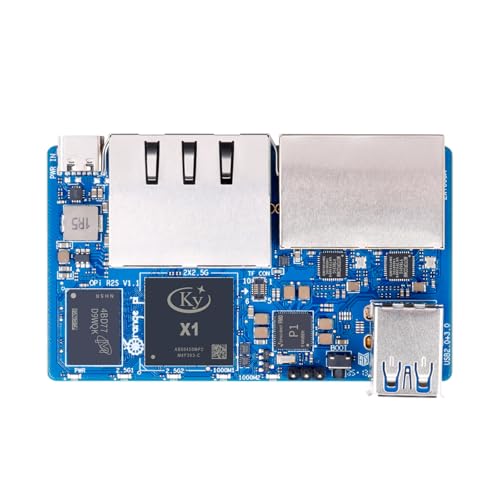
Orange Pi R2S RISC-V Single Board Computer
Best for: Ubuntu-based multi-gigabit edge network gateways
- Architecture
- RISC-V (what this guide is about)
- Processor
- Ky X1
- RAM Capacity
- 4GB
- RAM Type
- LPDDR4X
- Storage
- 8GB eMMC
- Ethernet
- Dual 2.5G, Dual Gigabit Ethernet
The Orange Pi R2S is a compact RISC-V single board computer built around the Ky X1 8-core processor with 2TOPS of integrated AI compute. It features 4GB of LPDDR4X memory, 8GB of onboard eMMC flash, dual 2.5G ports, and dual Gigabit Ethernet ports. Supporting Ubuntu and OpenWrt, this board fits your needs if you deploy network gateways, edge nodes, or industrial systems requiring multi-port wired networking.
Pros
- Ky X1 8-core RISC-V CPU with 2TOPS integrated AI performance
- Dual 2.5G and dual Gigabit Ethernet ports onboard
- 8GB onboard eMMC storage plus TF card slot
- Compact board size measuring 79.2mm by 46mm
Cons
- Onboard eMMC storage capacity limited to 8GB
- No integrated Wi-Fi or Bluetooth listed in specifications
Good fit if
- You need multiple wired network interfaces including dual 2.5G Ethernet ports.
- You plan to run Ubuntu on an 8-core RISC-V processor for edge tasks.
- You require hardware-integrated AI acceleration up to 2TOPS.
Skip if
- You require built-in wireless connectivity without adding external adapters.
- You need more than 8GB of high-speed onboard eMMC storage.
Verdict: Orange Pi R2S RISC-V Single Board Computer delivers four Ethernet ports and 2TOPS AI compute for Ubuntu deployments. Its compact dimensions make it practical for space-constrained edge networking tasks.

Orange Pi 4A Allwinner T527 SBC
Best for: Android 13 edge AI and automation deployments
- Architecture
- RISC-V (what this guide is about)
- Processor
- Allwinner T527
- RAM Capacity
- 4GB
- RAM Type
- LPDDR4/4X
- Ethernet
- Gigabit Ethernet
- Wireless Connectivity
- WiFi 5, BT 5.0
The Orange Pi 4A is a development board pairing an Allwinner T527 octa-core Cortex-A55 processor with integrated RISC-V co-processors. You get support for up to 4GB of LPDDR4X memory, a 2 TOPS NPU, and compatibility with Android 13, Debian, and Ubuntu. Its dual MIPI interfaces and Gigabit Ethernet suit you if you are building edge AI systems, retail kiosks, or robotic controllers that rely on Android software.
Pros
- Supports Android 13, Ubuntu, and Debian operating systems
- Integrated 2 TOPS NPU handles edge AI workloads
- Dual MIPI-CSI camera inputs and MIPI-DSI display support
- Offers Gigabit Ethernet, WiFi 5, and PCIe 2.0 connectivity
Cons
- Uses USB 2.0 instead of higher-speed USB 3.0
- RISC-V architecture is implemented via co-processors rather than the primary CPU
Good fit if
- You need an Android 13 operating environment with hardware AI acceleration.
- You want RISC-V co-processors for real-time control and low-power standby.
- You require dual camera inputs via MIPI-CSI alongside Gigabit Ethernet.
Skip if
- You need high-speed USB 3.0 throughput for external drives.
- You want a board where the primary compute cores use RISC-V instead of Arm Cortex-A55.
Verdict: Orange Pi 4A RISC-V SBC delivers functional Android 13 support alongside built-in 2 TOPS machine learning acceleration. It serves edge AI and interactive terminal projects needing secondary real-time RISC-V control.

Orange Pi RV RISC-V Single Board Computer
Best for: Bluetooth 5.0 RISC-V Linux projects
- Architecture
- RISC-V (what this guide is about)
- Processor
- StarFive JH-7110
- RAM Capacity
- 2GB
- RAM Type
- LPDDR4
- Ethernet
- Gigabit Ethernet
- Wireless Connectivity
- Wi-Fi 5.0, Bluetooth 5.0
The Orange Pi RV is a Linux-compatible RISC-V single-board computer built around a quad-core 64-bit processor running at 1.5GHz. It provides integrated GPU graphics, Wi-Fi 5, and Bluetooth 5.0 wireless networking alongside Gigabit Ethernet. With hardware 4K video decoding, an M.2 M-Key 2280 slot, and a 40-pin expansion port, this board fits your needs if you build connected edge appliances or embedded projects.
Pros
- Built-in Bluetooth 5.0 and Wi-Fi 5 networking
- Hardware 4K at 30fps H.264 and H.265 video decoding
- M.2 M-Key 2280 slot and PCIe 2.0 interface
- Gigabit Ethernet and USB 3.0 connectivity
Cons
- Video encoding capped at 1080p at 30fps
- Requires a dedicated 5V 4A Type-C power input
Good fit if
- You need integrated Bluetooth 5.0 and Wi-Fi 5 on a RISC-V board.
- You want to attach high-speed storage via M.2 M-Key 2280.
- You build edge Linux projects requiring 4K video decoding.
Skip if
- You require hardware video encoding higher than 1080p.
- You do not have a 5V 4A Type-C power supply.
Verdict: Orange Pi RV Quad-Core SBC delivers four 64-bit RISC-V cores with integrated Bluetooth 5.0 and Wi-Fi 5 connectivity. It gives you flexible peripheral expansion including M.2 2280 and PCIe 2.0 on Linux.
Specifications side by side
| Spec | WayPonDEV Banana Pi WiFi 7 NIC Module | WayPonDEV Banana Pi Aluminum Case with Fan | EC Buying Luckfox Pico Mini B Linux AI Board | EC Buying Luckfox Pico Linux AI Board | EC Buying Luckfox Pico Plus Linux Board | Orange Pi RV2 4GB RISC-V SBC | Orange Pi R2S RISC-V Single Board Computer | Orange Pi 4A Allwinner T527 SBC | Orange Pi RV RISC-V Single Board Computer |
|---|---|---|---|---|---|---|---|---|---|
| Processor | MediaTek MT7995AV | not specified | RV1103 | RV1103 | RV1103 | RISC-V octa-core | Ky X1 | Allwinner T527 | StarFive JH-7110 |
| RAM Capacity | not specified | not specified | 64MB | not specified | 64MB | 4GB | 4GB | 4GB | 2GB |
| RAM Type | not specified | not specified | DDR2 | not specified | DDR2 | LPDDR4X | LPDDR4X | LPDDR4/4X | LPDDR4 |
| Storage | not specified | not specified | 128MB Flash | not specified | 128MB SPI NAND FLASH | not specified | 8GB eMMC | not specified | not specified |
| Ethernet | 2x 10Gbe SFP, 4x Gbe | not specified | not specified | not specified | 10/100M Ethernet | Gigabit Ethernet | Dual 2.5G, Dual Gigabit Ethernet | Gigabit Ethernet | Gigabit Ethernet |
| Wireless Connectivity | Wi-Fi 7 | not specified | not specified | not specified | not specified | Wi-Fi 5, BT 5 with BLE | not specified | WiFi 5, BT 5.0 | Wi-Fi 5.0, Bluetooth 5.0 |
| Video Resolution | not specified | not specified | not specified | not specified | not specified | not specified | not specified | not specified | 4K@30fps |
| Operating System Support | OpenWRT | not specified | Linux | Linux | Linux | Ubuntu24.04 | OpenWrt, Ubuntu | Ubuntu, Debian, Android 13 | Linux, Debian |
| Memory | not specified | not specified | not specified | not specified | not specified | 4GB RAM | not specified | not specified | not specified |
| Operating System | not specified | not specified | Linux | Linux | Linux | not specified | Ubuntu | Android | Linux |
| Architecture | RISC-V | RISC-V | RISC-V | RISC-V | RISC-V | RISC-V | RISC-V | RISC-V | RISC-V |
| Connectivity | not specified | not specified | not specified | not specified | not specified | WiFi 5 | not specified | WiFi 5 | WiFi 5, Bluetooth 5.0 |
| Dimensions | 5.9 × 4.01 × 0.78 inches | not specified | not specified | not specified | not specified | 3.5 × 2.2 × 0.5 inches | not specified | 10 × 2 × 50 inches | 10 × 2 × 50 inches |
| Weight | 8.82 ounces | not specified | not specified | not specified | not specified | 2 ounces | not specified | not specified | not specified |
| Size | 32-bit RISC-V MCU | Motherboard Not include | not specified | not specified | not specified | not specified | not specified | not specified | not specified |
| Color | WiFi7 NIC Module | Black Metal Case | not specified | not specified | not specified | 4GB | not specified | not specified | not specified |
| Model | BPI-R4 NIC BE14 Wi-Fi 7 Module | BPI-F3 Black Metal Case | not specified | not specified | not specified | Orange Pi RV2 | 4GB | XTD-US-4A4G | XTD-US-RV2G |
If you also research outdoor equipment, you can review the best single kayaks through dimensions, weight limits, and material specs.
How to Choose a RISC-V Single Board Computer
-
Select the Matching Operating System
Check the target operating system before you choose a RISC-V single board computer. Certain projects require Android 13 for touch displays and automation terminals, while others rely on Linux distributions. If your software stack requires an Android environment, verify board support directly from the specifications. The Orange Pi 4A lists explicit Android 13 operating system compatibility alongside its hardware. Selecting a board that matches your intended platform prevents software mismatches and driver setup complications during project deployment.
-
Count Physical Ethernet Ports
Look closely at onboard Ethernet port counts if you plan to build network appliances. Standard single board computers often provide a single Ethernet port or rely entirely on wireless networking. Dedicated gateway setups require multiple physical connections for local network routing. The Orange Pi R2S includes four Ethernet ports directly on the board. This configuration allows you to route traffic between networks without adding external USB network adapters. Checking interface counts ensures your board handles wired routing tasks efficiently.
-
Distinguish Boards from Hardware Accessories
Verify whether the listing is a complete single board computer or a peripheral accessory. Some product listings feature enclosures or add-on components designed for specific hardware rather than an independent computer. For instance, the WayPonDEV Banana Pi Aluminum Case with Fan explicitly lists motherboard not included. It provides active fan cooling and aluminum protection, but requires you to supply the compatible board separately. Confirming the package contents in the specifications prevents ordering an empty chassis when you need functional computing hardware.
-
Inspect Machine Learning Acceleration
Check for an integrated neural processing unit if you deploy machine vision or real-time object detection models. Standard RISC-V cores handle general instructions, but machine learning inference runs better on dedicated acceleration hardware. Look at the published TOPS rating to gauge processing capacity. The EC Buying Luckfox Pico Linux AI Board integrates a 1.0 TOPS NPU alongside its processor cores. This dedicated hardware accelerates edge vision algorithms without overloading the main processor. Choose a board with an NPU whenever your tasks involve visual processing.
-
Evaluate Onboard Wireless Protocols
Check the wireless connectivity specifications to ensure compatibility with your local wireless networks and peripheral devices. Some RISC-V boards rely on basic wireless hardware, while others support specific Bluetooth protocols and Wi-Fi revisions. If your setup requires wireless sensors or peripherals, look for integrated transceivers. The Orange Pi RV RISC-V Single Board Computer includes both Wi-Fi 5 and Bluetooth 5.0 on the board. Selecting hardware with the right wireless standards saves you from occupying physical USB ports with external communication adapters.
Frequently asked questions
What makes a RISC-V single board computer different from ARM or x86 boards?
RISC-V uses an open-standard instruction set architecture rather than proprietary designs like x86 or ARM. This open framework allows hardware makers to build custom silicon tailored for specific tasks. In practical setups, you will find pure 64-bit multi-core processors running Linux alongside hybrid boards that combine RISC-V microcontrollers with machine learning accelerators or secondary host processors for embedded computing.
Can you run standard operating systems on RISC-V single board computers?
Yes, you can run supported operating systems like Linux, Ubuntu, and Android on compatible RISC-V hardware. Software availability depends entirely on the specific board and board support packages provided by the manufacturer. For example, the Orange Pi R2S is built for Ubuntu deployments, while the Orange Pi 4A supports Android 13. Smaller micro-tier models, such as the Luckfox Pico series, run specialized embedded Linux distributions.
What should you look for when using a RISC-V board for edge AI?
You should check the board's Neural Processing Unit compute rating and memory capacity. Processing power determines how quickly the board handles vision models. Compact modules like the Luckfox Pico Mini B feature a 1.0 TOPS NPU for low-power capture tasks. More demanding edge AI deployments benefit from hardware like the Orange Pi RV2, which provides 2 TOPS of acceleration alongside 4GB of system memory.
Do all RISC-V listings include a complete single board computer?
No, you must carefully read product specifications to confirm whether you are buying a standalone board or an accessory. Some items sharing the RISC-V classification are expansion modules or enclosures. For instance, the WayPonDEV Banana Pi WiFi 7 NIC Module is a specialized network card containing a 32-bit RISC-V MCU, and the Banana Pi Aluminum Case is a protective metal enclosure that does not include a motherboard.
What wireless and wired networking options do RISC-V boards offer?
RISC-V hardware provides diverse connectivity options ranging from multi-port Ethernet to modern Wi-Fi 7 standards. For physical networking, gateway-oriented boards like the Orange Pi R2S provide four dedicated Ethernet ports, while the Luckfox Pico Plus integrates an Ethernet interface for compact setups. For wireless connections, boards like the Orange Pi RV supply Wi-Fi 5 and Bluetooth 5.0, while add-on modules offer cutting-edge tri-band Wi-Fi 7 capabilities.
How does onboard expansion support storage and peripherals on RISC-V systems?
Expansion interfaces allow you to attach high-speed solid-state drives and external peripherals directly to your board. Standard high-performance boards frequently provide dedicated slots for expandability. The Orange Pi RV features PCIe 2.0 and an M.2 2280 interface for fast peripheral and drive access. Similarly, the Orange Pi RV2 includes dual NVMe storage expansion slots, allowing you to build local data storage alongside your compute workflows.