Best Orange Pi Single Board Computers Under $100 in 2026: 6 Picks
As an Amazon Associate we earn from qualifying purchases. Links on this page are affiliate links.
Finding the best orange pi single board computers under $100 requires balancing processing power, memory, and connectivity for your projects. We compared 6 models strictly using specifications published on the listings.
The Orange Pi 3B 4GB Single Board Computer takes the top spot because its RK3566 processor, Gigabit networking, and M.2 expansion provide a balanced setup for Linux and Android builds. This guide helps you choose the right board architecture, memory capacity, and port selection for your specific development workload.
Quick picks
| # | Product | Best for | Price |
|---|---|---|---|
| 1 | Orange Pi 3B 4GB Single Board Computer Best overall | general-purpose Linux and Android development projects | Check price of Orange Pi 3B 4GB Single Board Computer on Amazon |
| 2 | Orange Pi RV2 4GB RISC-V SBC Best premium | RISC-V edge AI and storage development | Check price of Orange Pi RV2 4GB RISC-V SBC on Amazon |
| 3 | Orange Pi R2S RISC-V Single Board Computer Best budget | Ubuntu networking setups and edge computing | Check price of Orange Pi R2S RISC-V Single Board Computer on Amazon |
| 4 | Orange Pi Zero 3 Allwinner H618 SBC Also great | compact Android-based wireless IoT projects | Check price of Orange Pi Zero 3 Allwinner H618 SBC on Amazon |
| 5 | Orange Pi Zero 3 Allwinner H618 SBC Also great | compact media streaming and lightweight Linux projects | Check price of Orange Pi Zero 3 Allwinner H618 SBC on Amazon |
| 6 | Orange Pi Zero 3W 6GB LPDDR5 SBC Best wifi 6 | compact edge AI and dual-display projects | Check price of Orange Pi Zero 3W 6GB LPDDR5 SBC on Amazon |
The best fit for you
- You need a general-purpose Android development board. Orange Pi 3B 4GB Single Board Computer The board features an RK3566 processor with Gigabit networking and M.2 expansion.
- You want RISC-V hardware with NVMe storage. Orange Pi RV2 4GB RISC-V SBC This model provides a RISC-V architecture, edge AI processing, and dual NVMe expansion.
- You build headless Ubuntu network installations. Orange Pi R2S RISC-V Single Board Computer It features multi-port Ethernet networking and a RISC-V processor running Ubuntu.
- You require high-speed WiFi 6 connectivity. Orange Pi Zero 3W 6GB LPDDR5 SBC It provides integrated WiFi 6 networking alongside 6GB of LPDDR5 RAM.
Our 6 picks

Orange Pi 3B 4GB Single Board Computer
Best for: general-purpose Linux and Android development projects
- Processor
- Rockchip RK3566
- RAM Capacity
- 4GB
- RAM Type
- LPDDR4/4X
- Ethernet
- Gigabit LAN
- Wireless Connectivity
- Wi-Fi5, BT5.0
- Operating System Support
- Android, Ubuntu, Debian, OpenHarmony
The Orange Pi 3B is a compact computer board running a 1.8 GHz quad-core Rockchip RK3566 processor paired with 4GB of LPDDR4 memory. You get Gigabit Ethernet, Wi-Fi 5, an M.2 M-key slot, and 4K video decoding at 60 fps. It fits media playback, lightweight edge computing, and multi-OS tinkering across Android, Ubuntu, and Debian distributions.
Pros
- Rockchip RK3566 quad-core processor reaching up to 1.8 GHz
- 4GB LPDDR4/4X memory with M.2 M-key expansion slot
- Gigabit Ethernet, Wi-Fi 5, and Bluetooth 5.0 onboard
- Hardware 4K decoding at 60 fps with HDMI and eDP outputs
Cons
- Integrated NPU provides 0.8 TOPS, lower than alternative 8-core boards
- Quad-core CPU offers fewer processing threads than 8-core options
Good fit if
- You want balanced connectivity including Gigabit Ethernet, USB 3.0, and M.2 storage.
- You need broad operating system support covering Android, Ubuntu, and Debian.
- You require 4K video playback at 60 fps for media or display projects.
Skip if
- You need more than 0.8 TOPS of AI compute for heavy edge workloads.
- You need an 8-core processor for multi-threaded compilation.
Verdict: Orange Pi 3B 4GB Single Board Computer gives you a versatile RK3566 foundation with Gigabit networking and M.2 expansion for everyday embedded Linux or Android projects.

Orange Pi RV2 4GB RISC-V SBC
Best for: RISC-V edge AI and storage development
- Processor
- RISC-V octa-core
- RAM Capacity
- 4GB
- RAM Type
- LPDDR4X
- Ethernet
- Gigabit Ethernet
- Wireless Connectivity
- Wi-Fi 5, BT 5 with BLE
- Operating System Support
- Ubuntu24.04
The Orange Pi RV2 is an octa-core RISC-V single-board computer built for edge computing and development. You get 4GB of LPDDR4X memory, an integrated AI engine delivering 2 TOPS of processing power, and dual M.2 M-Key slots for NVMe SSD storage. It includes Wi-Fi 5, Bluetooth 5.0, and Gigabit Ethernet, making it a capable compact setup if you want modern RISC-V hardware for local AI tasks or network-attached storage projects.
Pros
- Octa-core RISC-V processor with 2 TOPS AI compute power
- Two M.2 M-Key PCIe 2.0 slots supporting NVMe SSDs
- Gigabit Ethernet, Wi-Fi 5, and Bluetooth 5.0 onboard
- Display and camera interfaces including HDMI, MIPI DSI, and MIPI CSI
Cons
- eMMC storage module is optional rather than built in
- M.2 interfaces run at PCIe 2.0 speeds
- Wi-Fi is limited to Wi-Fi 5 instead of Wi-Fi 6
Good fit if
- You want a RISC-V platform with built-in AI acceleration for edge workloads.
- You need dual NVMe SSD slots on a compact development board.
- You plan to run Ubuntu 24.04 on non-ARM open-architecture hardware.
Skip if
- You need standard ARM or x86 software compatibility for your applications.
- You require integrated onboard storage out of the box.
Verdict: Orange Pi RV2 4GB RISC-V Board delivers dedicated edge AI processing and dual NVMe storage expansion on an efficient RISC-V architecture. It is a capable development platform if you want to deploy workloads outside the typical ARM ecosystem.
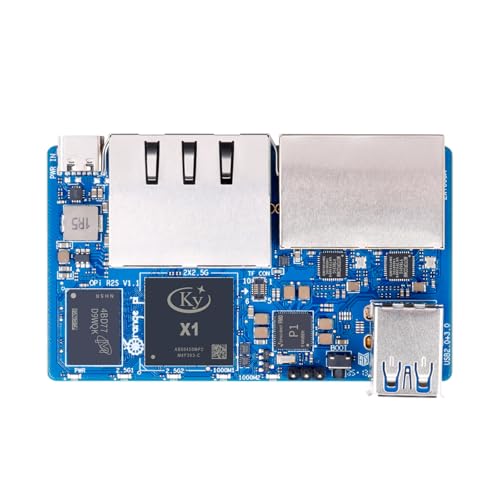
Orange Pi R2S RISC-V Single Board Computer
Best for: Ubuntu networking setups and edge computing
- Processor
- Ky X1
- RAM Capacity
- 4GB
- RAM Type
- LPDDR4X
- Storage
- 8GB eMMC
- Ethernet
- Dual 2.5G, Dual Gigabit Ethernet
- Operating System Support
- OpenWrt, Ubuntu
The Orange Pi R2S is a compact single board computer built around an eight-core RISC-V processor with 2TOPS of AI compute power. It features 4GB of LPDDR4X RAM, 8GB of onboard eMMC storage, and an extensive network array consisting of dual 2.5G and dual Gigabit Ethernet ports. If you need a small-footprint system running Ubuntu for edge routing, network appliances, or light AI processing, this board offers targeted connectivity.
Pros
- Dual 2.5G LAN ports and dual Gigabit Ethernet ports
- Eight-core RISC-V processor with 2TOPS AI compute power
- 8GB onboard eMMC storage and TF card expansion
- Official support for Ubuntu and OpenWrt operating systems
Cons
- No integrated Wi-Fi or Bluetooth connectivity listed
- No video display output ports included on board
Good fit if
- You need high-speed wired networking with dual 2.5G and dual Gigabit ports.
- You plan to run Ubuntu or OpenWrt on a multi-core RISC-V platform.
- You require integrated AI acceleration for edge computing tasks.
Skip if
- You need built-in wireless networking without adding external adapters.
- You require video display outputs for direct monitor setups.
Verdict: Orange Pi R2S 4GB RISC-V Single Board Computer delivers specialized multi-port Ethernet networking and RISC-V processing for headless Ubuntu edge installations. It provides high wired throughput in a compact footprint where direct display outputs are unnecessary.

Orange Pi Zero 3 Allwinner H618 SBC
Best for: compact Android-based wireless IoT projects
- Processor
- Allwinner H618
- RAM Capacity
- 4GB
- RAM Type
- LPDDR4
- Wireless Connectivity
- WiFi 5.0, Bluetooth 5.0
- Operating System Support
- Linux, Debian, Ubuntu, Android
- Dimensions
- 10 × 2 × 50 inches
The Orange Pi Zero 3 is a compact single-board computer powered by an Allwinner H618 quad-core 64-bit processor. You get integrated dual-band Wi-Fi 5 and Bluetooth 5.0 for wireless setups, along with memory configurations ranging from 1 GB up to 4 GB of LPDDR4 RAM. It runs Android out of the box. This board suits you if you need a tiny, connected controller for lightweight network utilities or embedded IoT tasks.
Pros
- Allwinner H618 64-bit quad-core processor
- Dual-band 2.4 GHz and 5 GHz Wi-Fi 5 with Bluetooth 5.0
- LPDDR4 memory options up to 4 GB
Cons
- Listed operating system support is limited to Android
- Base variation provides only 1 GB of RAM
Good fit if
- You need integrated dual-band Wi-Fi 5 and Bluetooth 5.0 wireless connectivity.
- You plan to build lightweight IoT hardware running Android.
- You want an Allwinner quad-core board with up to 4 GB of LPDDR4 memory.
Skip if
- You require more than 4 GB of RAM for your workload.
- You need officially listed Linux OS support out of the box.
Verdict: Orange Pi Zero 3 H618 Single Board Computer provides reliable quad-core processing with integrated Wi-Fi 5 and Bluetooth for small-footprint builds. It serves as a dependable controller for Android-based embedded applications.

Orange Pi Zero 3 Allwinner H618 SBC
Best for: compact media streaming and lightweight Linux projects
- Processor
- Allwinner H618
- RAM Capacity
- 4GB
- RAM Type
- LPDDR4
- Storage
- 16MB SPI flash
- Ethernet
- Gigabit Ethernet
- Wireless Connectivity
- WiFi 5, Bluetooth 5.0
The Orange Pi Zero 3 is a compact single-board computer powered by an Allwinner H618 quad-core Cortex-A53 processor. It features up to 4GB of LPDDR4 memory, Gigabit Ethernet, micro HDMI output supporting 4K video, WiFi 5, and Bluetooth 5.0. If you need a small-footprint board for running lightweight Linux distributions like Ubuntu or Debian, or an Android 12 TV media setup, this model provides essential connectivity in a tight footprint.
Pros
- Gigabit Ethernet, WiFi 5, and Bluetooth 5.0 onboard
- Allwinner H618 quad-core Cortex-A53 processor with 4K video output
- Supports Android 12 TV, Debian 11/12, and Ubuntu 20.04/22.04
- Includes 16MB SPI flash and 26-pin expansion header
Cons
- Only one standard USB 2.0 port directly on the board
- Requires 13-pin expansion board for headphone jack and extra USB ports
- Uses micro HDMI rather than a standard full-size connector
Good fit if
- You want a compact board with Gigabit Ethernet and WiFi 5 for network utilities.
- You plan to run Android 12 TV or Debian for a compact media streamer.
- You need up to 4GB of LPDDR4 memory on a small-form-factor board.
Skip if
- You require multiple onboard full-size USB ports without using expansion headers.
- You prefer standard full-size HDMI ports to avoid using micro HDMI adapters.
Verdict: Orange Pi Zero 3 Allwinner H618 SBC delivers quad-core processing, Gigabit networking, and 4K display capability in an ultra-compact footprint. It offers a solid hardware base for compact Linux servers or media installations.

Orange Pi Zero 3W 6GB LPDDR5 SBC
Best for: compact edge AI and dual-display projects
- Processor
- Allwinner A733
- RAM Capacity
- 6GB
- RAM Type
- LPDDR5
- Wireless Connectivity
- Wi-Fi 6, Bluetooth 5.4
- Video Resolution
- 4K@60fps
- Operating System Support
- Android, Debian, Ubuntu, OpenHarmony
The Orange Pi Zero 3W is a compact single-board computer powered by an Allwinner A733 octa-core processor and 6GB of LPDDR5 memory. It includes an integrated 3 TOPS neural processing unit for local machine learning tasks, Wi-Fi 6, and Bluetooth 5.4. With a Mini HDMI 2.0 port and DisplayPort Alt Mode over USB Type-C, you can drive two independent displays. It suits edge computing, AI development, and compact Linux builds.
Pros
- Allwinner A733 8-core processor with 6GB LPDDR5 memory
- Integrated 3 TOPS NPU supporting INT8, INT16, FP16, and BF16
- Dual display support via Mini HDMI 2.0 and USB Type-C DisplayPort Alt Mode
- Wi-Fi 6 and Bluetooth 5.4 wireless connectivity
- Supports Android, Debian, Ubuntu, and OpenHarmony
Cons
- Onboard eMMC and UFS storage chips are unpopulated by default
- TF card slot capacity is capped at 128GB
- Requires a Mini HDMI adapter or cable for standard monitors
Good fit if
- You need an onboard 3 TOPS NPU for running AI frameworks like PyTorch, ONNX, or TensorFlow.
- You want 6GB of fast LPDDR5 RAM and dual-screen output on a small board.
- You plan to deploy edge projects using Wi-Fi 6 and Bluetooth 5.4.
Skip if
- You want pre-installed onboard eMMC or UFS flash storage out of the box.
- You need a full-size HDMI video port.
- You require TF card storage exceeding 128GB.
Verdict: Orange Pi Zero 3W 6GB SBC delivers 3 TOPS of AI compute, 6GB of LPDDR5 RAM, and dual-display outputs in a compact form factor. It provides a solid hardware platform for edge AI tasks and embedded Linux setups.
Specifications side by side
| Spec | Orange Pi 3B 4GB Single Board Computer | Orange Pi RV2 4GB RISC-V SBC | Orange Pi R2S RISC-V Single Board Computer | Orange Pi Zero 3 Allwinner H618 SBC | Orange Pi Zero 3 Allwinner H618 SBC | Orange Pi Zero 3W 6GB LPDDR5 SBC |
|---|---|---|---|---|---|---|
| Processor | Rockchip RK3566 | RISC-V octa-core | Ky X1 | Allwinner H618 | Allwinner H618 | Allwinner A733 |
| RAM Capacity | 4GB | 4GB | 4GB | 4GB | 4GB | 6GB |
| RAM Type | LPDDR4/4X | LPDDR4X | LPDDR4X | LPDDR4 | LPDDR4 | LPDDR5 |
| Storage | not specified | not specified | 8GB eMMC | not specified | 16MB SPI flash | not specified |
| Ethernet | Gigabit LAN | Gigabit Ethernet | Dual 2.5G, Dual Gigabit Ethernet | not specified | Gigabit Ethernet | not specified |
| Wireless Connectivity | Wi-Fi5, BT5.0 | Wi-Fi 5, BT 5 with BLE | not specified | WiFi 5.0, Bluetooth 5.0 | WiFi 5, Bluetooth 5.0 | Wi-Fi 6, Bluetooth 5.4 |
| Video Resolution | not specified | not specified | not specified | not specified | 4K | 4K@60fps |
| Operating System Support | Android, Ubuntu, Debian, OpenHarmony | Ubuntu24.04 | OpenWrt, Ubuntu | Linux, Debian, Ubuntu, Android | Android 12 TV, Debian, Ubuntu | Android, Debian, Ubuntu, OpenHarmony |
| Memory | not specified | 4GB RAM | not specified | not specified | not specified | not specified |
| Operating System | Android | not specified | Ubuntu | Android | Android | Android |
| Networking | not specified | not specified | not specified | not specified | not specified | WiFi 6 |
| Architecture | not specified | RISC-V | RISC-V | not specified | not specified | not specified |
| Connectivity | not specified | WiFi 5 | not specified | WiFi 5, Bluetooth 5.0 | WiFi 5, Bluetooth 5.0 | not specified |
| Dimensions | not specified | 3.5 × 2.2 × 0.5 inches | not specified | 10 × 2 × 50 inches | not specified | not specified |
| Weight | not specified | 2 ounces | not specified | not specified | not specified | not specified |
| Color | Pi 3B 4GB | 4GB | not specified | not specified | 1GB+Power Supply | Zero 3W 6GB |
| Model | not specified | Orange Pi RV2 | 4GB | XTD-US-PZ304GNEW | Orange Pi Zero 3 | Orange Pi Zero 3W |
| Size | not specified | not specified | not specified | not specified | 4GB+Power Supply | not specified |
If you need standard desktop expansion instead of single-board hardware, compare specifications for a computer workstation under 100.
How to Choose an Orange Pi Board
-
Select Your Processor Architecture
You should check the instruction set architecture before selecting a board. Models with an Allwinner H618 quad-core processor target mainstream software builds and general media workloads. In contrast, boards running RISC-V processors provide an open-standard architecture tailored for modern software experimentation and platform development. If you develop software for established ARM pipelines, choose an Allwinner chip. If you plan to build, test, and compile software specifically for open hardware architectures, select a RISC-V board instead. Verify compiler and library support for your target architecture before you decide.
-
Evaluate Memory Capacity and Type
System memory dictates how many background processes and services you can run simultaneously. Configurations range from 1GB or 4GB up to 6GB of LPDDR5 memory. If you run basic headless utilities, lightweight automation scripts, or single-purpose services, 1GB of RAM is often adequate. For running desktop environments, compiling code, or managing multiple background daemons, select at least 4GB of RAM. Faster LPDDR5 memory provides higher bandwidth for data-intensive tasks. Check the exact memory capacity listed on the specification sheet to ensure your intended programs fit into system memory without bottlenecking the system.
-
Assess High Speed Storage Options
Storage throughput affects operating system boot speeds and input-output performance during heavy read or write cycles. While basic projects function on standard micro-SD cards, sustained data operations benefit from dedicated solid-state drives. The Orange Pi RV2 features dual NVMe storage expansion interfaces, allowing you to connect fast solid-state drives directly to the board. If your project involves constant database logging, large file caching, or rapid asset loading, look for dedicated NVMe drive support. Check whether the board specifies NVMe storage slots if you require consistent high-speed throughput for disk-heavy tasks.
-
Check Monitor and Display Capabilities
Examine the video output specifications if you intend to connect your computer to an external screen. Some boards omit display hardware entirely to focus strictly on headless network deployments. Others, like the Orange Pi Zero 3, provide 4K display capability for connecting high-resolution monitors and media playback setups. If you plan to build a digital dashboard, a desktop workstation, or a video streaming setup, verify the supported screen resolution and display interfaces. For projects that require multiple active monitors or specific video playback features, ensure the hardware outputs match your display equipment.
-
Review Dedicated AI Compute Power
Edge artificial intelligence tasks require dedicated hardware acceleration to run efficiently without overwhelming the main processor. The Orange Pi Zero 3W delivers 3 TOPS of dedicated AI compute to process machine learning models and vision algorithms locally. If your deployment involves real-time image recognition, sensor data classification, or offline neural network inference, compare the TOPS rating on the spec sheet. Standard processors without dedicated AI processing hardware must handle these math operations through general computing cores, which slows execution. Select a board with integrated AI compute when deploying on-device machine learning.
-
Verify Local Wireless Connectivity Protocols
Wireless capabilities determine how easily you can place your board without routing physical Ethernet cables. Look closely at the exact Wi-Fi generation and Bluetooth versions listed on the specification sheet. Models with Wi-Fi 5 and Bluetooth 5.0 provide dependable connections for IoT sensors, wireless peripherals, and local network communication. If your installation sits far from a router or operates in an area with high network traffic, newer wireless protocols offer better channel efficiency. Check whether Bluetooth 5.0 is included if you plan to interface with wireless sensors or external hardware accessories.
Frequently asked questions
Which Orange Pi model includes dedicated hardware for edge AI workloads?
You have two choices for artificial intelligence tasks. The Orange Pi Zero 3W supplies 3 TOPS of AI compute alongside 6GB of LPDDR5 memory. If you prefer alternative processor architectures, the Orange Pi RV2 delivers dedicated edge AI processing with 4GB of RAM and dual NVMe expansion slots.
Can you run dual monitors from a compact Orange Pi board?
Yes, you can connect multiple monitors using the Orange Pi Zero 3W. This compact single board computer includes dual-display outputs for multi-screen setups. It also incorporates 6GB of LPDDR5 memory, WiFi 6 networking, and Android operating system compatibility to handle your visual computing and embedded display needs.
Which Orange Pi boards run on RISC-V architecture instead of ARM?
The Orange Pi RV2 and Orange Pi R2S both utilize RISC-V architecture. The RV2 includes 4GB of RAM, WiFi 5, and dual NVMe storage expansion. The R2S provides 4GB of memory and multi-port Ethernet networking specifically optimized for headless edge computing under the Ubuntu operating system.
What wireless connectivity options come standard on Orange Pi Zero 3 boards?
Orange Pi Zero 3 boards feature integrated WiFi 5 and Bluetooth 5.0 wireless connectivity. Powered by the Allwinner H618 quad-core processor, these units support Android operating systems. Certain configurations also deliver Gigabit networking and 4K display capability in an ultra-compact footprint for media streaming or embedded wireless projects.
Which Orange Pi single board computer is designed for wired networking setups?
The Orange Pi R2S is engineered specifically for wired edge setups with its multi-port Ethernet configuration. Running Ubuntu, it handles high network throughput without needing video display ports. If you need standard single-port Gigabit networking alongside M.2 expansion and Android support, consider the Orange Pi 3B instead.
What storage expansion capabilities are available on the Orange Pi RV2?
The Orange Pi RV2 features dual NVMe storage expansion slots on its compact circuit board. Measuring 3.5 inches long, 2.2 inches wide, and weighing 2 ounces, this 4GB RISC-V unit allows you to connect high-speed solid-state drives directly for storage-heavy edge deployments and local data logging.