MAGICNUC AS1 Plus Mini PC vs MAGICNUC AS1 Mini Desktop Computer (2026): Key Differences
As an Amazon Associate we earn from qualifying purchases. Links on this page are affiliate links.
You are comparing the magicnuc as1 plus mini PC vs as1 mini desktop computer. Both units share the same compact chassis design, dual Gigabit Ethernet ports, and triple-display support via HDMI, DisplayPort, and USB-C. They also both use Wi-Fi 5 and Bluetooth 5.0. The main difference lies in their internal components. One model offers higher factory-installed memory and storage, while the other provides a specific processor architecture with upgrade flexibility for networking tasks.
Key differences
| Aspect | MAGICNUC AS1 Plus Mini PC | MAGICNUC AS1 Mini PC Ryzen 5 16GB 512GB |
|---|---|---|
| Processor | AMD Ryzen 5 3501U (2.1GHz base, up to 3.7GHz) | AMD Ryzen 5 3550H (up to 3.7GHz) |
| Installed RAM | 8GB DDR4 | 16GB DDR4 |
| Storage | 256GB M.2 SATA SSD | 512GB M.2 NVMe PCIe 3.0 SSD |
| Networking | Dual Gigabit Ethernet with Jumbo Frames support | Dual Gigabit Ethernet |
| Dimensions | 4.7 x 4.7 x 1.97 inches | not listed |
Which one should you choose?
Choose MAGICNUC AS1 Plus Mini PC if
- You need a dedicated firewall or router with Jumbo Frame support for network optimization
- You want to upgrade RAM to 32GB for heavy multitasking
Choose MAGICNUC AS1 Mini PC Ryzen 5 16GB 512GB if
- You prefer 16GB of RAM out of the box for smoother office performance
- You require a larger 512GB NVMe SSD for faster file access
Verdict: The AS1 Plus suits users building network appliances or those who plan to upgrade memory themselves. The standard AS1 is better for immediate plug-and-play office work thanks to its higher baseline RAM and faster NVMe storage.
AS1 Plus vs AS1 Spec Comparison
processor performance
The MAGICNUC AS1 Plus uses the AMD Ryzen 5 3501U, a desktop-class APU built on 12nm Zen+ architecture. It features 4 cores and 8 threads with a 3.7GHz boost clock. The MAGICNUC AS1 Mini Desktop Computer uses the Ryzen 5 3550H, a mobile processor with the same core count and boost speed. The 3550H is designed for laptops, while the 3501U targets entry-level desktops. In multi-threaded workloads, the 3501U often shows better sustained performance due to its desktop-oriented thermal design and higher TDP headroom, making it slightly more robust for continuous heavy tasks like compiling code or running virtual machines.
installed memory
You get 8GB of DDR4 RAM in the MAGICNUC AS1 Plus out of the box. The MAGICNUC AS1 Mini Desktop Computer comes with 16GB of DDR4 RAM. Both units support dual-channel memory configurations via two SODIMM slots, allowing upgrades up to 32GB total. However, the 16GB baseline in the AS1 Mini Desktop Computer provides immediate headroom for multitasking without requiring an immediate upgrade. If you plan to run multiple browser tabs, office suites, or light video editing simultaneously, the larger installed memory in the AS1 model reduces the need for early hardware modification.
storage capacity
The MAGICNUC AS1 Plus includes a 256GB M.2 SATA SSD. The MAGICNUC AS1 Mini Desktop Computer includes a 512GB M.2 NVMe PCIe 3.0 x4 SSD. The AS1 Mini Desktop Computer offers double the storage space and uses the faster NVMe interface, which provides higher read and write speeds compared to the SATA connection in the AS1 Plus. Both units have an additional empty M.2 slot for expansion, but the AS1 Mini Desktop Computer starts with a more capable primary drive. This makes it better suited for users who need more space for large files or faster application loading times from day one.
networking features
Both mini PCs feature dual Gigabit Ethernet ports, supporting Wake-on-LAN and Jumbo Frames. This makes either unit suitable for firewall or router builds. The MAGICNUC AS1 Plus explicitly lists support for pfSense, OPNsense, and OpenWrt, indicating strong compatibility with open-source network operating systems. The MAGICNUC AS1 Mini Desktop Computer also includes dual LAN ports and Wi-Fi 5 with Bluetooth 5.0. While both offer identical wired connectivity, the AS1 Plus documentation emphasizes its networking versatility for specialized network tasks, giving it a slight edge for users planning to deploy it as a dedicated network appliance.
display output
Both units support triple displays using HDMI 2.0, DisplayPort 1.4, and USB-C. The HDMI and DisplayPort outputs on both machines handle 4K resolution at 60Hz with HDR support. The USB-C port on both units outputs 1080p at 60Hz. The integrated Radeon Vega 8 graphics run at 1200MHz on both models, providing identical hardware decoding for HEVC/H.265 video. Since the display capabilities and GPU performance are identical, there is no practical difference in visual output quality or multitasking monitor setups between the two models.
Which MAGICNUC AS1 model fits you
Users needing maximum out-of-box storage and memory
The AS1 Mini Desktop Computer arrives with 16GB of DDR4 RAM and a 512GB NVMe SSD. This configuration handles multitasking better than the AS1 Plus, which ships with only 8GB of RAM and a 256GB SATA drive. You get more capacity immediately without needing to upgrade components yourself.
Home office workers wanting quiet operation
The AS1 Plus features a 15W TDP processor and an intelligent thermal design that keeps noise below 25dB. It includes a VESA mount for behind-monitor installation. This setup ensures a silent, clutter-free desk environment, making it ideal for continuous use in home or small office settings.
Network engineers building a home lab
Both units offer dual Gigabit Ethernet ports, but the AS1 Plus explicitly supports Jumbo Frames and Wake-on-LAN. These features are critical for running firewall software like pfSense or OPNsense. The dedicated USB 2.0 port also minimizes interference for wireless receivers, enhancing stability for network-focused projects.
Users prioritizing raw CPU multi-core speed
The AS1 Plus uses the Ryzen 5 3501U, which benchmarks over 30% higher in multi-threading tasks than common budget Intel chips. While the AS1 uses the Ryzen 5 3550H, the AS1 Plus is highlighted for its performance in heavy workloads like large spreadsheets and video conferencing.
The products compared

MAGICNUC AS1 Plus Mini PC
Best for: Networking tasks and multi-monitor setups
- Processor
- AMD Ryzen 5 3501U
- Installed RAM
- 8GB
- Storage Capacity
- 256GB
- Memory Type
- DDR4
- Graphics
- Radeon Vega 8
- Ethernet Ports
- Dual Gigabit
View on Amazon: MAGICNUC AS1 Plus Mini PC Affiliate link
The MAGICNUC AS1 Plus Mini PC uses an AMD Ryzen 5 3501U processor with 4 cores and 8 threads. It includes 8GB of DDR4 RAM and a 256GB SATA SSD. The system features dual Gigabit Ethernet ports and three display outputs for triple 4K monitors. This compact unit supports dual-channel memory upgrades and adds an NVMe slot for extra storage. It suits users needing strong multi-core performance and flexible connectivity.
Pros
- AMD Ryzen 5 3501U processor with 4 cores and 8 threads
- Dual Gigabit Ethernet ports for networking flexibility
- Supports triple 4K displays via HDMI, DisplayPort, and USB-C
- Expandable memory up to 32GB and additional NVMe storage slot
Cons
- Includes only 8GB of RAM out of the box
- Pre-installed storage is limited to a 256GB SATA SSD
- Uses Wi-Fi 5 instead of the newer Wi-Fi 6 standard
Good fit if
- You need dual network interfaces for a firewall or router setup
- You require three separate monitors for your workflow
- You want a system that supports easy RAM and storage upgrades
Skip if
- You need more than 8GB of RAM for immediate use without upgrades
- You require faster Wi-Fi 6 connectivity for wireless devices
- You prefer a larger storage capacity without adding a second drive
Verdict: The MAGICNUC AS1 Plus Mini PC offers solid multi-core performance and versatile connectivity for networking tasks. It is a practical choice for users who need dual Ethernet ports and multiple display outputs.
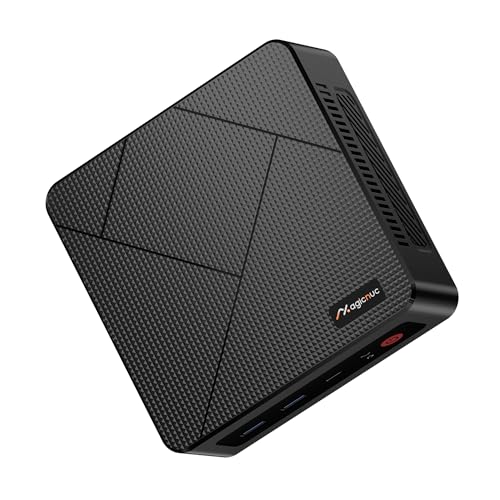
MAGICNUC AS1 Mini PC Ryzen 5 16GB 512GB
Best for: Office multitasking with triple displays
- Processor
- AMD Ryzen 5 3550H
- Installed RAM
- 16GB
- Storage Capacity
- 512GB
- Memory Type
- DDR4
- Graphics
- Radeon Vega 8
- Ethernet Ports
- Dual LAN
View on Amazon: MAGICNUC AS1 Mini PC Ryzen 5 16GB 512GB Affiliate link
The MAGICNUC AS1 uses an AMD Ryzen 5 3550H processor with 4 cores and 8 threads. It includes 16GB of DDR4 RAM and a 512GB NVMe SSD for fast storage. The system supports triple displays via HDMI, DisplayPort, and USB Type-C. You get dual LAN ports, Wi-Fi 5, and Bluetooth 5.0 for stable connectivity. This setup suits home and office multitasking.
Pros
- AMD Ryzen 5 3550H processor up to 3.7GHz
- 16GB DDR4 RAM expandable to 32GB
- 512GB NVMe PCIe 3.0 SSD
- Triple display support via HDMI, DP, and USB-C
- Dual RJ45 LAN ports for stable networking
Cons
- Wi-Fi 5 is slower than modern Wi-Fi 6
- Radeon Vega 8 graphics lack dedicated VRAM
- Only includes a 1-year warranty
Good fit if
- You need three monitors for office work
- You want dual Ethernet ports for networking
- You require 16GB of RAM for multitasking
Skip if
- You need high-end gaming performance
- You require Wi-Fi 6 connectivity
- You want a dedicated graphics card
Verdict: MAGICNUC AS1 Ryzen 5 3550H Mini PC fits users who need triple displays and dual LAN ports for stable office work. It handles multitasking well but lacks modern wireless speeds.
Specifications side by side
| Spec | MAGICNUC AS1 Plus Mini PC | MAGICNUC AS1 Mini PC Ryzen 5 16GB 512GB |
|---|---|---|
| Processor | AMD Ryzen 5 3501U | AMD Ryzen 5 3550H |
| Installed RAM | 8GB | 16GB |
| Storage Capacity | 256GB | 512GB |
| Memory Type | DDR4 | DDR4 |
| Graphics | Radeon Vega 8 | Radeon Vega 8 |
| Ethernet Ports | Dual Gigabit | Dual LAN |
| Memory | 8GB RAM | 16GB RAM |
| Storage | 256GB SSD | not stated |
| Use | Home, Office | not stated |
| Connectivity | WiFi 5 | WiFi 5 |
| Dimensions | 4.7 × 4.7 × 1.97 inches | not stated |
| Weight | 1.1 pounds | not stated |
| Color | Black | not stated |
| Model | As1 | AS1 |
| Size | not stated | 16GB 512GB |
Frequently asked questions
Which model supports more displays?
Both the MAGICNUC AS1 Plus and the AS1 Mini Desktop Computer support triple displays. You can connect monitors via HDMI, DisplayPort, and USB-C on either unit. This allows you to run three screens simultaneously for productivity or entertainment purposes.
Does the AS1 Plus have better networking capabilities?
Both units feature dual Gigabit Ethernet ports for stable wired connections. The AS1 Plus is highlighted as ideal for networking tasks. However, both models rely on Wi-Fi 5 for wireless connectivity, which lacks the speed of newer standards.
What is the difference in RAM between the two?
The AS1 Mini Desktop Computer comes with 16GB of DDR4 RAM out of the box. The AS1 Plus ships with only 8GB of memory. The higher RAM in the AS1 model allows for smoother multitasking and better performance with multiple applications open.
How much storage does each Mini PC have?
The AS1 Mini Desktop Computer includes a 512GB NVMe SSD. The AS1 Plus does not list its storage capacity in the provided data. You should verify the storage size of the AS1 Plus separately if this detail is critical for your needs.
Are the physical dimensions identical for both models?
The AS1 Plus measures 4.7 inches in width and length, with a height of 1.97 inches. It weighs 1.1 pounds. The AS1 Mini Desktop Computer shares the same compact chassis design, meaning both fit easily into small spaces or behind monitors.
Which processor is faster for office work?
The AS1 Plus uses the AMD Ryzen 5 3501U with a 3.7GHz boost clock. The AS1 Mini Desktop Computer uses the Ryzen 5 3550H. The 3550H generally offers better performance for office multitasking, especially when paired with its 16GB of RAM.
Can I use these Mini PCs for multi-monitor setups?
Yes, both models are designed for multi-monitor environments. They each provide HDMI, DisplayPort, and USB-C outputs to support up to three displays. This makes them suitable for users who need extended desktop space for spreadsheets, code, or media.