UDPTCP Fanless Industrial Mini PC or UDPTCP Fanless Pentium N3710 Dual LAN Mini PC? Which UDPTCP Model to Buy
As an Amazon Associate we earn from qualifying purchases. Links on this page are affiliate links.
This comparison looks at the udptcp fanless mini PC vs dual lan ports models from UDPTCP. Both units offer industrial-grade reliability with passive cooling and dual Gigabit Ethernet ports for networking tasks like soft routing or firewalls. The main difference lies in their processors. One uses a dual-core Celeron N2840, while the other features a quad-core Pentium N3710. You need to check which CPU and memory speed best fit your specific workload requirements.
Key differences
| Aspect | UDPTCP Fanless Industrial Mini PC | UDPTCP Fanless Pentium N3710 Dual LAN Mini PC |
|---|---|---|
| Processor | Celeron N2840 (2 Cores, 2 Threads) | Pentium N3710 (4 Cores, 4 Threads) |
| Memory Speed | DDR3L 1333MHz | DDR3L 1600MHz |
| Storage Options | SATA 3Gb/s and mSATA | mSATA only |
| Display Support | HDMI + VGA (4K@60Hz) | HDMI only (4K@30Hz) |
| USB Ports | 1x USB 3.0, 5x USB 2.0 | 2x USB 3.0 |
Which one should you choose?
Choose UDPTCP Fanless Industrial Mini PC if
- You need dual display outputs with higher refresh rates for video tasks.
- You require more USB 2.0 ports for legacy peripherals.
- You prefer the flexibility of a standard SATA drive connection.
Choose UDPTCP Fanless Pentium N3710 Dual LAN Mini PC if
- You need more processing cores for multitasking or virtualization.
- You want faster memory bandwidth for system responsiveness.
- You prefer a simpler port layout with more USB 3.0 connections.
Verdict: Choose the N2840 model if you need dual displays and SATA storage flexibility. Select the N3710 model if you prioritize processing power and faster memory speeds for networking applications. Both provide reliable dual Gigabit Ethernet connectivity for industrial use.
Processor and Memory Comparison
Processor performance
The UDPTCP Fanless Pentium N3710 Dual LAN Mini PC features a quad-core processor with four threads. It includes a 2 MB cache and reaches a max turbo frequency of 2.56 GHz with a 6 W TDP. The UDPTCP Fanless Industrial Mini PC uses a dual-core Celeron N2840. It has two threads, 1 MB cache, and a higher max turbo of 2.58 GHz with a 7.5 W TDP. The N3710 offers more parallel processing power for multitasking. The N2840 provides slightly higher clock speeds but fewer cores. For tasks requiring multiple simultaneous processes, the N3710 architecture is superior.
Memory specifications
Both systems support DDR3L SO-DIMM memory, but the speed differs. The Pentium N3710 model supports DDR3L at 1600 MHz. The Celeron N2840 industrial unit supports DDR3L at 1333 MHz. Faster memory bandwidth can improve overall system responsiveness, especially when handling network traffic or running virtual machines. Both units leave the RAM slot empty in the base configuration, requiring you to add memory separately. The 1600 MHz support in the N3710 model gives it a technical advantage in memory throughput potential.
Storage interfaces
Storage options vary between the two units. The Fanless Industrial Mini PC includes a SATA 3 Gb/s standard socket and an mSATA socket with a MiniPCIe interface. This provides flexibility for connecting different storage types. The Fanless Pentium N3710 Dual LAN Mini PC supports one mSATA slot with an additional SATA 3.0 power supply connection. The industrial model offers a broader range of storage connectivity options. If you need to use standard SATA drives or specific mSATA configurations, the N2840 model provides more versatile internal mounting options.
Display capabilities
Both units integrate UHD Graphics for video output. The Celeron N2840 industrial PC supports dual display interfaces including HD and VGA. It can output 4K resolution at 60 Hz. The Pentium N3710 model supports HDMI 1.4 interfaces and outputs 4K resolution at 30 Hz. The N2840 offers a smoother refresh rate for 4K displays. If you plan to use the mini PC as a media center or need high-refresh-rate 4K output for monitoring dashboards, the N2840 provides better display performance.
Network connectivity
Both mini PCs feature dual Gigabit Ethernet ports for networking tasks. The industrial model uses two Realtek RTL8106E/RTL8111H network card chips. The Pentium model uses two Realtek RTL8111H chips. Both support 1000M speeds with filter connectors. This setup is ideal for soft routers, firewalls, or dual-WAN configurations. Since both provide identical dual 1GbE LAN capabilities, there is no practical difference in network throughput or port count. You get the same networking foundation regardless of which processor you choose.
Choose Your UDPTCP Fanless Mini PC
Users needing quad-core performance
The Pentium N3710 model offers four cores and four threads. This provides better multitasking capability compared to the dual-core alternative. If you plan to run multiple virtual machines or handle heavier processing loads, the extra cores and 2 MB cache will help maintain smooth operation.
Users requiring 4K@60Hz display
The Celeron N2840 model supports 4K resolution at 60 Hz. The N3710 model is limited to 4K at 30 Hz. If you need a smoother visual experience for digital signage or high-refresh monitors, this higher refresh rate support is a significant practical advantage for your display setup.
Users needing more USB ports
The Celeron N2840 model includes five USB 2.0 ports and one USB 3.0 port. The N3710 model only has two USB 3.0 ports. If you need to connect multiple peripherals like barcode scanners or input devices, the extra USB ports on the N2840 model provide more connectivity options.
Users needing COM ports
The Celeron N2840 model features two RS232 COM ports. These are essential for industrial automation or legacy serial device connections. The N3710 model does not list COM ports in its specifications. If your project requires serial communication, this model is the necessary choice for your hardware integration.
The products compared

UDPTCP Fanless Industrial Mini PC
Best for: Dual LAN soft router or industrial controller
- Processor
- Celeron N2840
- Installed RAM
- No RAM
- Storage Capacity
- No SSD
- Memory Type
- DDR3L 1333MHz
- Graphics
- UHD Graphics
- Ethernet Ports
- 2x 1000M
View on Amazon: UDPTCP Fanless Industrial Mini PC Affiliate link
This UDPTCP industrial mini PC uses a dual-core Celeron N2840 processor running at 2.58 GHz. It features two Gigabit Ethernet ports for network tasks. The system supports dual displays via HDMI and VGA. You get rich connectivity with USB and COM ports. Note that this model ships without RAM or SSD. It is designed for soft routers or lightweight Linux workloads.
Pros
- Dual Gigabit Ethernet ports for networking
- Fanless design for silent operation
- Supports dual displays at 4K resolution
- Includes RS232 COM ports for industrial use
Cons
- Dual-core Celeron N2840 lacks multi-threading
- Ships with no RAM or SSD installed
- Uses older DDR3L memory standard
Good fit if
- You need a dual LAN soft router
- You require RS232 serial ports
- You plan to install your own RAM and SSD
Skip if
- You need a pre-configured system ready to use
- You require high-performance multi-core processing
- You want modern DDR4 or DDR5 memory
Verdict: UDPTCP Fanless Celeron N2840 Mini PC fits users who need dual Gigabit Ethernet ports and serial connectivity for industrial or router tasks. It is not suitable for users needing high performance or pre-installed storage.
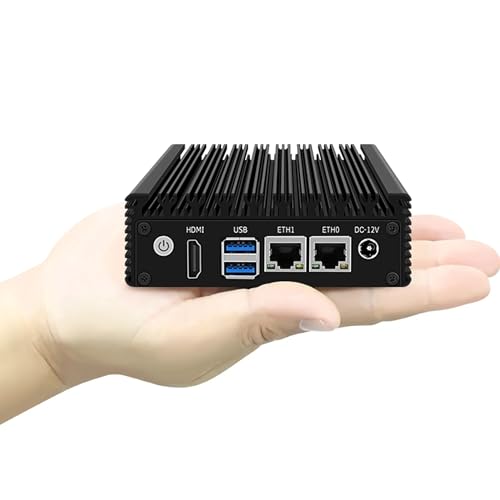
UDPTCP Fanless Pentium N3710 Dual LAN Mini PC
Best for: dual LAN networking and soft router builds
- Processor
- Pentium N3710
- Installed RAM
- NO RAM
- Storage Capacity
- NO SSD
- Memory Type
- DDR3L 1600MHz
- Graphics
- UHD Graphics
- Ethernet Ports
- 2x 1000M
View on Amazon: UDPTCP Fanless Pentium N3710 Dual LAN Mini PC Affiliate link
This UDPTCP model features a Pentium N3710 processor with four cores and a 6 W TDP. It includes dual 1GbE LAN ports using Realtek RTL8111H chips, making it suitable for soft router or firewall setups. The system supports DDR3L memory and mSATA storage, though RAM and SSD are not included. You get UHD Graphics with HDMI 1.4 for 4K display output. It runs Windows or Linux and supports GPIO and Wake on LAN.
Pros
- Dual 1GbE LAN ports with Realtek RTL8111H chips
- Pentium N3710 processor with 4 cores and 4 threads
- Fanless industrial design with 6 W TDP
- Supports DDR3L memory and mSATA storage
- HDMI 1.4 output supporting 4K@30Hz
Cons
- Does not include RAM or SSD
- Pentium N3710 is an older, lower-performance processor
- Only one HDMI port available
Good fit if
- You need a fanless unit with two Ethernet ports for networking tasks
- You want to build a soft router or firewall
- You prefer an industrial PC with GPIO support
Skip if
- You need pre-installed RAM and storage
- You require high-performance gaming or heavy multitasking
- You need multiple display outputs
Verdict: UDPTCP Fanless Dual LAN Pentium N3710 Mini PC is a solid choice for networking enthusiasts who need dual gigabit ports and a fanless design for soft router applications.
Specifications side by side
| Spec | UDPTCP Fanless Industrial Mini PC | UDPTCP Fanless Pentium N3710 Dual LAN Mini PC |
|---|---|---|
| Processor | Celeron N2840 | Pentium N3710 |
| Installed RAM | No RAM | NO RAM |
| Storage Capacity | No SSD | NO SSD |
| Memory Type | DDR3L 1333MHz | DDR3L 1600MHz |
| Graphics | UHD Graphics | UHD Graphics |
| Ethernet Ports | 2x 1000M | 2x 1000M |
| Operating System | Linux | not stated |
| Use | Industrial | Home, Business, Firewall |
| Networking | Gigabit Ethernet | not stated |
| Weight | 4 pounds | not stated |
| Size | No RAM No SSD | NO RAM NO SSD |
| Model | TF-N2840-2C-2L | CW-X86-N3700-2L |
Frequently asked questions
Does the UDPTCP Fanless Industrial Mini PC come with RAM and SSD installed?
No, the UDPTCP Fanless Industrial Mini PC does not include internal memory or storage. You must purchase and install your own RAM and SSD separately. The product is sold as a barebone unit without these components pre-installed. This allows you to select specific modules that fit your industrial or networking requirements.
What operating system does the UDPTCP Fanless Celeron N2840 model run?
This model ships with Linux as its operating system. It is designed for industrial use cases where Linux is preferred for stability and networking tasks. You will need to configure the Linux environment for your specific soft router or controller needs, as it does not include Windows.
Is the UDPTCP Fanless Pentium N3710 suitable for soft router builds?
Yes, this mini PC is a solid choice for soft router applications. It features dual Gigabit Ethernet ports and a fanless design, which are essential for networking enthusiasts. The dual LAN setup allows you to create a firewall or router without the noise and heat issues associated with active cooling systems.
What is the weight of the UDPTCP Fanless Industrial Mini PC?
The UDPTCP Fanless Industrial Mini PC weighs four pounds. This weight reflects its industrial-grade build quality and passive cooling design. It is compact enough for mounting in tight spaces while providing the durability needed for industrial environments or dedicated networking stations.
Can I use the UDPTCP Fanless Pentium N3710 for dual LAN networking?
Yes, the UDPTCP Fanless Pentium N3710 Dual LAN Mini PC is built specifically for dual LAN networking. It includes two Gigabit Ethernet ports, making it ideal for tasks like routing, bridging, or running a firewall. The fanless design ensures quiet operation in home or office network setups.
Does the UDPTCP Fanless Celeron N2840 support serial connectivity?
Yes, this model supports serial connectivity, which is crucial for industrial control applications. Along with its dual Gigabit Ethernet ports, it provides the necessary interfaces for connecting to legacy industrial equipment. This makes it a versatile option for users who need both modern networking and traditional serial communication.