UDPTCP Fanless Dual LAN Celeron Mini PC vs UDPTCP Fanless Pentium N3710 Dual LAN Mini PC: Spec Comparison
As an Amazon Associate we earn from qualifying purchases. Links on this page are affiliate links.
You are comparing two UDPTCP fanless mini PCs for your network needs. The udptcp firewall vs dual lan ports debate centers on performance and versatility. Both units feature dual 1000M Ethernet ports and passive cooling, making them suitable for soft router or firewall applications. The main difference lies in the processor architecture. One uses a dual-core Celeron, while the other offers a quad-core Pentium. This choice affects multitasking and throughput for your specific setup.
Key differences
| Aspect | UDPTCP Fanless Dual LAN Celeron Mini PC | UDPTCP Fanless Pentium N3710 Dual LAN Mini PC |
|---|---|---|
| Processor | Celeron N2840 (2 Cores, 2 Threads) | Pentium N3710 (4 Cores, 4 Threads) |
| Max Turbo Frequency | 2.58 GHz | 2.56 GHz |
| Display Output | HDMI and VGA | HDMI only |
| Display Resolution | 4K@60Hz | 4K@30Hz |
| Additional Interfaces | USB 2.0, Audio, WiFi antenna | GPIO, Watchdog, PXE support |
Which one should you choose?
Choose UDPTCP Fanless Dual LAN Celeron Mini PC if
- You need dual display outputs for monitoring or management tasks.
- You require higher frame rates for local video playback at 4K resolution.
- You want built-in WiFi connectivity via the dual antenna.
Choose UDPTCP Fanless Pentium N3710 Dual LAN Mini PC if
- You prioritize more processing cores for handling multiple network rules or virtual machines.
- You need industrial features like GPIO, Watchdog programming, or PXE boot support.
- You prefer a processor with a slightly lower thermal design power.
Verdict: The Celeron model suits users who need versatile display options and WiFi. The Pentium model is better for heavy network processing and industrial control features. Choose based on whether you value extra ports or core count.
Processor and Network Specs Compared
Processor performance
The UDPTCP Fanless Pentium N3710 Dual LAN Mini PC uses a four-core, four-thread processor with a 2.56 GHz turbo frequency. This unit offers more parallel processing power for multitasking network tasks. The UDPTCP Fanless Dual LAN Celeron Mini PC relies on a two-core, two-thread Celeron N2840 chip. It reaches a slightly higher 2.58 GHz turbo speed but handles fewer threads simultaneously. For complex firewall rules or running multiple virtual machines, the extra cores in the Pentium model provide a tangible advantage in throughput and stability under load.
Networking hardware
Both mini PCs feature identical networking hardware for your firewall setup. Each unit includes two Realtek RTL8111H gigabit Ethernet ports with filter connectors. This dual 1000M LAN configuration allows you to manage inbound and outbound traffic effectively. Both devices support soft router functions to monitor network data and improve security. Since the network interface controllers are the same in both models, neither product holds an edge in raw bandwidth or connection reliability. You get the same dual-port foundation regardless of your processor choice.
Display capabilities
If you plan to connect a monitor for local diagnostics, the Celeron model offers better video output. It supports dual display interfaces at 4K resolution with a 60Hz refresh rate. This smoother frame rate aids in reading detailed network logs or system statuses clearly. The Pentium N3710 model also supports 4K resolution but is limited to 30Hz. The lower refresh rate may cause noticeable stuttering when moving windows or viewing dynamic data. For a responsive local interface experience, the Celeron N2840 provides a superior visual performance.
Storage and memory options
The Celeron mini PC lists specific storage configurations in its variations, including options with 64GB or 256GB SSDs and varying RAM amounts. It supports mSATA3.0 SSDs for system boot and data storage. The Pentium model is listed as having no RAM and no SSD, though it supports mSATA with additional SATA power. The Celeron unit provides more immediate configuration flexibility for storage needs. You can select a pre-configured option with memory and storage included, whereas the Pentium unit requires you to source and install these components separately.
Connectivity features
The Celeron mini PC includes built-in dual-band Wi-Fi with dual antennas for reliable wireless connectivity. It offers two USB 3.0 ports, four USB 2.0 ports, HDMI, VGA, and audio jacks. The Pentium N3710 model lists two USB 3.0 ports and HDMI but does not mention Wi-Fi or VGA support. The absence of listed wireless capabilities in the Pentium data means you would need an external adapter if you require wireless access. The Celeron unit provides a more complete set of built-in connectivity options for peripheral integration.
Choose the Right UDPTCP Mini PC
Users needing more CPU cores for multitasking
The Pentium N3710 model offers four cores and four threads, providing better parallel processing for complex network tasks. While the Celeron N2840 has two cores, the N3710 handles multiple virtual machines or heavy firewall rules more efficiently. This makes it the superior choice for users who prioritize raw computational power over single-thread speed.
Buyers wanting higher resolution display support
The Celeron N2840 unit supports 4K resolution at 60Hz via HDMI and VGA. In contrast, the Pentium N3710 model is limited to 4K at 30Hz. If you plan to connect this mini PC to a monitor or TV for local media playback or a clear dashboard view, the smoother 60Hz refresh rate makes a noticeable difference in usability.
Shoppers requiring built-in Wi-Fi connectivity
The Celeron N2840 configuration includes dual-band Wi-Fi with dual antennas for reliable wireless connectivity. The Pentium N3710 listing does not mention Wi-Fi capabilities, focusing instead on the dual wired LAN ports. If you need to connect wirelessly for management or backup links, the Celeron model provides the necessary hardware without requiring additional adapters.
The products compared

UDPTCP Fanless Dual LAN Celeron Mini PC
Best for: Dual LAN networking and firewall tasks
- Processor
- Celeron N2840
- Memory Type
- DDR3L 1333/1600MHz
- Graphics
- UHD Graphics
- Ethernet Ports
- 2 x 1000M
- Use
- Home, Business, Office, Industrial, Firewall
View on Amazon: UDPTCP Fanless Dual LAN Celeron Mini PC Affiliate link
This fanless mini PC uses an Intel Celeron N2840 processor with two cores and a 2.58 GHz turbo speed. It features dual 1000M Ethernet ports for robust networking tasks. The system supports dual 4K displays via HDMI and VGA. You get versatile connectivity including USB 3.0, USB 2.0, and dual-band Wi-Fi. It is designed for firewall, router, or industrial use. Note that RAM and SSD capacity vary by configuration.
Pros
- Dual 1000M Ethernet ports for network monitoring
- Fanless design with 7.5 W TDP processor
- Supports dual 4K displays at 60Hz
- Includes dual-band Wi-Fi and Bluetooth
Cons
- DDR3L memory is an older generation standard
- Base model ships with no RAM or SSD
- Only two USB 3.0 ports available
Good fit if
- You need a dedicated firewall or soft router
- You require dual wired network connections
- You want a fanless industrial or office PC
Skip if
- You need high-end gaming performance
- You require modern DDR4 or DDR5 memory
- You want a pre-configured system with storage
Verdict: UDPTCP Fanless Celeron N2840 Mini PC suits network-focused users needing dual LAN ports and quiet operation. It is ideal for firewall setups or light industrial tasks where wired connectivity is priority.
UDPTCP Fanless Pentium N3710 Dual LAN Mini PC
Best for: dual LAN network routing and firewall tasks
- Processor
- Pentium N3710
- Installed RAM
- NO RAM
- Storage Capacity
- NO SSD
- Memory Type
- DDR3L 1600MHz
- Graphics
- UHD Graphics
- Ethernet Ports
- 2x 1000M
View on Amazon: UDPTCP Fanless Pentium N3710 Dual LAN Mini PC Affiliate link
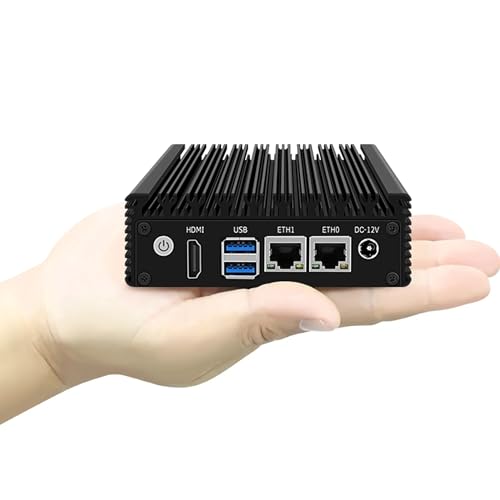
This UDPTCP mini PC uses a Pentium N3710 processor with four cores and a 6 W TDP for efficient, fanless operation. It includes two 1GbE LAN ports, making it suitable for dual-network tasks. The system supports DDR3L memory and mSATA storage, though it ships without RAM or SSD installed. You get integrated UHD graphics with dual display support via HDMI.
Pros
- Pentium N3710 processor with 4 cores and 2.56 GHz max turbo
- Dual 1GbE LAN ports with Realtek RTL8111H chips
- Fanless design with 6 W TDP for silent operation
- Supports DDR3L memory and mSATA storage expansion
Cons
- Ships without RAM or SSD installed
- Only one HDMI port for display output
- Limited to DDR3L memory speed
Good fit if
- You need dual network interfaces for routing or firewall tasks
- You require a silent, fanless computer for continuous operation
- You are building a soft router or industrial controller
Skip if
- You need pre-installed RAM and storage for immediate use
- You require multiple display outputs for multi-monitor setups
- You need high-performance gaming or video editing capabilities
Verdict: UDPTCP Fanless Pentium N3710 Mini PC fits users who need dedicated dual LAN ports for network management tasks. It is ideal for soft routers or firewall applications where silent operation and multiple network interfaces are required.
Specifications side by side
| Spec | UDPTCP Fanless Dual LAN Celeron Mini PC | UDPTCP Fanless Pentium N3710 Dual LAN Mini PC |
|---|---|---|
| Processor | Celeron N2840 | Pentium N3710 |
| Installed RAM | not stated | NO RAM |
| Storage Capacity | not stated | NO SSD |
| Memory Type | DDR3L 1333/1600MHz | DDR3L 1600MHz |
| Graphics | UHD Graphics | UHD Graphics |
| Ethernet Ports | 2 x 1000M | 2x 1000M |
| Use | Home, Business, Office, Industrial, Firewall | Home, Business, Firewall |
| Size | 0GB RAM 0GB SSD | NO RAM NO SSD |
| Model | G30-N2840-2L | CW-X86-N3700-2L |
Frequently asked questions
Can I use the UDPTCP Celeron Mini PC as a firewall?
Yes, this unit is designed for firewall tasks. It features dual LAN ports for separate network interfaces. The fanless design ensures quiet operation in your home or office. It suits light industrial tasks where wired connectivity is the priority. You get a reliable platform for network security without noise.
Does the Pentium N3710 model have dual LAN ports?
Yes, it includes dual 1000M Ethernet ports. This setup allows for dedicated network management tasks. You can use it for soft routers or firewall applications. The dual interfaces provide the necessary connectivity for routing traffic between different networks efficiently.
Is the UDPTCP Celeron fanless?
Yes, the UDPTCP Fanless Dual LAN Celeron Mini PC uses passive cooling. It has no internal fans to reduce noise. This makes it ideal for quiet environments like home offices. The design prioritizes silent operation while maintaining necessary performance for network duties.
What is the model number for the Celeron unit?
The model number is G30-N2840-2L. This identifier helps you locate the specific hardware. It confirms the device is the Celeron N2840 variant. You can use this number to verify compatibility with your existing network infrastructure or software requirements.
Does the Pentium N3710 come with RAM installed?
No, the specifications list NO RAM. You must purchase memory separately. The unit is sold without internal storage as well. This allows you to choose RAM that fits your specific performance needs for network routing or firewall tasks.
Which Mini PC is better for soft routing?
The Pentium N3710 is often preferred for soft routing. It offers four cores and four threads for better multitasking. The Celeron has two cores. The Pentium handles multiple virtual machines more effectively. Both support dual LAN ports for network separation.
Are both units suitable for industrial use?
Yes, the Celeron model lists industrial use in its attributes. Both units feature fanless designs for reliability. The dual LAN ports provide stable wired connections. These features make them suitable for environments requiring consistent network performance without moving parts.