Looking Beyond the WayPonDEV Banana Pi Allwinner H618? 6 Alternatives Worth a Look
As an Amazon Associate we earn from qualifying purchases. Links on this page are affiliate links.
The WayPonDEV Banana Pi BPI M4 Zero offers a compact ARM-based solution with dual-band WiFi and an Allwinner H618 processor. If you are searching for waypondev banana pi bpi m4 alternatives, you might want different specs or a distinct brand. This board provides 2GB LPDDR4 RAM and 8GB eMMC storage, making it suitable for IoT projects and lightweight media playback. Its small form factor ensures compatibility with Raspberry Pi Zero W accessories, which is a key advantage for many developers.
However, you may need more RAM, faster Ethernet, or a different operating system support. Some projects require x86 architecture or integrated touchscreens that this single board computer does not provide. We selected these 6 alternatives because their published specifications overlap with the original product in meaningful ways. Each option brings unique hardware attributes, such as larger storage capacities or different connectivity options, to help you find the best fit for your specific technical requirements.
Our top pick: Banana Pi Allwinner H618 SBC.
How each alternative compares
CanaKit Raspberry Pi 4 2GB Starter Kit
The CanaKit Raspberry Pi 4 2GB Starter Kit shifts you from an ARM Cortex-A53 to a more powerful quad-core processor with higher memory bandwidth. It provides 2GB of RAM, matching the Banana Pi’s capacity, but includes a complete starter kit rather than just the board. This is better for hobbyists who want a ready-to-use platform without sourcing accessories separately. You give up the BPI M4 Zero’s dual-band WiFi 4 and compact 65mm x 30mm form factor. The Raspberry Pi 4 is larger and lacks the direct Zero W case compatibility. Pick this if you prioritize a full kit and established Linux support over compact size and wireless convenience.
DFRobot UNIHIKER ARM Single Board Computer
The DFRobot UNIHIKER ARM Single Board Computer replaces the bare-bones BPI M4 Zero with an integrated 2.8-inch touch display and built-in sensors. It targets Python beginners and IoT prototyping with a user-friendly environment. While it uses an ARM architecture like the Banana Pi, it sacrifices raw processing power and the 4K video output capability for ease of setup. The UNIHIKER is larger at 3.27 inches long, making it unsuitable for small Zero W cases. It is ideal for students who need immediate visual feedback and sensor data without configuring GPIO pins manually. Choose this if you value an all-in-one educational tool over expandability and high-resolution display support.
Libre Computer La Frite 1GB SBC
The Libre Computer La Frite 1GB SBC offers a smaller footprint and lower power consumption than the Banana Pi Allwinner H618. It provides 1GB of RAM, which is half the capacity of the BPI M4 Zero, and lacks eMMC storage, relying on external media. This board is better for low-power Linux embedded projects where energy efficiency is critical. You lose the 2GB RAM, 8GB eMMC, and dual-band WiFi found on the Banana Pi. The La Frite is larger at 3.5 inches long but uses less power. Select this option if you are building a always-on device where power draw matters more than multitasking capability or built-in wireless connectivity.
Youyeetoo UP Board 16GB eMMC SBC
The Youyeetoo UP Board 16GB eMMC SBC switches from an ARM processor to an x86 architecture, enabling Windows and Android support unlike the Linux-only Banana Pi. It provides 16GB of eMMC storage, significantly more than the BPI M4 Zero’s 8GB, but only 1GB of RAM. This is better for x86 Windows IoT projects that require HAT compatibility. You give up the Allwinner H618’s 2GB RAM, dual-band WiFi, and 4K video encoding. The UP Board is larger at 3.3 inches long. Pick this if you need x86 software compatibility and ample storage, and can work with limited memory and no wireless features.
Taidacent Rock Pi S with Shell
The Taidacent Rock Pi S with Shell focuses on basic IoT connectivity and audio sensing rather than general-purpose computing. It includes a shell for protection and offers 1GB of NAND storage, which is less than the Banana Pi’s 8GB eMMC. This board is better for simple IoT projects where low cost and audio detection are priorities. You lose the 2GB RAM, 4K video output, and dual-band WiFi of the BPI M4 Zero. The Rock Pi S is larger and lacks the compact 65mm x 30mm size. Choose this if you need a ruggedized board for specific sensor tasks and can accept limited memory and no wireless networking capabilities.
Waveshare Raspberry Pi Compute Module 4 Lite
The Waveshare Raspberry Pi Compute Module 4 Lite offers a different form factor designed for industrial use rather than desktop compatibility. It provides 2GB of RAM, matching the Banana Pi, but lacks built-in storage, requiring external setup. This is better for developers building custom hardware solutions who need a tiny 2.17-inch module. You give up the BPI M4 Zero’s 8GB eMMC, dual-band WiFi, and 4K video output. The CM4 Lite is smaller but requires additional components for functionality. Pick this if you are integrating the computer into a custom device and can handle external storage and connectivity setups instead of using a plug-and-play board.
Quick picks
Our 7 picks

Banana Pi Allwinner H618 SBC
Best for: Raspberry Pi Zero W upgrades with dual-band WiFi
- Processor
- Allwinner H618
- RAM Capacity
- 2GB
- RAM Type
- LPDDR4
- Storage
- 8GB eMMC
- Ethernet
- 100Mbps Ethernet
- Wireless Connectivity
- WiFi 4, Bluetooth 4.2
View on Amazon: Banana Pi Allwinner H618 SBC Affiliate link
This is a compact single-board computer built around the Allwinner H618 processor. It features 2GB of LPDDR4 RAM and 8GB of eMMC storage. The device supports dual-band WiFi 4 and Bluetooth 4.2 for wireless connectivity. It includes a mini HDMI port capable of 4K@60Hz video output. The form factor matches the Raspberry Pi Zero W, allowing you to use existing cases and accessories for your projects.
Pros
- Allwinner H618 quad-core processor up to 1.5GHz
- 2GB LPDDR4 RAM and 8GB eMMC storage
- Dual-band 2.4G/5G WiFi 4 and Bluetooth 4.2
- Mini HDMI 2.0A supporting 4K@60Hz resolution
Cons
- 100Mbps Ethernet limits wired network speeds
- Only 2GB of RAM restricts heavy multitasking
- WiFi 4 is slower than modern WiFi 6 standards
Good fit if
- You need a Raspberry Pi Zero W compatible board
- You want dual-band wireless connectivity for IoT projects
- You require 4K video output for media centers
Skip if
- You need fast 1Gbps wired internet connections
- You require high RAM for demanding applications
- You want the latest WiFi 6 wireless standard
Verdict: WayPonDEV BPI M4 Zero Mini PC is a solid choice for developers who need Raspberry Pi Zero W compatibility with faster processing and dual-band wireless. It suits users building IoT devices or lightweight media players who can accept slower wired networking.

CanaKit Raspberry Pi 4 2GB Starter Kit
Best for: Linux hobbyists needing a complete starter kit
- Processor
- 1.5GHz 64-bit quad-core CPU
- RAM Capacity
- 2GB
- Storage
- 32GB EVO+ Micro SD Card
- Video Resolution
- up to 4K 60p
- Memory
- 2GB RAM
View on Amazon: CanaKit Raspberry Pi 4 2GB Starter Kit Affiliate link
This kit includes the Raspberry Pi 4 Model B with 2GB RAM and a 1.5GHz quad-core CPU. It comes with a 32GB microSD card, a case with fan mount, and a 3.5A USB-C power supply. The board supports video output up to 4K 60p. It is a complete starter package for Linux projects. You get the core components needed to begin development without searching for separate accessories.
Pros
- Includes 2GB RAM and 1.5GHz quad-core CPU
- Comes with a 32GB EVO+ Micro SD card
- Features a case with fan mount and low noise fan
- Supports up to 4K 60p video resolution
Cons
- Limited to 2GB RAM compared to higher-end models
- Uses microSD storage instead of eMMC
- Requires separate purchase of a display for setup
Good fit if
- You need a complete starter kit for Raspberry Pi 4
- You are running Linux-based projects
- You want included storage and cooling accessories
Skip if
- You require more than 2GB of RAM
- You prefer Windows operating system support
- You need built-in eMMC storage
Verdict: CanaKit Raspberry Pi 4 2GB Starter Kit provides a ready-to-use platform for entry-level Linux development. It suits hobbyists who want included accessories rather than buying parts separately.

DFRobot UNIHIKER ARM Single Board Computer
Best for: Python beginners and IoT prototyping
- Processor
- Quad-Core ARM
- Storage
- 16GB Flash
- Wireless Connectivity
- Wi-Fi, Bluetooth
- Operating System Support
- Debian Linux
- Use
- IoT
- Dimensions
- 3.27 × 2.03 × 0.51 inches
View on Amazon: DFRobot UNIHIKER ARM Single Board Computer Affiliate link
The DFRobot UNIHIKER M10 is a pocket-sized single board computer with a 2.8-inch color touchscreen. It uses a quad-core ARM processor and includes 16GB of flash storage. You get pre-installed Debian Linux and a full Python environment. Wi-Fi and Bluetooth connect it to your network. This all-in-one design includes sensors like a gyroscope and microphone. It suits beginners who want to skip complex OS setup and start coding immediately.
Pros
- 2.8-inch color touchscreen for real-time data visualization
- Pre-installed Debian Linux with Python and Jupyter Notebook
- Built-in Wi-Fi and Bluetooth connectivity
- Integrated sensors including gyroscope, accelerometer, and microphone
- 16GB flash storage for local files and code
Cons
- ARM architecture limits compatibility with Windows desktop software
- 2.8-inch screen is small for detailed multitasking
- No dedicated RAM specification listed in the data
Good fit if
- You want to start coding in Python without configuring an OS
- You need built-in sensors for IoT projects without extra wiring
- You prefer a compact device with a touchscreen interface
Skip if
- You require a Windows operating system for your applications
- You need a large display for complex data analysis
- You are building a server that requires high RAM capacity
Verdict: DFRobot UNIHIKER M10 2.8" Touch IoT Dev Kit is ideal for students and hobbyists who need a ready-to-use Python development environment with integrated sensors. It fits users who prioritize ease of setup over raw processing power or large screen real estate.
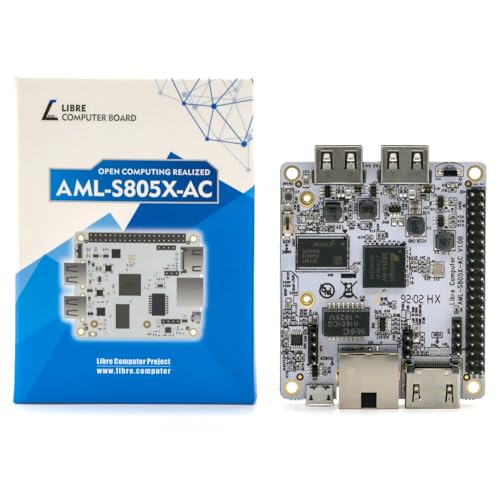
Libre Computer La Frite 1GB SBC
Best for: Low-power Linux embedded projects
- Processor
- Quad 64-bit ARM Cortex-A53
- RAM Capacity
- 1GB
- RAM Type
- DDR4
- Operating System Support
- Ubuntu, Debian, Raspbian
- Dimensions
- 3.5 × 2.5 × 0.75 inches
View on Amazon: Libre Computer La Frite 1GB SBC Affiliate link
The Libre Computer La Frite is a compact ARM single-board computer built for low-power projects. It features a quad-core 1.2GHz Cortex-A53 processor and 1GB of DDR4 RAM. The board supports Ubuntu and Debian Linux, making it suitable for developers who need a small, energy-efficient platform. Its 2W power draw and 28nm fabrication technology keep heat and energy use minimal. You get a 40-pin header for hardware expansion, allowing you to connect various peripherals and sensors directly.
Pros
- Quad 64-bit ARM Cortex-A53 processor at 1.2GHz
- 1GB of high-bandwidth DDR4 RAM
- Supports Ubuntu 23.04, 22.04 LTS, and Debian 12
- 2W standard power consumption
- 40-pin header for hardware extensibility
Cons
- Only 1GB of RAM limits multitasking
- No eMMC storage included
- ARM architecture restricts Windows compatibility
Good fit if
- You need a low-power device for always-on tasks
- You are building a Linux-based embedded project
- You want hardware expansion via a 40-pin header
Skip if
- You require Windows 10 or 11
- You need more than 1GB of RAM
- You want pre-installed storage for immediate use
Verdict: Libre Computer La Frite 1GB ARM SBC is a practical choice for developers who need a small, Linux-compatible board with low power usage. It fits users who prioritize hardware extensibility and energy efficiency over raw processing power or large memory.

Youyeetoo UP Board 16GB eMMC SBC
Best for: x86 Windows IoT projects with HAT needs
- Processor
- Quad Core Intel CPU
- RAM Capacity
- 1GB
- Storage
- 16GB eMMC
- Operating System Support
- Windows 10, Ubuntu, Android OS
- Dimensions
- 3.3 × 2.2 × 0.8 inches
View on Amazon: Youyeetoo UP Board 16GB eMMC SBC Affiliate link
This small development board uses a quad-core Intel CPU and includes 1GB of RAM with 16GB of eMMC storage. It supports Windows 10, Ubuntu, and Android OS. The unit measures 3.3 by 2.2 inches. You get compatibility with most Raspberry Pi HATs. It is designed for developers who need x86 architecture in a compact form factor for IoT projects.
Pros
- 16GB eMMC storage capacity
- Quad-core Intel CPU
- Supports Windows 10 and Ubuntu
- Compatible with Raspberry Pi HATs
Cons
- Only 1GB of RAM
- Small 16GB storage limit
- No mention of included power supply
Good fit if
- You need Windows 10 on an x86 board
- You want Raspberry Pi HAT compatibility
- You are building an IoT device
Skip if
- You require more than 1GB of RAM
- You need large internal storage
- You prefer ARM-based processors
Verdict: Youyeetoo AAEON UP Board 1GB 16GB eMMC fits developers who need x86 Windows support in a Raspberry Pi-compatible form factor, provided you can work with limited memory.

Taidacent Rock Pi S with Shell
Best for: Basic IoT projects with audio sensing
- Processor
- Rockchip RK3308 Quad A35 64bit
- RAM Capacity
- 256MB
- Storage
- 1GB NAND
- Ethernet
- RJ45 10/100Mbit Ethernet
- Use
- IoT
View on Amazon: Taidacent Rock Pi S with Shell Affiliate link
The Taidacent Rock PI S is a single-board computer built for IoT projects. It uses a Rockchip RK3308 quad-core processor and includes 256MB of RAM. The board features 1GB of NAND storage and 10/100Mbit Ethernet. It also has a built-in VAD audio detector. This compact unit suits developers who need basic connectivity and audio sensing for small-scale applications.
Pros
- Rockchip RK3308 quad-core processor
- Built-in VAD audio detector
- RJ45 10/100Mbit Ethernet port
- USB 2.0 OTG and Host ports
Cons
- Only 256MB of RAM limits multitasking
- 10/100Mbit Ethernet is slower than Gigabit
- No Bluetooth connectivity included
Good fit if
- You need a low-cost board for simple IoT tasks
- You require built-in voice activity detection
- You are building a small network device
Skip if
- You need high-performance computing
- You require Gigabit Ethernet speeds
- You need Bluetooth wireless connectivity
Verdict: Taidacent Rock PI S IoT Board is a practical option for developers who need basic IoT connectivity and audio detection. It fits well in projects where low cost and simple networking are priorities.

Waveshare Raspberry Pi Compute Module 4 Lite
Best for: compact industrial compute modules
- Processor
- BCM2711, quad-core Cortex-A72
- RAM Capacity
- 2GB
- Storage
- 0GB (Lite) eMMC Flash
- Wireless Connectivity
- WiFi
- Memory
- 2GB RAM
- Dimensions
- 2.17 × 0.39 × 0.19 inches
View on Amazon: Waveshare Raspberry Pi Compute Module 4 Lite Affiliate link
This Waveshare module uses the BCM2711 quad-core processor and 2GB RAM. It includes WiFi connectivity but has 0GB eMMC storage. The compact size makes it suitable for industrial applications. You get faster data rates compared to older models. This unit is ideal for developers who need a powerful, small form factor for custom projects.
Pros
- BCM2711 quad-core Cortex-A72 processor
- 2GB RAM capacity
- Integrated WiFi connectivity
- Compact 2.17-inch form factor
Cons
- No internal eMMC storage included
- Requires separate carrier board for full functionality
- Limited to 2GB RAM for heavy multitasking
Good fit if
- You need a compact, powerful compute module
- You are developing industrial IoT applications
- You plan to use external storage solutions
Skip if
- You require built-in storage for immediate use
- You need a complete computer with display
- You want a plug-and-play desktop experience
Verdict: Waveshare CM4 2GB Lite offers strong processing power in a tiny package. It fits developers building custom hardware solutions who can handle external storage setups.
Specifications side by side
| Spec | Banana Pi Allwinner H618 SBC | CanaKit Raspberry Pi 4 2GB Starter Kit | DFRobot UNIHIKER ARM Single Board Computer | Libre Computer La Frite 1GB SBC | Youyeetoo UP Board 16GB eMMC SBC | Taidacent Rock Pi S with Shell | Waveshare Raspberry Pi Compute Module 4 Lite |
|---|---|---|---|---|---|---|---|
| Processor | Allwinner H618 | 1.5GHz 64-bit quad-core CPU | Quad-Core ARM | Quad 64-bit ARM Cortex-A53 | Quad Core Intel CPU | Rockchip RK3308 Quad A35 64bit | BCM2711, quad-core Cortex-A72 |
| RAM Capacity | 2GB | 2GB | not stated | 1GB | 1GB | 256MB | 2GB |
| RAM Type | LPDDR4 | not stated | not stated | DDR4 | not stated | not stated | not stated |
| Storage | 8GB eMMC | 32GB EVO+ Micro SD Card | 16GB Flash | not stated | 16GB eMMC | 1GB NAND | 0GB (Lite) eMMC Flash |
| Ethernet | 100Mbps Ethernet | not stated | not stated | not stated | not stated | RJ45 10/100Mbit Ethernet | not stated |
| Wireless Connectivity | WiFi 4, Bluetooth 4.2 | not stated | Wi-Fi, Bluetooth | not stated | not stated | not stated | WiFi |
| Video Resolution | 4K@60Hz | up to 4K 60p | not stated | not stated | not stated | not stated | not stated |
| Operating System Support | Debian, Ubuntu | not stated | Debian Linux | Ubuntu, Debian, Raspbian | Windows 10, Ubuntu, Android OS | not stated | not stated |
| Memory | 2GB RAM | 2GB RAM | not stated | not stated | not stated | not stated | 2GB RAM |
| Operating System | Ubuntu | not stated | not stated | not stated | Android | not stated | not stated |
| Use | IoT | not stated | IoT | not stated | not stated | IoT | not stated |
| Architecture | ARM | not stated | ARM | ARM | not stated | not stated | not stated |
| Dimensions | 2.56 × 1.18 × 0.2 inches | not stated | 3.27 × 2.03 × 0.51 inches | 3.5 × 2.5 × 0.75 inches | 3.3 × 2.2 × 0.8 inches | not stated | 2.17 × 0.39 × 0.19 inches |
| Weight | not stated | not stated | not stated | not stated | not stated | not stated | 3.53 ounces |
| Size | 2GB LPDDR4 RAM 8GB eMMC | 2GB RAM | not stated | 1GB+No eMMC | not stated | With Shell | not stated |
| Color | Bundle2 | black | Black | not stated | 1G RAM & 16G eMMC | 256MB Without Bluetooth With 1GB NAND | 2GB RAM-0GB (Lite) with WIFI |
| Model | BPI M4 Zero Allwinner H618 SBC | 99294 | DFR0706-EN | LC-SBC-AML-S805X-AC | not stated | not stated | CM4102000 |
If your setup requires portable networking hardware instead, you can compare pyramid pi 4000 alternatives for travel use.
Frequently asked questions
Which alternative offers the best overall performance for Raspberry Pi Zero W upgrades?
The WayPonDEV Banana Pi Allwinner H618 SBC stands out as the best overall choice. It features an Allwinner H618 processor and 2GB of LPDDR4 RAM. This board supports dual-band WiFi, making it ideal for IoT devices and lightweight media players. It maintains compatibility with Raspberry Pi Zero W while offering faster processing speeds for your projects.
What is the best option for Linux hobbyists who want a complete starter kit?
The CanaKit Raspberry Pi 4 2GB Starter Kit is the best premium option. It provides a ready-to-use platform for entry-level Linux development. The kit includes 2GB of RAM and comes with necessary accessories. This saves you from buying parts separately, making it perfect for hobbyists who prefer a complete setup over individual component sourcing.
Which single board computer is best for Python beginners and IoT prototyping?
The DFRobot UNIHIKER ARM Single Board Computer is an excellent choice for beginners. It includes a 2.8-inch touch screen and integrated sensors. This device offers a ready-to-use Python development environment. It fits users who prioritize ease of setup and immediate functionality over raw processing power or large screen real estate for their IoT projects.
What is the best budget-friendly choice for low-power Linux embedded projects?
The Libre Computer La Frite 1GB SBC is the best budget option. It features an ARM architecture and 1GB of RAM without eMMC storage. This board prioritizes hardware extensibility and energy efficiency. It is a practical choice for developers who need a small, Linux-compatible board with low power usage for embedded applications.
Which alternative supports x86 Windows for IoT projects with HAT compatibility?
The Youyeetoo UP Board 16GB eMMC SBC supports x86 Windows and Android. It offers 1GB of RAM and 16GB of eMMC storage. This board fits in a Raspberry Pi-compatible form factor. It is ideal for developers who need Windows support in a compact size, provided you can work with the limited memory capacity for your specific needs.
Which board is suitable for basic IoT projects requiring audio sensing?
The Taidacent Rock Pi S with Shell is a practical option for basic IoT connectivity. It includes audio detection capabilities and comes with a shell. This board is designed for projects where low cost and simple networking are priorities. It fits well for developers who need reliable, entry-level IoT solutions without complex configurations or high processing demands.
What is the best compact industrial compute module for custom hardware solutions?
The Waveshare Raspberry Pi Compute Module 4 Lite offers strong processing power in a tiny package. It includes 2GB of RAM and WiFi. This module is ideal for developers building custom hardware solutions. It requires external storage setups but provides a robust compute core in a compact form factor suitable for industrial or specialized applications.