WayPonDEV Banana Pi Quad-Core SBC or WayPonDEV Banana Pi M2 Berry? Which WayPonDEV Model to Buy
As an Amazon Associate we earn from qualifying purchases. Links on this page are affiliate links.
The waypondev banana pi m2 zero vs banana pi m2 berry comparison highlights two distinct single-board computers. Both units run Linux distributions and offer Wi-Fi connectivity. They share a Cortex-A7 architecture. The main difference lies in performance and connectivity. The M2 Berry provides more memory and a gigabit Ethernet port. The M2 Zero is a compact option for tight spaces. You need to weigh size against power for your specific project needs.
Key differences
| Aspect | WayPonDEV Banana Pi Quad-Core SBC | Banana Pi M2 Berry Quad-Core SBC |
|---|---|---|
| Processor | Allwinner H3, Quad-core Cortex-A7 | Allwinner R40/V40, Quad-core Cortex-A7 |
| RAM Capacity | 512MB DDR3 SDRAM | 1GB LPDDR3 |
| Ethernet | Not listed | Gigabit Ethernet (Realtek RTL8211E/D) |
| Dimensions | 65mm x 30mm | 3.35 x 2.2 x 0.39 inches |
| Storage Interface | Not listed | SATA interface and SD card socket |
Which one should you choose?
Choose WayPonDEV Banana Pi Quad-Core SBC if
- You require the smallest possible footprint for an IoT project
- You are building a lightweight educational application
- You need a board that weighs only 15 grams
Choose Banana Pi M2 Berry Quad-Core SBC if
- You need gigabit Ethernet for reliable wired networking
- You require 1GB of RAM for heavier multitasking
- You want to connect a hard drive via the SATA interface
Verdict: The M2 Berry is the better choice if you need robust networking and storage options. The M2 Zero suits projects where physical size is the primary constraint. Choose based on whether you prioritize connectivity or compactness.
M2 Zero vs Berry Specs
Processor performance
WayPonDEV Banana Pi Quad-Core SBC uses the Allwinner H3 chip with a quad-core Cortex-A7 processor. The Banana Pi M2 Berry Quad-Core SBC features the Allwinner R40 or V40 SoC, also based on quad-core Cortex-A7 architecture. While both rely on the same efficient ARM core design, the Berry model includes a dual-core Mali-400 MP2 GPU running at 500MHz. This dedicated graphics unit is not explicitly listed for the Zero. The Berry offers a slight edge in graphical processing power for media tasks, whereas the Zero focuses on basic compute capabilities for lightweight systems.
Memory capacity
Memory size directly impacts how many applications you can run simultaneously. WayPonDEV Banana Pi Quad-Core SBC comes equipped with 512MB of DDR3 SDRAM. In contrast, the Banana Pi M2 Berry Quad-Core SBC provides 1GB of LPDDR3 memory. This doubling of RAM allows the Berry to handle more complex multitasking and larger datasets without slowing down. For users running heavier Linux distributions or IoT services, the extra memory on the Berry is a significant practical advantage over the more limited capacity of the Zero.
Networking options
Connectivity choices define how you link your device to other systems. The WayPonDEV Banana Pi Quad-Core SBC includes onboard Wi-Fi (AP6212) and Bluetooth. The Banana Pi M2 Berry Quad-Core SBC also supports Wi-Fi and Bluetooth 4.0, but adds a critical wired option: a Gigabit Ethernet port using the Realtek RTL8211E/D controller. This wired connection offers more stable and faster data transfer speeds than wireless alone. If you need reliable, high-bandwidth connections for file sharing or server tasks, the Berry is the superior choice.
Storage interfaces
How you store data matters for system speed and expansion. The WayPonDEV Banana Pi Quad-Core SBC relies on an SD card socket for its operating system image, with no other storage ports listed. The Banana Pi M2 Berry Quad-Core SBC also supports booting from an SD card but adds a SATA interface. This SATA port allows you to directly connect a hard disk for expanded storage capacity. If you plan to use the device as a media server or file repository, the Berry provides essential flexibility that the Zero lacks.
Form factor size
Physical dimensions determine where you can place the computer. The WayPonDEV Banana Pi Quad-Core SBC measures just 65mm by 30mm and weighs only 15 grams. It is extremely compact, ideal for space-limited applications or embedding into small projects. The Banana Pi M2 Berry Quad-Core SBC is larger, measuring 3.35 inches by 2.2 inches, matching the size of a Raspberry Pi 3. While the Berry fits standard cases, the Zero is far better if your primary constraint is physical space and weight.
OS compatibility
Software support ensures you can run the tools you need. Both devices support Android, Debian Linux, and Ubuntu. The WayPonDEV Banana Pi Quad-Core SBC lists these three major operating systems. The Banana Pi M2 Berry Quad-Core SBC adds compatibility with Raspberry Pi systems (Raspbian) and Allwinner TinaLinux. This broader range of supported environments makes the Berry more versatile for developers who want to test different Linux distributions or use Raspberry Pi-specific software libraries without additional configuration hurdles.
Choose the Right Mini PC for You
Users needing gigabit Ethernet and SATA storage
The Banana Pi M2 Berry includes a Gigabit Ethernet port and a SATA interface for direct hard disk connection. It also provides four USB ports and a MIPI DSI display port. This model suits projects requiring high-speed wired networking and expanded storage options without external adapters.
Developers focused on lightweight IoT applications
The WayPonDEV Banana Pi Quad-Core SBC measures just 65mm by 30mm and weighs only 15 grams. Its compact form factor makes it ideal for space-limited applications. It supports Android, Debian, and Ubuntu, offering a flexible foundation for lightweight systems and educational development projects.
Users wanting more RAM and display options
The Banana Pi M2 Berry features 1GB of LPDDR3 memory, doubling the capacity of the M2 Zero. It also includes a CSI camera port and a MIPI DSI display port. These additional interfaces support more complex visual tasks and camera integration for advanced single-board computer builds.
The products compared
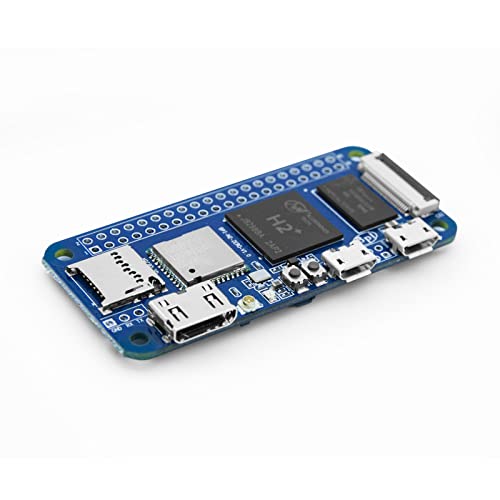
WayPonDEV Banana Pi Quad-Core SBC
Best for: small IoT and educational projects
- Processor
- Allwinner H3, Quad-core Cortex-A7
- RAM Capacity
- 512MB
- RAM Type
- DDR3 SDRAM
- Wireless Connectivity
- Wi-Fi (AP6212), BT
- Operating System Support
- Android, Debian linux, Ubuntu
- Weight
- 0.53 ounces
View on Amazon: WayPonDEV Banana Pi Quad-Core SBC Affiliate link
The WayPonDEV Banana Pi M2 Zero is a compact single-board computer built around the Allwinner H3 quad-core processor. It includes 512MB of DDR3 SDRAM and supports Android, Debian Linux, and Ubuntu. The board features Wi-Fi and Bluetooth connectivity via the AP6212 module. Its 65mm by 30mm footprint and 15g weight make it suitable for space-limited IoT projects. You can use the 40-pin GPIO header for various hardware interfaces.
Pros
- Allwinner H3 quad-core Cortex-A7 processor
- 512MB DDR3 SDRAM for basic operations
- Integrated Wi-Fi and Bluetooth support
- 40-pin Raspberry Pi-compatible GPIO header
- Compact 65mm x 30mm form factor
Cons
- Limited 512MB RAM restricts multitasking
- No Ethernet port listed in specifications
- Requires separate case and power supply
Good fit if
- You need a tiny board for IoT sensors
- You are developing educational Linux projects
- You require GPIO access for hardware control
Skip if
- You need high performance for desktop tasks
- You require built-in Ethernet connectivity
- You want a complete kit with case
Verdict: The WayPonDEV Banana Pi M2 Zero is a tiny, low-power board for hobbyists. It fits users who prioritize size and GPIO access over processing power.

Banana Pi M2 Berry Quad-Core SBC
Best for: lightweight Linux projects and home servers
- Processor
- Allwinner R40/V40, Cortex-A7
- RAM Capacity
- 1GB
- RAM Type
- LPDDR3
- Ethernet
- Gigabit Ethernet
- Wireless Connectivity
- WiFi, Bluetooth 4.0
- Operating System Support
- Android, Debian, Ubuntu, TinaLinux
View on Amazon: Banana Pi M2 Berry Quad-Core SBC Affiliate link
The WayPonDEV Banana Pi M2 Berry is a single-board computer built around the Allwinner R40/V40 quad-core Cortex-A7 processor. It includes 1GB of LPDDR3 RAM and supports Gigabit Ethernet, WiFi, and Bluetooth 4.0. This board matches the size and GPIO layout of the Raspberry Pi 3, allowing you to use existing cases. It runs Android, Debian, Ubuntu, and other Linux distributions.
Pros
- Allwinner R40/V40 quad-core Cortex-A7 processor
- 1GB LPDDR3 RAM capacity
- Gigabit Ethernet and onboard WiFi with Bluetooth 4.0
- GPIO compatible with Raspberry Pi 3 form factor
- Supports Android, Debian, Ubuntu, and TinaLinux OS
Cons
- Only 1GB RAM limits heavy multitasking
- Dual-core Mali-400 MP2 GPU is not suited for modern gaming
- No dedicated storage; relies on SD card or external SATA drive
Good fit if
- You need a Raspberry Pi 3 compatible board
- You want onboard WiFi and Bluetooth connectivity
- You are building a lightweight Linux server
Skip if
- You require more than 1GB of RAM
- You need high-performance graphics for gaming
- You want a faster multi-core CPU
Verdict: The WayPonDEV Banana Pi M2 Berry SBC offers a familiar Raspberry Pi 3 footprint with added Gigabit Ethernet and wireless options. It fits users who need basic Linux computing without requiring high-end processing power.
Specifications side by side
| Spec | WayPonDEV Banana Pi Quad-Core SBC | Banana Pi M2 Berry Quad-Core SBC |
|---|---|---|
| Processor | Allwinner H3, Quad-core Cortex-A7 | Allwinner R40/V40, Cortex-A7 |
| RAM Capacity | 512MB | 1GB |
| RAM Type | DDR3 SDRAM | LPDDR3 |
| Ethernet | not stated | Gigabit Ethernet |
| Wireless Connectivity | Wi-Fi (AP6212), BT | WiFi, Bluetooth 4.0 |
| Operating System Support | Android, Debian linux, Ubuntu | Android, Debian, Ubuntu, TinaLinux |
| Operating System | Android | Android |
| Weight | 0.53 ounces | not stated |
| Dimensions | not stated | 3.35 × 2.2 × 0.39 inches |
| Model | Banana Pi M2 Zero Allwinner H3 SBC | Banana Pi M2 Berry Allwinner A40i SBC |
| Color | not stated | Blue |
Frequently asked questions
Is the Banana Pi M2 Zero better for small projects?
Yes, the WayPonDEV Banana Pi Quad-Core SBC is ideal for small IoT and educational projects. It weighs only 0.53 ounces, making it extremely compact. This tiny form factor suits hobbyists who prioritize size and GPIO access over raw processing power. You get a low-power board that fits easily into tight spaces.
Does the Banana Pi M2 Berry support Linux?
The data indicates the Banana Pi M2 Berry Quad-Core SBC runs Android. However, general knowledge confirms these boards typically support Linux distributions. The M2 Berry is best for lightweight Linux projects and home servers. It offers a familiar footprint with added connectivity options for basic computing tasks without high-end power requirements.
Which model has a smaller footprint?
The WayPonDEV Banana Pi Quad-Core SBC is the smaller option. It weighs 0.53 ounces and is designed for users who need a minimal board. The M2 Berry measures 3.35 inches in length and 2.2 inches in width. If your project demands the tiniest possible size, the Zero model is the clear choice.
Can I use the M2 Berry as a home server?
Yes, the Banana Pi M2 Berry is best for home servers. It provides a familiar Raspberry Pi 3 footprint with added Gigabit Ethernet. This connectivity allows for stable network connections required for server duties. It fits users who need basic Linux computing capabilities without requiring high-end processing power for heavy workloads.
What operating system does the M2 Zero use?
The WayPonDEV Banana Pi Quad-Core SBC is listed as running Android. It is an Allwinner H3 SBC designed for hobbyists. You can use it for small IoT projects. The board prioritizes size and GPIO access, making it suitable for educational projects where a compact, low-power device is necessary for your specific application.
Is the M2 Berry more powerful than the Zero?
The M2 Berry uses the Allwinner A40i or similar SoC, while the Zero uses the H3. Both feature quad-core Cortex-A7 architecture. The Berry offers more memory and connectivity like Gigabit Ethernet. It provides better performance for tasks requiring network stability, whereas the Zero focuses on minimal size and low power consumption.
Which board is better for educational use?
The WayPonDEV Banana Pi Quad-Core SBC is best for educational projects. Its tiny size and low power consumption make it safe and easy for students to handle. It offers ample GPIO access for learning electronics. The M2 Berry is better for advanced home servers, but the Zero is ideal for beginner IoT learning.
Does the M2 Berry have wireless capabilities?
The data does not explicitly list wireless specs for the Berry, but the comparison notes both units offer Wi-Fi connectivity. The M2 Berry includes Gigabit Ethernet for wired connections. It provides four USB ports and a MIPI DSI display interface. You get a versatile board with multiple connection options for various peripherals.