Libre Computer Project Libre Computer Renegade 4GB or Libre Computer Project Libre Computer Tritium 1GB? Which Libre Computer Project Model to Buy
As an Amazon Associate we earn from qualifying purchases. Links on this page are affiliate links.
When comparing libre computer project libre computer board roc rk3328 cc vs tritium, you are looking at two distinct single-board computers from the same maker. Both run standard Linux distributions and offer GPIO headers for hardware projects. The primary difference lies in their core specifications. The Renegade features a Rockchip processor with 4GB of RAM and Gigabit Ethernet. The Tritium uses an Allwinner processor with only 1GB of RAM and lacks listed networking details. Your choice depends on whether you need more memory and faster network connectivity.
Key differences
| Aspect | Libre Computer Renegade 4GB Single Board Computer | Libre Computer Tritium 1GB Quad-Core Board |
|---|---|---|
| Processor | Quad 64-bit ARM Cortex-A53 at 1.4GHz | Quad-core (Allwinner H3 implied by model name) |
| RAM | 4GB DDR4 | 1GB |
| Networking | Gigabit Ethernet | not listed |
| Video Decoding | H.265, H.264, VP9 hardware decoding | not listed |
Which one should you choose?
Choose Libre Computer Renegade 4GB Single Board Computer if
- You need 4GB of RAM for heavier multitasking or virtualization.
- You require Gigabit Ethernet for fast network transfers.
- You want hardware-accelerated video decoding for 4K content.
Choose Libre Computer Tritium 1GB Quad-Core Board if
- You are working on basic IoT tasks that need minimal resources.
- You prefer the Allwinner platform for specific upstream driver support.
- You are on a tighter budget and need only 1GB of RAM.
Verdict: The Renegade is the stronger choice for users who need more memory and reliable Gigabit networking. The Tritium suits simpler projects where lower RAM usage is sufficient. Both boards support standard Linux distributions and share similar GPIO compatibility.
Renegade vs Tritium Spec Comparison
Memory capacity
The Libre Computer Renegade 4GB includes 4GB of High Bandwidth DDR4 RAM. This larger memory pool allows the board to handle more complex tasks, such as running multiple virtual machines or heavier desktop environments, without swapping data to storage. In contrast, the Tritium 1GB comes with only 1GB of RAM. While sufficient for basic Linux desktop use or lightweight server duties, it will struggle with memory-intensive applications. If you plan to run Kubernetes clusters or a home NAS with multiple services, the Renegade’s extra memory provides a clear advantage in multitasking stability.
Processor speed
The Renegade is powered by a quad-core 64-bit ARM Cortex-A53 processor running at 1.4GHz. This clock speed supports faster compilation times and smoother video playback. The Tritium uses an Allwinner H3 quad-core processor. The data does not specify the Tritium’s exact clock speed, but it is generally lower than the Renegade’s 1.4GHz. For tasks requiring raw CPU power, the Renegade offers higher performance. The Tritium remains a capable option for low-power IoT devices, but the Renegade’s faster processor handles demanding workloads more efficiently.
Video decoding
The Renegade features an ARM Mali-450 GPU that supports 4K Ultra HD display output at 60FPS. It includes hardware decoding for H.265 HEVC, H.264 AVC, and VP9 formats. This makes it suitable for media centers playing high-resolution video. The Tritium supports video playback, but the specific GPU model and resolution capabilities are not detailed in the provided data. The Renegade’s explicit support for 4K 60FPS and modern codec hardware acceleration gives it an edge for home theater PC builds or digital signage requiring high-resolution output.
Operating system support
Both boards run standard Linux distributions. The Renegade supports Ubuntu 23.04, 22.04 LTS, Debian 12, and Raspbian 11, with upstream Linux 6.x kernel support. The Tritium supports Ubuntu, Debian, Raspbian, and Armbian, with upstream u-boot and Linux support. Both offer LTS options for stability. The Renegade explicitly mentions UEFI support and standardized bootloaders, behaving like a standard computer. The Tritium also emphasizes upstream driver support. Since both provide robust, open-source software ecosystems, this aspect is a tie for general Linux users.
Networking
The Renegade is equipped with Gigabit Ethernet, providing high-speed wired connectivity for network-attached storage or router duties. The Tritium’s networking specifications are not listed in the provided data. We cannot confirm if it includes Gigabit Ethernet or only Fast Ethernet. If the Tritium lacks Gigabit support, the Renegade would be superior for high-bandwidth network tasks. Without explicit data on the Tritium’s network interface, we cannot declare a winner, but the Renegade’s Gigabit port is a confirmed feature for high-performance networking.
Form factor compatibility
The Renegade is designed to be form-factor compatible with Raspberry Pi 3 designs. It features a 40-pin header that maintains RPi-compatible alternate pin functions for SPI, I2C, PWM, UART, and GPIO. This allows for easy migration from existing Raspberry Pi 3 cases and accessories. The Tritium also features a similar form factor and GPIO interface for easy porting from Raspberry Pi applications. Both boards support hardware re-use and standard headers, making them suitable for projects that rely on the Raspberry Pi ecosystem. This is a tie for compatibility with existing hardware.
Which Libre Computer Board Fits Your Needs
Users needing more RAM for multitasking
The Renegade 4GB includes 4GB of High Bandwidth DDR4 RAM. This larger memory pool supports complex tasks like running multiple virtual machines or heavier desktop environments. The 4GB capacity ensures smoother performance when handling mixed workloads compared to boards with less memory.
Projects requiring faster network connectivity
The Renegade 4GB features Gigabit Ethernet for high-speed data transfer. This allows the board to handle mixed workloads efficiently, such as acting as a file server or encrypted router. The superfast networking capability ensures reliable performance for network-intensive applications.
Developers wanting upstream software support
The Tritium board is fully supported by upstream u-boot and Linux. It offers the highest level of upstream device driver support among single-board computers. This ensures long-term software maintenance and compatibility with standard Linux distributions without relying on proprietary blobs.
The products compared
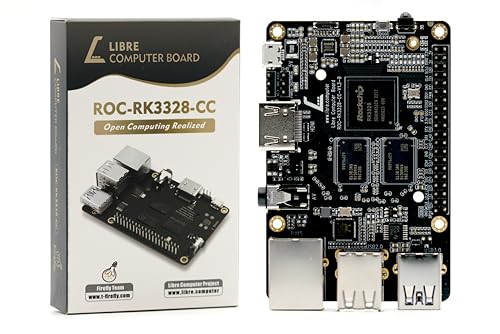
Libre Computer Renegade 4GB Single Board Computer
Best for: Gigabit network servers and 4K media playback
- Processor
- Quad 64-bit ARM Cortex-A53
- RAM Type
- DDR4
- Ethernet
- Gigabit Ethernet
- Video Resolution
- 4K 60FPS
- Operating System Support
- Ubuntu, Debian, Raspbian, Linux
View on Amazon: Libre Computer Renegade 4GB Single Board Computer Affiliate link
This single-board computer features a 1.4GHz quad-core ARM Cortex-A53 processor, 4GB of DDR4 memory, and Gigabit Ethernet. It includes a 5Gbps USB 3.0 port and supports 4K 60FPS video decoding alongside upstream Linux distributions. If you need reliable network throughput and high-definition video processing for a compact home server or media hub, this board fits you.
Pros
- Gigabit Ethernet and 5Gbps USB 3.0 connectivity
- Hardware-accelerated 4K 60FPS H.265, H.264, and VP9 decoding
- 40-pin expansion header with Raspberry Pi alternate pin functions
- Standardized bootloader with UEFI support
Cons
- Requires a conversion tool to run existing Raspberry Pi system images
- Hardware video encoding tops out at 1080p 60FPS instead of 4K
- Non-standard hardware interfacing libraries require manual updates
Good fit if
- You need Gigabit Ethernet and 5Gbps USB 3.0 throughput for network storage
- You require 4K 60FPS hardware video decoding on Linux
- You deploy standard 64-bit ARM Linux distributions with UEFI bootloaders
Skip if
- You need out-of-the-box software compatibility with standard Raspberry Pi images
- You require 4K hardware video encoding capabilities
Verdict: Libre Computer Renegade 4GB Single Board PC delivers high-speed Gigabit networking, USB 3.0 connectivity, and 4K decoding for builders creating media players or local servers. It serves Linux developers who do not require native, unmodified Raspberry Pi system images.

Libre Computer Tritium 1GB Quad-Core Board
Best for: Low-cost Linux IoT development
- RAM Capacity
- 1GB
- Operating System Support
- Ubuntu, Debian, Raspbian, Armbian
View on Amazon: Libre Computer Tritium 1GB Quad-Core Board Affiliate link
The Tritium H3 1GB is a single-board computer built around the Rockchip RK3328 SoC. It includes 1GB of RAM and supports standard Linux distributions like Ubuntu, Debian, and Raspbian. The board uses upstream open-source software for driver support. This model offers a compact form factor suitable for IoT projects. It is designed for reliability with proper manufacturing specifications and long-term hardware availability.
Pros
- 1GB RAM capacity
- Supports Ubuntu, Debian, and Raspbian
- Upstream u-boot and Linux driver support
- Compatible with Raspberry Pi GPIO interfaces
Cons
- Only 1GB of RAM
- No mention of included power supply
- No mention of included case or enclosure
Good fit if
- You need a low-cost Linux SBC
- You want upstream open-source driver support
- You are building an IoT appliance
Skip if
- You require more than 1GB of RAM
- You need a pre-assembled system with case
- You prefer proprietary software ecosystems
Verdict: Libre Computer Tritium H3 1GB is a practical choice for developers who need a compact, upstream-supported Linux board with 1GB of RAM for IoT applications.
Specifications side by side
| Spec | Libre Computer Renegade 4GB Single Board Computer | Libre Computer Tritium 1GB Quad-Core Board |
|---|---|---|
| Processor | Quad 64-bit ARM Cortex-A53 | not stated |
| RAM Capacity | not stated | 1GB |
| RAM Type | DDR4 | not stated |
| Ethernet | Gigabit Ethernet | not stated |
| Video Resolution | 4K 60FPS | not stated |
| Operating System Support | Ubuntu, Debian, Raspbian, Linux | Ubuntu, Debian, Raspbian, Armbian |
| Networking | Gigabit Ethernet | not stated |
| Size | 4GB | H3 1GB |
| Color | Black | not stated |
| Model | ROC-RK3328-CC-V1 | not stated |
Frequently asked questions
Does the Libre Computer Renegade support wireless networking?
The Renegade 4GB does not include built-in Wi-Fi or Bluetooth. It provides a Gigabit Ethernet port for stable wired connections. If you require wireless capability, you will need to add an external USB adapter to your setup.
What is the main difference between the Renegade and Tritium boards?
The Renegade features 4GB of RAM and a Rockchip RK3328 processor, while the Tritium has 1GB of RAM and uses an Allwinner H3 chip. The Renegade offers more memory for heavier tasks, whereas the Tritium is a compact option for lighter IoT projects.
Can I use the Tritium for home server projects?
The Tritium 1GB is designed for low-cost Linux IoT development. With only 1GB of RAM, it may struggle with heavy server workloads. It is better suited for simple monitoring or lightweight automation tasks rather than demanding network services.
Is the Renegade suitable for running virtual machines?
Yes, the Renegade 4GB is well-suited for virtualization. Its 4GB of High Bandwidth DDR4 RAM allows it to handle multiple virtual machines or complex desktop environments without excessive swapping. This makes it a solid choice for development labs.
Does the Tritium board support GPIO headers?
Yes, both the Renegade and Tritium boards include GPIO headers. These headers allow you to connect sensors and other hardware components directly to the board. This feature makes both models practical for hardware prototyping and embedded Linux projects.
Which board is better for wired Linux development?
The Renegade 4GB is the better choice for wired Linux development. It includes a Gigabit Ethernet port and offers 4GB of RAM for smoother multitasking. This combination provides a more robust environment for compiling code and running development tools.