Libre Computer Project Libre Computer Renegade 4GB vs Libre Computer Project Libre Computer Sweet Potato (2026): Key Differences
As an Amazon Associate we earn from qualifying purchases. Links on this page are affiliate links.
This comparison covers the Libre Computer Project Libre Computer Renegade 4GB vs Libre Computer Sweet Potato. Both boards offer 4K video support and run standard Linux distributions. The main difference lies in their hardware generation and memory capacity. The Renegade provides 4GB of RAM and a Rockchip processor, while the Sweet Potato uses an Amlogic chip with 2GB of RAM. You should review the specific specs below to see which fits your workflow.
Key differences
| Aspect | Libre Computer Renegade 4GB Single Board Computer | Libre Computer Sweet Potato 2GB SBC |
|---|---|---|
| Processor | Quad 64-bit 1.4GHz ARM Cortex-A53 | AML-S905X-CC (Amlogic) |
| RAM | 4GB DDR4 | 2GB |
| Operating Systems | Ubuntu 23.04/22.04, Debian 12 | Ubuntu 24.04, Debian 13, Fedora 42 |
| Power Input | Not listed | USB Type-C |
| Networking | Gigabit Ethernet | Gigabit Ethernet |
Which one should you choose?
Choose Libre Computer Renegade 4GB Single Board Computer if
- You need 4GB of RAM for heavier multitasking or virtualization.
- You prefer a board with a known quad-core ARM Cortex-A53 processor.
- You want hardware acceleration for H.264 encoding.
Choose Libre Computer Sweet Potato 2GB SBC if
- You require USB Type-C power input for modern setups.
- You want support for newer OS releases like Fedora 42 or Debian 13.
- You plan to use a POE mezzanine card for remote deployments.
Verdict: The Renegade is better for users who need more RAM and specific hardware encoding capabilities. The Sweet Potato suits those who prefer modern power inputs and the latest operating system versions. Choose based on your memory needs and power connector preferences.
Renegade 4GB vs Sweet Potato Specs
Memory Capacity
The Libre Computer Renegade 4GB includes 4GB of High Bandwidth DDR4 RAM. This larger memory pool allows you to run more complex applications simultaneously without slowdowns. In contrast, the Libre Computer Sweet Potato offers only 2GB of RAM. While sufficient for basic tasks, the Renegade provides double the memory for multitasking, virtualization, or heavier workloads. If you plan to run multiple services or larger databases, the extra 2GB on the Renegade is a clear advantage for sustained performance.
Processor Performance
The Renegade features a Quad 64-bit 1.4GHz ARM Cortex-A53 processor paired with an ARM Mali-450 GPU. The Sweet Potato uses the AML-S905X-CC-V2 chipset. While both are ARM-based, the Renegade’s specifications highlight up to 40% faster performance than older single-board computers like the Raspberry Pi 3. The Sweet Potato focuses on efficiency rather than raw speed. For compute-heavy tasks, the Renegade’s dedicated GPU and higher clock speed provide better graphical and processing capabilities compared to the Sweet Potato’s standard setup.
Operating System Support
Both boards support modern Linux distributions. The Renegade supports Ubuntu 23.04, 22.04 LTS, and Debian 12 with hardware-accelerated video playback. The Sweet Potato supports Fedora 42, Debian 13, Ubuntu 24.04 LTS, and CoreELEC. The Sweet Potato has an edge for media center users due to native CoreELEC support. The Renegade offers broader general-purpose Linux support with UEFI booting. Both run upstream Linux 6.x kernels. Your choice depends on whether you prioritize media playback optimization or general desktop server environments.
Networking and Connectivity
The Renegade is equipped with Gigabit Ethernet and USB 3.0 ports offering 5Gbps transfer speeds. The Sweet Potato also supports Gigabit Ethernet but adds a USB Type-C power input and a standard PC-style USB header for internal expansion. The Sweet Potato can support Power over Ethernet (PoE) with a separate mezzanine board. The Renegade relies on external USB dongles for WiFi. If you need internal WiFi/Bluetooth connectivity, the Sweet Potato’s header is more convenient than the Renegade’s external-only approach.
Power Efficiency
The Sweet Potato is designed for extreme power efficiency, with an idle power usage of just 1W. This makes it ideal for 24/7 operation in remote or battery-backed deployments. The Renegade does not list specific idle power figures but emphasizes high performance for mixed workloads. If your priority is minimizing energy consumption for a always-on server or network appliance, the Sweet Potato’s 1W idle draw is significantly more efficient than the Renegade’s performance-oriented design.
Which Mini PC Suits Your Needs
Users needing more RAM for multitasking
The Renegade provides 4GB of DDR4 RAM. This extra memory allows you to run more applications simultaneously without slowdowns. You get a Quad 64-bit ARM Cortex-A53 processor. It supports Ubuntu 23.04 and Debian 12. The larger memory pool handles complex workloads better than the 2GB Sweet Potato model.
Users wanting modern OS and USB-C
The Sweet Potato supports Fedora 42 and Ubuntu 24.04 LTS. It features USB Type-C power input for standard supplies. You get a full UEFI BIOS for customization. It offers hardware-accelerated 4K decoding for H.265 and VP9. The design focuses on efficiency with idle power usage of just 1W for 24/7 operation.
Users building a low-power server
The Sweet Potato is designed for extreme power efficiency. It uses just 1W at idle. This makes it ideal for 24/7 operation. You can max out network throughput for VPN operations. The board supports booting from eMMC and USB drives. Its low energy draw keeps running costs minimal over time.
Users needing Gigabit Ethernet and USB 3
The Renegade features superfast Gigabit Ethernet and USB 3.0 ports. These interfaces provide high-speed data transfer for mixed workloads. You can turn it into a NAS or file server. The board includes a 40-pin header for hardware extensibility. It supports UHS Micro SD cards for fast storage access.
The products compared
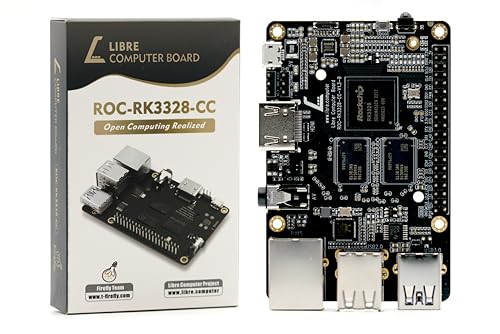
Libre Computer Renegade 4GB Single Board Computer
Best for: wired network servers requiring 4GB RAM
- Processor
- Quad 64-bit ARM Cortex-A53
- RAM Type
- DDR4
- Ethernet
- Gigabit Ethernet
- Video Resolution
- 4K 60FPS
- Operating System Support
- Ubuntu, Debian, Raspbian, Linux
View on Amazon: Libre Computer Renegade 4GB Single Board Computer Affiliate link
This ARM single-board computer features a quad-core 1.4GHz Cortex-A53 processor, 4GB of DDR4 memory, and high-speed input-output connectivity. You get a dedicated Gigabit Ethernet port, a 5Gbps USB 3.0 port, and 4K 60FPS video decoding. It suits you if you need reliable wired bandwidth and double the memory of 2GB alternative boards for home servers or network appliances.
Pros
- 4GB DDR4 memory provides capacity for memory-heavy workloads
- Gigabit Ethernet and 5Gbps USB 3.0 for fast local networking and storage
- Hardware-accelerated 4K 60FPS HDR video decoding
- 40-pin header supports standard hardware expansion options
Cons
- No integrated Wi-Fi or Bluetooth hardware on the board
- Raspberry Pi software images require conversion before boot
Good fit if
- You need 4GB RAM for running local services or lightweight servers.
- You plan to connect primarily via wired Gigabit Ethernet.
- You require a 5Gbps USB 3.0 port for external drives.
Skip if
- You need onboard wireless networking without using external USB dongles.
- You require out-of-the-box Raspberry Pi OS compatibility without conversion tools.
Verdict: Libre Computer Renegade 4GB Single Board Computer provides the extra RAM and USB 3.0 throughput needed for wired file servers, network appliances, and media decoding. It is built for developers and hobbyists who prioritize wired networking and 4GB capacity over built-in wireless hardware.

Libre Computer Sweet Potato 2GB SBC
Best for: Low-power 4K media and lightweight Linux tasks
- RAM Capacity
- 2GB
- Video Resolution
- 4K 60 FPS
- Operating System Support
- Fedora 42, Debian 13, Ubuntu 24.04 LTS
- Architecture
- ARM
- Dimensions
- 4.75 × 3 × 1 inches
View on Amazon: Libre Computer Sweet Potato 2GB SBC Affiliate link
The Libre Computer Sweet Potato is a 2GB ARM single-board computer designed for low-power, always-on tasks. It supports 4K video playback at 60 FPS and runs Fedora 42, Debian 13, and Ubuntu 24.04 LTS. With an idle power draw of just 1W, it suits users needing efficient hardware acceleration for media or VPN operations. Its compact 3x4.75 inch form factor allows for flexible mounting in small spaces.
Pros
- 2GB RAM capacity for lightweight computing tasks
- Hardware-accelerated 4K 60 FPS video decoding
- Ultra-low 1W idle power consumption
- Supports Fedora 42, Debian 13, and Ubuntu 24.04 LTS
Cons
- Only 2GB RAM limits multitasking compared to 4GB alternatives
- No built-in Wi-Fi or Bluetooth; requires separate mezzanine or adapter
- Requires separate power supply and storage media
Good fit if
- You need a low-power device for 24/7 media playback
- You want to run standard Linux distributions like Ubuntu or Debian
- You are building a compact network or VPN appliance
Skip if
- You require more than 2GB of RAM for heavy workloads
- You need built-in wireless connectivity without extra hardware
- You prefer a complete system with included power and storage
Verdict: The Libre Computer Sweet Potato 2GB ARM SBC offers efficient 4K media support and low power usage for lightweight Linux projects. It fits users who prioritize energy efficiency and open-source software flexibility over high memory capacity.
Specifications side by side
| Spec | Libre Computer Renegade 4GB Single Board Computer | Libre Computer Sweet Potato 2GB SBC |
|---|---|---|
| Processor | Quad 64-bit ARM Cortex-A53 | not stated |
| RAM Capacity | not stated | 2GB |
| RAM Type | DDR4 | not stated |
| Ethernet | Gigabit Ethernet | not stated |
| Video Resolution | 4K 60FPS | 4K 60 FPS |
| Operating System Support | Ubuntu, Debian, Raspbian, Linux | Fedora 42, Debian 13, Ubuntu 24.04 LTS |
| Networking | Gigabit Ethernet | not stated |
| Architecture | not stated | ARM |
| Dimensions | not stated | 4.75 × 3 × 1 inches |
| Size | 4GB | 2GB |
| Color | Black | Board |
| Model | ROC-RK3328-CC-V1 | LC-SBC-AML-S905X-CC-V2-2GB-UPC |
Frequently asked questions
Which board is better for wired networking?
The Renegade 4GB is the better choice for wired connections. It features a dedicated Gigabit Ethernet port. This provides stable, high-speed internet access for servers or desktop replacements. The Sweet Potato focuses more on general media tasks rather than specific networking hardware advantages.
Does the Sweet Potato use ARM architecture?
Yes, the Sweet Potato utilizes ARM architecture. This design prioritizes energy efficiency and low power consumption. It is ideal for lightweight Linux tasks and 4K media playback. The Renegade also uses an ARM processor but offers more RAM for heavier workloads.
What is the physical size of the Sweet Potato?
The Sweet Potato measures 4.75 inches in length, 3 inches in width, and 1 inch in height. These compact dimensions make it easy to fit into small enclosures. The Renegade is a single board computer, but specific external dimensions are not listed in the provided data.
Can I run Ubuntu on the Renegade?
Yes, the Renegade supports Ubuntu 23.04. It is designed for open-source Linux projects and development. You can install standard distributions to suit your needs. This makes it suitable for hobbyists who are comfortable configuring Linux systems for various applications.
Which board has more RAM capacity?
The Renegade 4GB has more RAM capacity. It includes 4GB of High Bandwidth DDR4 RAM. This allows for better multitasking and running more complex applications. The Sweet Potato offers 2GB of memory, which is sufficient for lightweight tasks but less for heavy multitasking.
Is the Sweet Potato suitable for 4K media?
Yes, the Sweet Potato is well-suited for 4K media. It offers efficient 4K video support with low power usage. This makes it ideal for media centers or lightweight Linux projects. The Renegade also supports 4K video but focuses more on general computing power.
What model number does the Sweet Potato use?
The Sweet Potato uses the model LC-SBC-AML-S905X-CC-V2-2GB-UPC. This identifier helps you find compatible accessories and documentation. It is a specific variant of the Libre Computer Project board designed for efficient performance in small form factors.