Libre Computer Project Libre Computer Tritium 1GB vs Libre Computer Project Libre Computer Le Potato: Spec Comparison
As an Amazon Associate we earn from qualifying purchases. Links on this page are affiliate links.
This libre computer project libre computer tritium 1gb vs libre computer le comparison looks at two single-board computers from the same maker. Both boards prioritize open-source software and upstream Linux support for long-term reliability. They share similar GPIO layouts for easy integration into existing projects. The main difference lies in processing power and memory capacity. The Tritium offers a basic quad-core setup with 1GB of RAM. The Le Potato provides double the memory and faster hardware acceleration for media tasks.
Key differences
| Aspect | Libre Computer Tritium 1GB Quad-Core Board | Libre Computer Le Potato 2GB 2-Pack |
|---|---|---|
| Processor | Quad-core (unspecified model) | Quad 64-bit ARM Cortex-A53 at 1.5GHz |
| RAM Capacity | 1GB | 2GB DDR3 |
| Graphics Performance | Standard desktop acceleration | Mali-450 GPU with 4K 60FPS decoding |
| Video Decoding | Standard hardware acceleration | 4K multi-codec (H.265, H.264, VP9) |
| OS Support | Ubuntu, Debian, Raspbian, Armbian | Ubuntu 22.04 LTS, Raspbian 11 |
Which one should you choose?
Choose Libre Computer Tritium 1GB Quad-Core Board if
- You need a lower-cost option for basic compute tasks
- You require a simple quad-core board with 1GB of RAM
- You want a board with broad third-party distribution support
Choose Libre Computer Le Potato 2GB 2-Pack if
- You need 2GB of RAM for multitasking or larger applications
- You require hardware-accelerated 4K video playback
- You want faster CPU performance with 64-bit architecture
Verdict: The Le Potato is the better choice for users who need more memory and robust media capabilities. It offers double the RAM and superior video decoding for a small performance gain. Choose the Tritium if your project only requires 1GB of memory and basic processing power.
Tritium vs Le Potato Specs
Processor Performance
The Libre Computer Tritium 1GB utilizes a quad-core processor architecture, designed for general compute tasks and IoT applications. In contrast, the Libre Computer Le Potato features a quad 64-bit ARM Cortex-A53 processor running at 1.5GHz. This specific clock speed allows the Le Potato to deliver higher sustained performance under load. The Tritium focuses on reliability and upstream driver support rather than raw speed benchmarks. For users requiring faster processing for desktop-like experiences or heavy multitasking, the Le Potato's specified 1.5GHz Cortex-A53 cores provide a clear computational advantage over the Tritium's unspecified frequency quad-core design.
Memory Capacity
Memory size directly impacts how many applications you can run simultaneously. The Libre Computer Tritium 1GB comes equipped with 1GB of RAM. The Libre Computer Le Potato offers 2GB of High Bandwidth DDR3 memory. This doubling of capacity allows the Le Potato to handle more complex workloads without slowing down. If you plan to run a Linux desktop environment with multiple browser tabs or background services, the extra gigabyte in the Le Potato reduces the likelihood of memory bottlenecks. The Tritium’s 1GB is sufficient for lightweight tasks but limits scalability compared to its counterpart.
Graphics and Video
Visual output capabilities differ significantly between these two boards. The Libre Computer Le Potato includes a 4K Ultra HD Display Engine supporting 60FPS and hardware decoding for H.265, H.264, and VP9 codecs. It also features an ARM Mali-450 GPU for 2D/3D acceleration. The Tritium 1GB data does not specify video resolution or GPU details. For media centers or displays requiring high-resolution output, the Le Potato’s explicit 4K support and codec handling make it the superior choice. The Tritium is better suited for projects where video playback is not a primary requirement.
Software Support
Both boards prioritize open-source stability, but their supported versions differ. The Libre Computer Tritium 1GB supports Ubuntu, Debian, Raspbian, and Armbian, with a focus on upstream u-boot and Linux drivers for long-term reliability. The Libre Computer Le Potato explicitly supports Ubuntu 22.04 LTS and Raspbian 11, along with Linux 6.x and UEFI support via GRUB. The Le Potato’s inclusion of UEFI and newer LTS versions offers a more modern PC-like boot experience. The Tritium’s emphasis on upstream drivers ensures broad compatibility, but the Le Potato provides more recent distribution versions out of the box.
Form Factor and Compatibility
Physical dimensions and compatibility with existing cases matter for integration. The Libre Computer Le Potato shares the same form factor as the Raspberry Pi 3 Model B, allowing reuse of existing cases and power supplies. It features an identical 40-pin header layout. The Tritium 1GB data does not specify its physical dimensions or case compatibility. While the Tritium mentions a similar GPIO interface, the Le Potato’s explicit compatibility with Pi 3 cases and accessories offers immediate plug-and-play convenience for users migrating from Raspberry Pi ecosystems. The Tritium requires verification of physical fit for your specific enclosure.
Choose the Right Board for Your Needs
Users needing 4K media playback and modern OS support
The Le Potato offers 2GB of DDR3 RAM and a 1.5GHz Cortex-A53 processor. It supports Ubuntu 22.04 LTS and hardware-accelerated 4K video decoding. This combination provides faster performance and better graphics capabilities for media centers compared to the Tritium's 1GB configuration.
Developers prioritizing low power consumption and efficiency
The Le Potato is designed for high performance with low power usage. It uses half the power of a Pi 3 B+ while delivering superior sustained performance under load. This efficiency makes it ideal for always-on appliances where energy consumption matters.
Users seeking a simple, reliable quad-core board
The Tritium provides a straightforward quad-core solution with 1GB of RAM. It features upstream Linux support and stable hardware availability. This board is suitable for general IoT applications where basic compute power and long-term software reliability are your primary requirements.
The products compared

Libre Computer Tritium 1GB Quad-Core Board
Best for: Basic IoT projects and open-source development
- RAM Capacity
- 1GB
- Operating System Support
- Ubuntu, Debian, Raspbian, Armbian
View on Amazon: Libre Computer Tritium 1GB Quad-Core Board Affiliate link
The Tritium H3 is a single-board computer with 1GB of RAM. It uses the Allwinner H3 chip and supports Ubuntu, Debian, Raspbian, and Armbian. You get upstream Linux and U-Boot support for reliable long-term use. This board suits developers who need open-source software compatibility and a familiar GPIO layout for IoT projects.
Pros
- 1GB RAM capacity
- Supports Ubuntu, Debian, Raspbian, and Armbian
- Upstream U-Boot and Linux driver support
- Compatible with Raspberry Pi GPIO interfaces
Cons
- Only 1GB of RAM limits multitasking
- No mention of included power supply
- Single-board form factor requires external case
Good fit if
- You need a low-cost SBC for IoT
- You prefer upstream open-source software support
- You want Raspberry Pi GPIO compatibility
Skip if
- You require more than 1GB of RAM
- You need a pre-assembled desktop computer
- You rely on proprietary blobs for boot
Verdict: Libre Computer Tritium H3 1GB SBC fits developers who value open-source compatibility and GPIO familiarity. It is a solid choice for basic IoT applications.
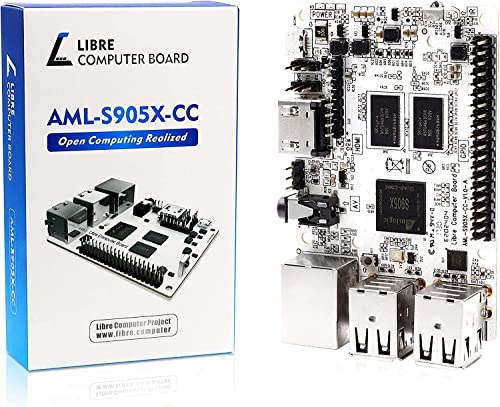
Libre Computer Le Potato 2GB 2-Pack
Best for: Pi 3 users needing 4K media playback
- Processor
- AML-S905X-CC ARM Cortex-A53
- RAM Capacity
- 2GB
- RAM Type
- DDR3
- Video Resolution
- 4K 60FPS
- Operating System Support
- Ubuntu 22.04 LTS, Raspbian 11
- Dimensions
- 8 × 5 × 1.5 inches
View on Amazon: Libre Computer Le Potato 2GB 2-Pack Affiliate link
This single board computer uses the AML-S905X-CC processor with 2GB of DDR3 RAM. It supports Ubuntu 22.04 LTS and Raspbian 11 with hardware-accelerated 4K video playback. The 40-pin header matches Raspberry Pi 3 dimensions for easy case reuse. It offers faster performance than the Pi 3 B+ while using half the power. This setup suits users needing reliable open-source software support and efficient media decoding.
Pros
- Quad-core 1.5GHz ARM Cortex-A53 processor
- 2GB DDR3 RAM capacity
- Hardware decoding for H.265 and VP9
- Compatible with Raspberry Pi 3 cases
- Supports Ubuntu 22.04 LTS
Cons
- Only 2GB RAM limits heavy multitasking
- DDR3 memory is slower than newer standards
- No built-in Wi-Fi or Bluetooth mentioned
Good fit if
- You need a Raspberry Pi 3 form factor replacement
- You want hardware-accelerated 4K video playback
- You prefer open-source Linux software support
Skip if
- You require more than 2GB of RAM
- You need built-in wireless connectivity
- You are looking for a pre-assembled desktop computer
Verdict: Libre Computer Le Potato 2GB delivers solid 4K media performance and Pi 3 compatibility for hobbyists. It fits users who prioritize open-source software and efficient hardware decoding over raw memory capacity.
Specifications side by side
| Spec | Libre Computer Tritium 1GB Quad-Core Board | Libre Computer Le Potato 2GB 2-Pack |
|---|---|---|
| Processor | not stated | AML-S905X-CC ARM Cortex-A53 |
| RAM Capacity | 1GB | 2GB |
| RAM Type | not stated | DDR3 |
| Video Resolution | not stated | 4K 60FPS |
| Operating System Support | Ubuntu, Debian, Raspbian, Armbian | Ubuntu 22.04 LTS, Raspbian 11 |
| Dimensions | not stated | 8 × 5 × 1.5 inches |
| Size | H3 1GB | 2GB 2-Pack |
Frequently asked questions
Which board is better for basic IoT projects?
The Libre Computer Tritium 1GB is the better choice for basic IoT applications. It fits developers who value open-source compatibility and familiar GPIO layouts. This board provides a solid foundation for simple connectivity tasks without requiring complex hardware decoding.
Can the Le Potato play 4K video?
Yes, the Libre Computer Le Potato supports hardware-accelerated 4K video decoding. It includes 2GB of DDR3 RAM and a 1.5GHz processor. This combination allows for smooth media playback, making it ideal for users who prioritize efficient video performance over raw processing speed.
What operating systems do these boards support?
Both boards prioritize open-source software and upstream Linux support for long-term reliability. The Le Potato specifically supports Ubuntu 22.04 LTS. This ensures you have access to modern, stable operating systems suitable for development and media centers.
Is the Le Potato compatible with Raspberry Pi?
The Libre Computer Le Potato offers Raspberry Pi 3 compatibility. It is designed for hobbyists who want to transition from Pi hardware. This compatibility simplifies integration into existing projects that were originally built for Raspberry Pi environments.
How much RAM does the Le Potato have?
The Libre Computer Le Potato features 2GB of DDR3 RAM. This memory capacity supports multitasking and modern OS requirements. It provides more resources than the Tritium 1GB for applications that need additional memory headroom.
What processor does the Le Potato use?
The Le Potato uses a quad 64-bit ARM Cortex-A53 processor running at 1.5GHz. This architecture delivers efficient performance for general compute tasks. It handles media decoding and standard applications with ease compared to older processor designs.
Which board is best for open-source development?
The Tritium 1GB fits developers who value open-source compatibility. It provides a solid choice for basic IoT applications with familiar GPIO layouts. This makes it easier to integrate into existing open-source projects without complex hardware adjustments.