Orange Pi RV2 4GB RISC-V SBC Alternatives: 6 Similar Picks Compared
As an Amazon Associate we earn from qualifying purchases. Links on this page are affiliate links.
If you are evaluating Orange Pi RV2 4GB RAM LPDDR4X alternatives, you have several hardware platforms to consider. The Orange Pi RV2 delivers an octa-core RISC-V processor with 2 TOPS of integrated AI arithmetic power, 4GB of LPDDR4X memory, and Ubuntu 24.04 support. It fits Gigabit Ethernet, Wi-Fi 5, Bluetooth 5, and dual M.2 M-Key PCIe 2.0 slots for NVMe storage onto an 89mm by 56mm footprint. These specifications make it an effective compact development board for edge computing and local AI workloads.
You might still need a different platform for your setup. Projects often call for established ARM architectures, bundled eMMC storage modules, Android operating system compatibility, or dedicated multi-Gigabit networking ports. Different board sizes and alternative brands also provide distinct layout choices. We selected these 6 alternatives because their core specifications overlap with the original, helping you compare processing architectures, memory capacities, and expansion options across similar compact hardware.
Our top pick: Orange Pi RV2 4GB RISC-V SBC.
Comparing Orange Pi RV2 Alternatives
Libre Computer Le Potato 128GB Starter Kit
Libre Computer Le Potato 128GB Starter Kit shifts you from the RISC-V architecture to an established ARM Cortex-A53 platform. Its main advantage is out-of-the-box storage capacity, providing 128GB of bundled eMMC flash alongside dedicated 4K video playback support. However, you give up significant compute flexibility compared to the Orange Pi RV2. The kit features 2GB of older DDR3 RAM, half the RV2's 4GB LPDDR4X memory capacity. You also lose the octa-core RISC-V CPU, the integrated 2 TOPS AI processor, and the dual M.2 NVMe slots. Choose this kit if you need an ARM-based media center or general Linux workstation with preinstalled eMMC storage instead of edge AI hardware.
Libre Computer Le Potato Kit with WiFi 5
Libre Computer Le Potato Kit provides an ARMv8 environment focused on lightweight computing and 4K media decoding. Compared to the Orange Pi RV2, this kit relies on an established ARM software foundation rather than an emerging RISC-V architecture. What you sacrifice is performance and expandability. You receive 2GB of memory rather than 4GB of LPDDR4X, and the board lacks the RV2's 2 TOPS AI arithmetic capability and dual M.2 NVMe slots for high-speed storage. The physical kit dimensions of 5.6 by 2.4 by 7.6 inches are also larger than the compact RV2. Pick this option if your priority is standard low-power Linux or basic media playback.
Libre Computer Renegade 4GB SBC
Libre Computer Renegade matches the Orange Pi RV2 with 4GB of system memory and Gigabit networking, but it uses an ARM quad-core architecture instead of RISC-V. This gives you broader native support across standard Linux distributions without early-stage RISC-V software adjustments. In exchange, you give up the RV2's octa-core processing, its dedicated 2 TOPS AI arithmetic power, and its dual M.2 PCIe 2.0 NVMe expansion slots. The Renegade measures 3 by 1 by 4.75 inches, making it slightly larger than the RV2. Choose the Renegade if you need a reliable headless ARM server or media host that prioritizes standard Linux software over edge AI acceleration.
WayPonDEV Banana Pi WiFi 7 NIC Module
WayPonDEV Banana Pi WiFi 7 NIC Module serves a fundamentally different purpose than the Orange Pi RV2. Rather than a full standalone computer, this module is a dedicated networking expansion card equipped with a 32-bit RISC-V MCU and tri-band Wi-Fi 7 capability. It outperforms the RV2's Wi-Fi 5 connection by providing cutting-edge wireless bandwidth and hardware network offloading. However, you give up complete single-board functionality. It lacks an octa-core application processor, 4GB of system memory, dual M.2 NVMe slots, and general operating system support like Ubuntu 24.04. Pick this module only if you are adding high-speed wireless routing capabilities to a compatible router host board.
Orange Pi R2S RISC-V Single Board Computer
Orange Pi R2S shares the RV2's 4GB memory capacity, RISC-V architecture, and Ubuntu operating system support. Where it excels is network throughput, substituting standard ports for multi-Gigabit Ethernet connectivity designed specifically for compact network appliances. In return, you lose the RV2's dual M.2 PCIe 2.0 slots, which limits your onboard NVMe storage expansion. The R2S is built around high-speed data routing rather than general edge computing or dual-drive local NAS configurations. You should select the Orange Pi R2S over the RV2 if your primary build requirement is a high-throughput hardware firewall, router, or dedicated network appliance that demands multi-Gigabit wire speeds.
Orange Pi 4A Allwinner T527 SBC
Orange Pi 4A pairs 4GB of memory with an Allwinner T527 processor featuring a mixed-core layout and a dedicated RISC-V coprocessor. It matches the RV2 with a 2 TOPS NPU and Wi-Fi 5, but it introduces native Android 13 support alongside Linux options for real-time control tasks. What you lose compared to the RV2 is a fully native octa-core RISC-V computing environment and the dual M.2 NVMe slots for high-speed SSD storage. At 2 by 50 by 10 inches according to spec, its packaging profile also differs. Choose the Orange Pi 4A if you require Android compatibility or hybrid coprocessor control alongside edge AI acceleration.
Quick picks
Our 7 picks

Orange Pi RV2 4GB RISC-V SBC
Best for: RISC-V edge computing and AI development
- Processor
- RISC-V octa-core
- RAM Capacity
- 4GB
- RAM Type
- LPDDR4X
- Ethernet
- Gigabit Ethernet
- Wireless Connectivity
- Wi-Fi 5, BT 5 with BLE
- Operating System Support
- Ubuntu24.04
The Orange Pi RV2 4GB is a compact single-board computer built around an octa-core RISC-V processor. It features 4GB of LPDDR4X memory, integrated 2 TOPS AI compute capacity, and two M.2 M-Key slots for NVMe storage over PCIe 2.0. With Gigabit Ethernet, Wi-Fi 5, and official Ubuntu 24.04 support, it suits you if you need a dedicated RISC-V development platform for edge computing, basic NAS duty, or machine learning tasks.
Pros
- Octa-core RISC-V processor with 2 TOPS AI computing power
- Dual M.2 M-Key slots with PCIe 2.0 support for NVMe SSDs
- Includes Gigabit Ethernet, Wi-Fi 5, and Bluetooth 5.0 with BLE
- Supports Ubuntu 24.04 operating system
Cons
- Uses older Wi-Fi 5 rather than Wi-Fi 6 or 7
- M.2 expansion operates at PCIe 2.0 speeds rather than faster generations
Good fit if
- You need an octa-core RISC-V platform for AI models or edge computing.
- You want dual M.2 NVMe storage support on a compact development board.
- You plan to run Ubuntu 24.04 for local development or home networking.
Skip if
- You require newer Wi-Fi 6 or Wi-Fi 7 wireless standards.
- You need PCIe 3.0 or faster NVMe transfer speeds.
Verdict: Orange Pi RV2 4GB RISC-V SBC delivers octa-core RISC-V processing and dual M.2 storage expansion in a credit-card-sized board. It gives you capable edge AI performance and solid networking for specialized development.

Libre Computer Le Potato 128GB Starter Kit
Best for: ARM media playback with bundled eMMC storage
- Processor
- AML-S905X-CC
- RAM Capacity
- 2GB
- RAM Type
- DDR3
- Storage
- 128GB eMMC
- Wireless Connectivity
- WiFi 5 BT
- Video Resolution
- 4K 60FPS
This single board computer kit includes an ARM Cortex-A53 quad-core processor, 2GB of DDR3 memory, and 128GB of eMMC storage. You get integrated WiFi 5, Bluetooth, and 4K 60FPS hardware video decoding alongside a 40-pin expansion header. It runs standard Linux distributions like Ubuntu and Debian 12 with UEFI bootloaders. It suits you if you need a pre-packaged ARM alternative with bundled flash storage instead of configuring bare boards.
Pros
- 128GB eMMC onboard storage module included
- 4K 60FPS hardware decoding for H.265, H.264, and VP9
- 40-pin header with Raspberry Pi alternate pin function compatibility
- UEFI bootloader support with upstream Linux 6.x kernel images
Cons
- DDR3 RAM instead of faster LPDDR4 or DDR4
- Limited to 2GB memory capacity
- Raspberry Pi software images require conversion and non-standard GPIO libraries will not work
Good fit if
- You need a bundled 128GB eMMC storage setup ready for Linux deployment.
- You require 4K 60FPS hardware video decoding via H.265, H.264, or VP9.
- You want an ARM Cortex-A53 board with UEFI bootloader support.
Skip if
- You need 4GB or more system RAM for demanding tasks.
- You require native RISC-V architecture instead of ARM Cortex-A53.
- You rely on out-of-the-box Raspberry Pi software images without image conversion.
Verdict: Libre Computer Le Potato 128GB Starter Kit pairs an established ARM Cortex-A53 platform with 128GB of eMMC storage and 4K video playback. It provides dependable media playback and general Linux utility, though system RAM is restricted to 2GB of DDR3.

Libre Computer Le Potato Kit with WiFi 5
Best for: low-power Linux projects and media playback
- Processor
- AML-S905X-CC
- RAM Capacity
- 2GB
- RAM Type
- DDR3
- Wireless Connectivity
- WiFi 5 BT
- Video Resolution
- 4K 60FPS
- Operating System Support
- Ubuntu, Debian 12, Raspbian 11
This single-board computer starter kit pairs a 1.5GHz quad-core ARM Cortex-A53 processor with 2GB of DDR3 memory and wireless connectivity via WiFi 5 and Bluetooth. You get 4K 60FPS hardware video decoding alongside a standard 40-pin header for hardware expansion. It suits you if you need a low-power ARMv8 platform for Debian or Ubuntu projects instead of a RISC-V architecture board.
Pros
- Quad-core 1.5GHz ARM Cortex-A53 CPU with 4K 60FPS hardware decoding
- Bundled WiFi 5 and Bluetooth wireless connectivity
- 40-pin expansion header supporting SPI, I2C, PWM, UART, and GPIO
- Upstream Linux 6.x kernel support with standardized UEFI bootloader
Cons
- Equipped with 2GB of DDR3 RAM rather than higher-capacity LPDDR4X
- Raspberry Pi software images require conversion tools rather than working out of the box
- Built on ARMv8 architecture rather than RISC-V
Good fit if
- You need 4K 60FPS hardware video decoding on standard Linux distributions.
- You want an ARM platform with a 40-pin header for hardware prototyping.
- You run Ubuntu or Debian workloads that do not exceed 2GB of RAM.
Skip if
- You specifically require a RISC-V processor architecture.
- You need more than 2GB of memory for data-heavy tasks.
- You require out-of-the-box compatibility with native Raspberry Pi software.
Verdict: LoveRPi Le Potato 2GB Starter Kit delivers reliable ARMv8 processing with 4K decoding and standard Linux distribution support. It is a capable option if your project does not need the higher memory ceiling or RISC-V core of the RV2.

Libre Computer Renegade 4GB SBC
Best for: standard Linux headless and media server deployments
- Processor
- ROC-RK3328-CC
- RAM Capacity
- 4GB
- RAM Type
- DDR4
- Ethernet
- Gigabit Ethernet
- Wireless Connectivity
- WiFi 5 BT4
- Video Resolution
- 4K 60FPS
The Libre Computer Renegade 4GB Single Board Computer is an ARM-based alternative featuring a quad-core 1.4GHz Cortex-A53 processor and 4GB of DDR4 memory. You get Gigabit Ethernet, a 5Gbps USB 3.0 port, 4K 60FPS video decoding, and a 40-pin expansion header. It suits you if you want a compact board running standard Linux distributions like Ubuntu or Debian for network services or media tasks.
Pros
- Gigabit Ethernet and 5Gbps USB 3.0 connectivity
- 4K 60FPS hardware decoding for H.265, H.264, and VP9
- 40-pin header with SPI, I2C, PWM, and UART support
- Standardized bootloader with UEFI support for Linux 6.x kernels
Cons
- No onboard Wi-Fi or Bluetooth emitter directly on the board
- Raspberry Pi OS software images require conversion tools
- Uses ARM Cortex-A53 architecture rather than RISC-V
Good fit if
- You need Gigabit Ethernet and USB 3.0 for server or network storage workloads.
- You want standard upstream Linux support with Ubuntu or Debian UEFI images.
- You plan to reuse standard 40-pin hardware accessories.
Skip if
- You specifically require a native RISC-V processor architecture.
- You need integrated onboard Wi-Fi rather than an external USB dongle.
- You depend on out-of-the-box Raspberry Pi software without running conversion tools.
Verdict: Libre Computer Renegade 4GB Single Board Computer provides reliable ARM quad-core performance, Gigabit networking, and standard Linux support for headless or multimedia setups. It is an effective ARMv8 option if you do not require a RISC-V architecture.

WayPonDEV Banana Pi WiFi 7 NIC Module
Best for: tri-band Wi-Fi 7 OpenWRT router builds
- Processor
- MediaTek MT7995AV
- Ethernet
- 2x 10Gbe SFP, 4x Gbe
- Wireless Connectivity
- Wi-Fi 7
- Operating System Support
- OpenWRT
- Architecture
- RISC-V
- Dimensions
- 5.9 × 4.01 × 0.78 inches
This network expansion module features a 32-bit RISC-V MCU and a MediaTek MT7995AV chip to provide Wi-Fi 7 connectivity. It supports tri-band wireless across 2.4GHz, 5GHz, and 6GHz bands with 320-MHz channel bandwidth and OpenWRT operating system support. An intelligent MAC design includes hardware offload engines to handle network traffic. You will find this module suitable if you need dedicated tri-band wireless hardware for an OpenWRT router setup.
Pros
- Tri-band Wi-Fi 7 support covering 2.4GHz, 5GHz, and 6GHz bands
- MediaTek MT7995AV processor with a 32-bit RISC-V MCU
- PCIe 3.0 two-lane miniPCIe interface connection
- Hardware offload engine for processing network tasks
- Supports OpenWRT operating system
Cons
- Functions as a network module rather than a standalone single-board computer
- Requires a compatible host router board with miniPCIe slots
Good fit if
- You need tri-band Wi-Fi 7 wireless connectivity for an OpenWRT router
- You have a compatible host board with PCIe 3.0 miniPCIe slots
- You want hardware offloading for high-bandwidth wireless network tasks
Skip if
- You need a standalone single-board computer with integrated display outputs
- You do not own a compatible base router board
Verdict: Banana Pi Wi-Fi 7 RISC-V Network Module delivers tri-band Wi-Fi 7 connectivity and hardware task offloading for compatible router hardware. It serves as a specialized network add-on rather than a complete standalone single-board computer.
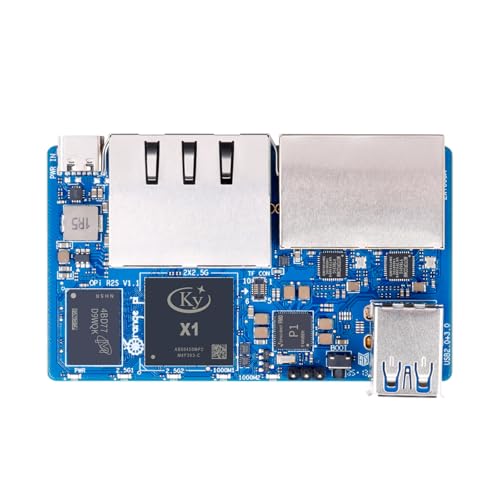
Orange Pi R2S RISC-V Single Board Computer
Best for: multi-Gigabit Ubuntu RISC-V networking projects
- Processor
- Ky X1
- RAM Capacity
- 4GB
- RAM Type
- LPDDR4X
- Storage
- 8GB eMMC
- Ethernet
- Dual 2.5G, Dual Gigabit Ethernet
- Operating System Support
- OpenWrt, Ubuntu
This compact single-board computer runs an eight-core Ky X1 RISC-V processor paired with 4GB of LPDDR4X memory. It features four total network interfaces, including dual 2.5G and dual Gigabit Ethernet ports, alongside 8GB of onboard eMMC storage. It also includes 2TOPS of AI computing power. If you need a small-footprint RISC-V platform for Ubuntu-based edge routing, networking projects, or industrial gateways, this board matches your requirements directly.
Pros
- Ky X1 8-core RISC-V processor with 2TOPS AI power
- Dual 2.5G Ethernet plus dual Gigabit Ethernet ports
- 8GB onboard eMMC storage plus TF card slot
- Official support for Ubuntu and OpenWrt
Cons
- Onboard eMMC capacity is limited to 8GB
- No built-in Wi-Fi or Bluetooth listed in specifications
Good fit if
- You need multi-port networking with dual 2.5G and dual Gigabit Ethernet interfaces.
- You plan to run Ubuntu or OpenWrt on a multi-core RISC-V platform.
Skip if
- You require integrated wireless connectivity out of the box.
- You need more than 8GB of onboard eMMC storage without using external media.
Verdict: Orange Pi R2S 4GB RISC-V SBC delivers extensive multi-Gigabit Ethernet connectivity and AI-capable RISC-V processing in a tiny form factor. It is a capable pick for running Ubuntu in space-constrained network appliances.

Orange Pi 4A Allwinner T527 SBC
Best for: Android 13 edge AI and control projects
- Processor
- Allwinner T527
- RAM Capacity
- 4GB
- RAM Type
- LPDDR4/4X
- Ethernet
- Gigabit Ethernet
- Wireless Connectivity
- WiFi 5, BT 5.0
- Operating System Support
- Ubuntu, Debian, Android 13
The Orange Pi 4A is a single-board computer powered by an Allwinner T527 octa-core Cortex-A55 processor paired with a RISC-V coprocessor. It provides 4GB of LPDDR4X RAM, a 2TOPS NPU for edge computing, and official support for Android 13 alongside Debian and Ubuntu. If you need a board optimized for Android deployments, edge artificial intelligence workloads, or low-power control tasks using dual MIPI ports and Gigabit Ethernet, this board fits your build.
Pros
- Supports Android 13, Ubuntu, and Debian operating systems
- Integrated 2TOPS NPU for edge artificial intelligence acceleration
- Includes a RISC-V architecture coprocessor alongside the octa-core CPU
- Equipped with Gigabit Ethernet, WiFi 5, and Bluetooth 5.0
Cons
- External USB ports are limited to USB 2.0 speeds
- Relies on Cortex-A55 primary cores instead of a pure RISC-V main CPU
- Wireless connectivity tops out at WiFi 5 rather than WiFi 6
Good fit if
- You want an SBC with verified Android 13 support alongside Linux
- You need an integrated 2TOPS NPU for edge machine learning tasks
- You require dual MIPI-CSI camera interfaces and PCIe 2.0 connectivity
Skip if
- You need native high-speed transfers over USB 3.0 ports
- You require an SBC driven entirely by a RISC-V primary processor
Verdict: Orange Pi 4A 4GB RISC-V Coprocessor SBC delivers a balanced platform for Android 13 and edge AI with its 2TOPS NPU and mixed-core architecture. It is a capable choice if you need real-time control features and flexible operating system options.
Specifications side by side
| Spec | Orange Pi RV2 4GB RISC-V SBC | Libre Computer Le Potato 128GB Starter Kit | Libre Computer Le Potato Kit with WiFi 5 | Libre Computer Renegade 4GB SBC | WayPonDEV Banana Pi WiFi 7 NIC Module | Orange Pi R2S RISC-V Single Board Computer | Orange Pi 4A Allwinner T527 SBC |
|---|---|---|---|---|---|---|---|
| Processor | RISC-V octa-core | AML-S905X-CC | AML-S905X-CC | ROC-RK3328-CC | MediaTek MT7995AV | Ky X1 | Allwinner T527 |
| RAM Capacity | 4GB | 2GB | 2GB | 4GB | not specified | 4GB | 4GB |
| RAM Type | LPDDR4X | DDR3 | DDR3 | DDR4 | not specified | LPDDR4X | LPDDR4/4X |
| Storage | not specified | 128GB eMMC | not specified | not specified | not specified | 8GB eMMC | not specified |
| Ethernet | Gigabit Ethernet | not specified | not specified | Gigabit Ethernet | 2x 10Gbe SFP, 4x Gbe | Dual 2.5G, Dual Gigabit Ethernet | Gigabit Ethernet |
| Wireless Connectivity | Wi-Fi 5, BT 5 with BLE | WiFi 5 BT | WiFi 5 BT | WiFi 5 BT4 | Wi-Fi 7 | not specified | WiFi 5, BT 5.0 |
| Video Resolution | not specified | 4K 60FPS | 4K 60FPS | 4K 60FPS | not specified | not specified | not specified |
| Operating System Support | Ubuntu24.04 | Ubuntu, Debian 12, Raspbian 11 | Ubuntu, Debian 12, Raspbian 11 | Ubuntu, Debian 12, Raspbian 11 | OpenWRT | OpenWrt, Ubuntu | Ubuntu, Debian, Android 13 |
| Memory | 4GB RAM | not specified | not specified | not specified | not specified | not specified | not specified |
| Operating System | not specified | not specified | not specified | not specified | not specified | Ubuntu | Android |
| Architecture | RISC-V | not specified | not specified | not specified | RISC-V | RISC-V | RISC-V |
| Connectivity | WiFi 5 | WiFi 5 | WiFi 5 | WiFi 5 | not specified | not specified | WiFi 5 |
| Dimensions | 3.5 × 2.2 × 0.5 inches | not specified | 7.6 × 5.6 × 2.4 inches | 4.75 × 3 × 1 inches | 5.9 × 4.01 × 0.78 inches | not specified | 10 × 2 × 50 inches |
| Weight | 2 ounces | not specified | not specified | not specified | 8.82 ounces | not specified | not specified |
| Color | 4GB | WiFi 5 BT | WiFi 5 BT | WiFi 5 BT4 | WiFi7 NIC Module | not specified | not specified |
| Model | Orange Pi RV2 | not specified | not specified | not specified | BPI-R4 NIC BE14 Wi-Fi 7 Module | 4GB | XTD-US-4A4G |
| Size | not specified | 128GB eMMC | not specified | 4GB | 32-bit RISC-V MCU | not specified | not specified |
If you prefer dedicated reading hardware with equal memory, compare specifications across the best e readers with 4GB RAM.
Frequently asked questions
Which Orange Pi RV2 alternatives offer 4GB of RAM?
If you need 4GB of RAM, you can choose the Libre Computer Renegade, Orange Pi R2S, or Orange Pi 4A. The Renegade utilizes an ARM quad-core processor with Gigabit networking. The Orange Pi R2S pairs 4GB memory with multi-Gigabit Ethernet and Ubuntu support. If you need Android or coprocessor support, the Orange Pi 4A includes 4GB RAM alongside a 2 TOPS NPU.
What is the main difference between the Orange Pi RV2 and the Libre Computer Le Potato?
The main differences center on architecture, system memory, and storage configurations. The Orange Pi RV2 uses an octa-core RISC-V processor with 4GB of RAM and dual M.2 storage expansion slots. In contrast, the Libre Computer Le Potato uses an ARM Cortex-A53 processor limited to 2GB of DDR3 RAM. However, the Le Potato starter kit bundles 128GB of eMMC storage and dedicated 4K playback.
Are there RISC-V alternatives to the Orange Pi RV2 for networking projects?
Yes, the Orange Pi R2S and the Banana Pi Wi-Fi 7 NIC module both feature RISC-V hardware for network setups. The Orange Pi R2S is a standalone single-board computer with multi-Gigabit Ethernet running Ubuntu. If you are building an OpenWRT router, the Banana Pi module provides tri-band Wi-Fi 7 connectivity using a 32-bit RISC-V MCU, though it requires compatible host hardware.
Can any Orange Pi RV2 alternative run the Android operating system?
Yes, the Orange Pi 4A supports Android 13 alongside Linux distributions. This single-board computer combines a 2 TOPS NPU with a RISC-V coprocessor and 4GB of RAM, making it suitable for edge AI applications and real-time control tasks. Other alternatives on this list, such as the Libre Computer boards and the Orange Pi R2S, focus primarily on standard Linux or Ubuntu environments.
Is the Banana Pi Wi-Fi 7 module a standalone replacement for the Orange Pi RV2?
No, the Banana Pi Wi-Fi 7 module cannot function as a standalone single-board computer. It is a specialized network interface card powered by a 32-bit RISC-V microcontroller. You use it as an add-on module for compatible router hardware, such as OpenWRT builds. If you need a complete computing board with processor, memory, and operating system support, select the RV2 or another full SBC.
What wireless connectivity options do these SBC alternatives provide?
Most alternatives provide integrated or bundled Wi-Fi 5 connectivity. The Orange Pi RV2, Libre Computer Le Potato kits, Libre Computer Renegade, and Orange Pi 4A all list Wi-Fi 5 wireless support. If your project demands higher wireless throughput, the Banana Pi network module delivers tri-band Wi-Fi 7 capabilities, though you must pair it with a compatible router board rather than using it standalone.