Looking Beyond the Orange Pi R2S RISC-V Single Board? 6 Alternatives Worth a Look
As an Amazon Associate we earn from qualifying purchases. Links on this page are affiliate links.
The Orange Pi R2S RISC-V Single Board Computer offers quad Ethernet ports and RISC-V AI processing in a compact 79.2mm by 46mm footprint. If you are searching for orange pi r2s 2gb 4gb 8gb risc v single alternatives, you may need different specifications for your specific project. This board supports Ubuntu and OpenWrt with dual 2.5G LAN ports, making it ideal for edge routing and industrial automation.
However, you might want more RAM, different wireless standards, or a distinct form factor. Some projects require dual NVMe storage or specialized Wi-Fi capabilities that the R2S does not provide. We selected these 6 alternatives because their published specs overlap with the original board’s core functions. You can compare architecture, memory, and connectivity options to find the best fit for your needs without guessing.
How these alternatives compare
WayPonDEV Banana Pi WiFi 7 NIC Module
The WayPonDEV Banana Pi Wi-Fi 7 Module focuses on wireless connectivity rather than acting as a standalone computer. It adds tri-band Wi-Fi 7 capability to OpenWRT setups, delivering specialized throughput for router configurations. Unlike the Orange Pi R2S, which provides dual 2.5G Ethernet ports and an 8-core AI CPU for edge computing, this module is an expansion component. It measures 5.9 inches by 4.01 inches and weighs 8.82 ounces. You should choose this if you already have a compatible router board and need high-speed wireless access points. It does not offer the processing power or wired network interfaces of the R2S, serving only to enhance the wireless layer of your network infrastructure.
Orange Pi RV2 4GB RISC-V SBC
The Orange Pi RV2 4GB RISC-V Board steps up significantly in processing power and storage flexibility compared to the R2S. It pairs an 8-core RISC-V processor with 2 TOPS of AI acceleration, similar to the R2S, but adds dual NVMe slots for high-speed storage expansion. The R2S relies on 8GB onboard eMMC and lacks NVMe support. The RV2 measures 3.5 inches by 2.2 inches and supports Ubuntu 24.04. You should pick the RV2 if your edge computing workloads demand faster storage I/O and you need to manage multiple drives. It offers greater versatility for complex AI tasks but requires more physical space and does not include the dual 2.5G Ethernet ports found on the R2S.
Libre Computer Tritium 1GB Quad-Core Board
The Libre Computer Tritium 1GB Quad-Core Board offers a simpler, budget-friendly option for basic Linux deployments. It features a quad-core processor and 1GB of RAM, which is less than the R2S’s 4GB or 8GB options. The Tritium supports upstream Linux projects without requiring proprietary binaries, making it suitable for lightweight IoT or educational use. Unlike the R2S, it lacks AI acceleration, dual 2.5G Ethernet ports, and eMMC storage. It is a smaller, less powerful board designed for users who prioritize open-source compatibility and low cost over high-speed networking or edge AI capabilities. Choose this if you need a minimal footprint for simple tasks.
Taidacent Rock Pi S with Shell
The Taidacent Rock Pi S with Shell is designed for low-overhead IoT appliances and voice applications. It uses a dedicated RK3308 processor with an audio detector and comes in a protective shell. The board has only 256MB of memory and 10/100Mbit Ethernet, which is far below the R2S’s 4GB RAM and dual 2.5G ports. It lacks AI acceleration and modern high-speed interfaces. You should select this board only for very specific, resource-light IoT roles where audio processing is key. It gives up nearly all the performance, connectivity, and storage capacity of the R2S, serving a niche market for compact, specialized embedded devices.
The Radxa Rock 5 Model B 8GB SBC targets heavy compute and multimedia workloads rather than networking. It uses the Rockchip RK3588 SoC to deliver 8K display capability and substantial ARM processing power. Unlike the R2S’s RISC-V architecture and dual 2.5G Ethernet ports, this board focuses on high-bandwidth visual output and general-purpose computing. It measures 6.69 inches by 3.94 inches and supports Ubuntu. You should choose the Rock 5 if your project requires 8K video playback or intensive desktop-like tasks. It sacrifices the specialized networking features and compact form factor of the R2S for raw graphical and computational performance.
The DFRobot UNIHIKER ARM Single Board Computer is built for Python learning and IoT prototyping. It features a 2.8-inch integrated screen and wireless connectivity, prioritizing usability over raw specs. Unlike the R2S, which has dual 2.5G Ethernet and an 8-core AI CPU, the UNIHIKER lacks wired high-speed networking and significant processing power. It measures 3.27 inches by 2.03 inches and uses ARM architecture. You should pick this board if you are a student or maker who values an immediate visual interface for coding. It gives up the industrial networking capabilities and edge AI performance of the R2S, focusing instead on ease of use for educational projects.
Quick picks
Our 7 picks
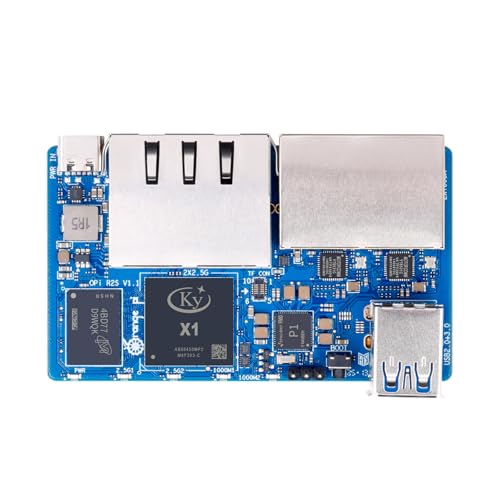
Orange Pi R2S RISC-V Single Board Computer
Best for: multi-gigabit RISC-V edge routing and automation
- Processor
- Ky X1
- RAM Capacity
- 4GB
- RAM Type
- LPDDR4X
- Storage
- 8GB eMMC
- Ethernet
- Dual 2.5G, Dual Gigabit Ethernet
- Operating System Support
- OpenWrt, Ubuntu
View on Amazon: Orange Pi R2S RISC-V Single Board Computer Affiliate link
The Orange Pi R2S 4GB RISC-V Board is a compact single-board computer built around an eight-core Ky X1 RISC-V processor with 2TOPS of AI compute power. You get 4GB of LPDDR4X memory, 8GB of onboard eMMC storage, dual 2.5G Ethernet ports, and dual Gigabit Ethernet ports. It suits you if you need a high-throughput networking device, edge gateway, or industrial controller running OpenWrt or Ubuntu.
Pros
- Dual 2.5G and dual Gigabit Ethernet interfaces
- Eight-core Ky X1 RISC-V processor with 2TOPS AI compute
- Onboard 8GB eMMC flash and TF card expansion
- USB 3.0, USB 2.0, and Type-C power input
Cons
- Integrated eMMC capacity is limited to 8GB
- No built-in Wi-Fi or Bluetooth connectivity listed
- Official OS support limited to OpenWrt and Ubuntu
Good fit if
- You need four physical Ethernet ports with 2.5G speed support.
- You deploy edge gateways or routers running OpenWrt or Ubuntu.
- You require an eight-core RISC-V CPU with integrated AI acceleration.
Skip if
- You need integrated wireless networking directly on the board.
- You require large onboard storage without adding a TF card.
Verdict: Orange Pi R2S 4GB RISC-V Board delivers quad Ethernet connectivity and RISC-V AI processing in a 79.2mm by 46mm footprint. It gives you capable hardware for compact routing, edge computing, and network management.

WayPonDEV Banana Pi WiFi 7 NIC Module
Best for: tri-band Wi-Fi 7 OpenWRT router setups
- Processor
- MediaTek MT7995AV
- Ethernet
- 2x 10Gbe SFP, 4x Gbe
- Wireless Connectivity
- Wi-Fi 7
- Operating System Support
- OpenWRT
- Architecture
- RISC-V
- Dimensions
- 5.9 × 4.01 × 0.78 inches
View on Amazon: WayPonDEV Banana Pi WiFi 7 NIC Module Affiliate link
This hardware is a Wi-Fi 7 network expansion module powered by the MediaTek MT7995AV processor and designed for the Banana Pi platform. It provides tri-band wireless coverage across 2.4GHz, 5GHz, and 6GHz bands with 320-MHz bandwidth support. Operating under OpenWRT, it offloads wireless processing from the host system. This card suits you if you need high-bandwidth tri-band routing capabilities and multi-gigabit networking hardware for custom router builds.
Pros
- MediaTek MT7995AV processor with hardware offload engine
- Tri-band Wi-Fi 7 connectivity covering 2.4GHz, 5GHz, and 6GHz
- Supports 320-MHz channel bandwidth and 4096-QAM
- Designed for OpenWRT network operating system
Cons
- Functions as an expansion module rather than a standalone single-board computer
- Requires a compatible host router board with miniPCIe slots
Good fit if
- You need tri-band Wi-Fi 7 support for a high-throughput router build.
- You use OpenWRT to manage your network traffic and hardware.
- You have a compatible Banana Pi router board with dual miniPCIe slots.
Skip if
- You want an all-in-one standalone single-board computer without extra modules.
- You do not need Wi-Fi 7 wireless speeds or 6GHz spectrum.
Verdict: WayPonDEV Banana Pi Wi-Fi 7 Module adds high-speed tri-band Wi-Fi 7 capability to OpenWRT-driven networking setups. It delivers specialized wireless throughput when paired with compatible router hardware.

Orange Pi RV2 4GB RISC-V SBC
Best for: AI edge computing and dual NVMe storage
- Processor
- RISC-V octa-core
- RAM Capacity
- 4GB
- RAM Type
- LPDDR4X
- Ethernet
- Gigabit Ethernet
- Wireless Connectivity
- Wi-Fi 5, BT 5 with BLE
- Operating System Support
- Ubuntu24.04
View on Amazon: Orange Pi RV2 4GB RISC-V SBC Affiliate link
The Orange Pi RV2 is an octa-core RISC-V development board built for advanced computing and edge deployments. You get 4GB of LPDDR4X memory, 2 TOPS of integrated AI arithmetic power, and dual M.2 M-Key slots for NVMe SSD expansion. It includes Gigabit Ethernet alongside Wi-Fi 5 and Bluetooth 5.0. This board suits you if you need a compact, power-efficient RISC-V alternative capable of running Ubuntu 24.04 for local AI and storage projects.
Pros
- Octa-core RISC-V processor with 2 TOPS integrated AI power
- Two M.2 M-Key slots supporting NVMe SSD expansion
- Onboard Wi-Fi 5 and Bluetooth 5.0 with BLE
- Gigabit Ethernet, USB 3.0, and HDMI output ports
Cons
- Relies on Wi-Fi 5 rather than newer wireless standards
- M.2 expansion operates at PCIe 2.0 speeds
- eMMC storage modules are optional rather than preinstalled
Good fit if
- You need hardware-accelerated AI compute on a RISC-V platform.
- You plan to run dual NVMe SSDs for fast local storage.
- You want an open-source development board compatible with Ubuntu 24.04.
Skip if
- You require Wi-Fi 6 or Wi-Fi 7 wireless connectivity.
- You need PCIe 3.0 or faster throughput for NVMe storage drives.
Verdict: Orange Pi RV2 4GB RISC-V Board pairs an 8-core RISC-V processor with 2 TOPS of AI acceleration and dual NVMe slots. It delivers substantial processing versatility and high-speed expansion for edge computing setups running Ubuntu 24.04.
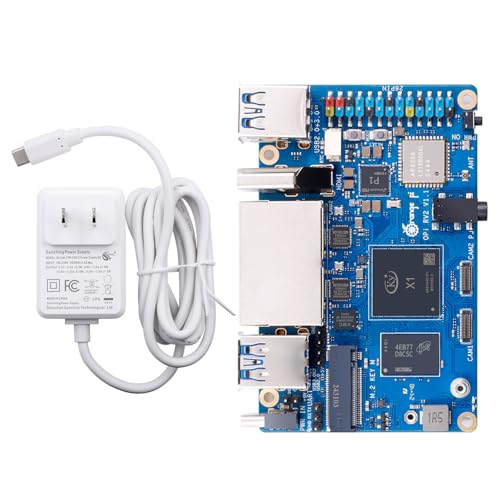
Orange Pi RV2 8GB RISC-V
Best for: edge AI and industrial control projects
- Processor
- 8-Core RISC-V
- RAM Capacity
- 2GB
- RAM Type
- LPDDR4x
- Ethernet
- Gigabit Ethernet
- Wireless Connectivity
- Wi-Fi 5.0, Bluetooth 5.0
- Operating System Support
- Linux, Ubuntu, OpenHarmony
View on Amazon: Orange Pi RV2 8GB RISC-V Affiliate link
The Orange Pi RV2 is a RISC-V single board computer with an octa-core processor and 2GB of LPDDR4X RAM. It includes built-in Wi-Fi 5.0 and Bluetooth 5.0 for wireless connectivity. The board features two M.2 M-Key slots for NVMe SSD expansion and a Gigabit Ethernet port. It offers 2.0 TOPS of AI performance for edge computing tasks. This model suits developers needing a compact, versatile platform for smart home or industrial control projects.
Pros
- Octa-core RISC-V processor with 2.0 TOPS AI performance
- 2GB LPDDR4X RAM for efficient memory usage
- Dual M.2 M-Key slots for NVMe SSD expansion
- Built-in Wi-Fi 5.0 and Bluetooth 5.0 connectivity
- Gigabit Ethernet port for stable wired network access
Cons
- 2GB RAM is lower than the 4GB and 8GB options available
- Wi-Fi 5.0 is slower than the Wi-Fi 7 module on the Banana Pi BPI-R4
- Single-core CPU performance is stated to surpass ARM A55 by over 30%, but absolute clock speeds are not listed
Good fit if
- You need a RISC-V board with integrated AI acceleration for edge computing
- You require dual M.2 slots for high-speed NVMe storage expansion
- You are developing for smart home or industrial control applications
Skip if
- You require Wi-Fi 7 for the latest wireless standards
- You need more than 2GB of RAM for heavy multitasking
- You prefer an ARM-based architecture over RISC-V
Verdict: The Orange Pi RV2 2GB RISC-V Board is a solid choice for developers building edge AI or industrial projects that benefit from dual M.2 storage and RISC-V architecture. It fits users who prioritize expansion options over maximum RAM or the newest Wi-Fi standard.

Orange Pi RV 4GB RISC-V Board
Best for: RISC-V video processing and edge development
- Processor
- JH-7110
- RAM Capacity
- 4GB
- RAM Type
- LPDDR4
- Ethernet
- Gigabit Ethernet
- Wireless Connectivity
- Wi-Fi 5, Bluetooth 5
- Video Resolution
- 4K@30fps
View on Amazon: Orange Pi RV 4GB RISC-V Board Affiliate link
The Orange Pi RV is a RISC-V single board computer featuring a quad-core JH-7110 processor running at 1.5GHz. It includes 4GB of LPDDR4 RAM and supports 4K video decoding. You will find Wi-Fi 5 and Bluetooth 5.0 for connectivity. The board offers a rich set of interfaces, including USB 3.0 and Gigabit Ethernet. It suits developers needing visual processing capabilities for edge computing tasks.
Pros
- Quad-core RISC-V JH-7110 processor at 1.5GHz
- 4GB LPDDR4 RAM
- 4K@30fps video decoding support
- Gigabit Ethernet and Wi-Fi 5
Cons
- Wi-Fi 5 is slower than the Wi-Fi 7 found on the Banana Pi BPI-R4
- Quad-core CPU has fewer cores than the 8-core options on the Orange Pi R2S and RV2
- Only 4GB RAM variant listed, less than the 8GB options available for other models
Good fit if
- You need a RISC-V board for video processing
- You require Gigabit Ethernet connectivity
- You are developing for edge computing scenarios
Skip if
- You need Wi-Fi 7 speeds
- You require an 8-core processor
- You need more than 4GB of RAM
Verdict: Orange Pi RV 4GB RISC-V Board fits users who prioritize video decoding and RISC-V architecture over raw core count or latest wireless standards.

Libre Computer Tritium 1GB Quad-Core Board
Best for: upstream Linux projects and lightweight IoT deployments
- RAM Capacity
- 1GB
- Operating System Support
- Ubuntu, Debian, Raspbian, Armbian
View on Amazon: Libre Computer Tritium 1GB Quad-Core Board Affiliate link
The Libre Computer Tritium is a quad-core single board computer equipped with 1GB of RAM and a Raspberry Pi-style GPIO interface. You get support for upstream Linux kernels and U-Boot, allowing you to boot standard distributions like Ubuntu, Debian, Raspbian, and Armbian without proprietary binary blobs. It suits you if you need an entry-level development board for basic IoT setups or software testing using mainstream open-source operating systems.
Pros
- Upstream Linux and U-Boot support without proprietary boot blobs
- Supported by Ubuntu, Debian, Raspbian, and Armbian operating systems
- Raspberry Pi-style GPIO interface and form factor
- Quad-core processing architecture
Cons
- Limited to 1GB of memory capacity
- No integrated Wi-Fi or wireless module listed in hardware specifications
- Certain hardware chip features require proprietary binaries for full performance
Good fit if
- You need upstream Linux and open-source boot support without closed binaries
- You deploy lightweight server setups on Ubuntu, Debian, or Armbian
- You want a Raspberry Pi-compatible GPIO header for external hardware
Skip if
- You require more than 1GB of RAM for memory-heavy tasks
- You need built-in wireless networking on the board
Verdict: Libre Computer Tritium 1GB SBC delivers standard open-source Linux support with a quad-core processor and 1GB of RAM. It handles basic Linux deployments without requiring proprietary software binaries.

Taidacent Rock Pi S with Shell
Best for: low-overhead voice and IoT appliances
- Processor
- Rockchip RK3308 Quad A35 64bit
- RAM Capacity
- 256MB
- Storage
- 1GB NAND
- Ethernet
- RJ45 10/100Mbit Ethernet
- Use
- IoT
View on Amazon: Taidacent Rock Pi S with Shell Affiliate link
This Taidacent Rock Pi S single-board computer runs on a Rockchip RK3308 quad-core A35 64-bit processor with a built-in VAD audio detector. You get 256MB of RAM, 1GB of onboard NAND storage, 10/100Mbit Ethernet, and an included shell. Equipped with USB Type-A host and Type-C OTG ports, it suits you if you deploy compact audio detection hardware or lightweight IoT network projects.
Pros
- Rockchip RK3308 quad A35 64-bit processor with integrated VAD
- 1GB onboard NAND storage
- Dual USB connectivity with Type-C OTG and Type-A host ports
- Comes with protective shell
Cons
- Limited to 256MB of RAM
- 10/100Mbit Ethernet rather than Gigabit speed
- Configuration lacks built-in Bluetooth
Good fit if
- You need a dedicated board with built-in VAD hardware for audio-triggered IoT tasks.
- You want an enclosed small-footprint device with onboard NAND storage.
Skip if
- You need Gigabit Ethernet speeds instead of a 10/100Mbit interface.
- You require onboard Bluetooth connectivity or more than 256MB of memory.
Verdict: Taidacent Rock Pi S IoT Board delivers a dedicated RK3308 processor with an audio detector and protective shell for compact smart setups. Its 256MB memory and 10/100Mbit Ethernet limit it to low-overhead IoT roles.
Specifications side by side
| Spec | Orange Pi R2S RISC-V Single Board Computer | WayPonDEV Banana Pi WiFi 7 NIC Module | Orange Pi RV2 4GB RISC-V SBC | Orange Pi RV2 8GB RISC-V | Orange Pi RV 4GB RISC-V Board | Libre Computer Tritium 1GB Quad-Core Board | Taidacent Rock Pi S with Shell |
|---|---|---|---|---|---|---|---|
| Processor | Ky X1 | MediaTek MT7995AV | RISC-V octa-core | 8-Core RISC-V | JH-7110 | not stated | Rockchip RK3308 Quad A35 64bit |
| RAM Capacity | 4GB | not stated | 4GB | 2GB | 4GB | 1GB | 256MB |
| RAM Type | LPDDR4X | not stated | LPDDR4X | LPDDR4x | LPDDR4 | not stated | not stated |
| Storage | 8GB eMMC | not stated | not stated | not stated | not stated | not stated | 1GB NAND |
| Ethernet | Dual 2.5G, Dual Gigabit Ethernet | 2x 10Gbe SFP, 4x Gbe | Gigabit Ethernet | Gigabit Ethernet | Gigabit Ethernet | not stated | RJ45 10/100Mbit Ethernet |
| Wireless Connectivity | not stated | Wi-Fi 7 | Wi-Fi 5, BT 5 with BLE | Wi-Fi 5.0, Bluetooth 5.0 | Wi-Fi 5, Bluetooth 5 | not stated | not stated |
| Video Resolution | not stated | not stated | not stated | not stated | 4K@30fps | not stated | not stated |
| Operating System Support | OpenWrt, Ubuntu | OpenWRT | Ubuntu24.04 | Linux, Ubuntu, OpenHarmony | Debian, Linux | Ubuntu, Debian, Raspbian, Armbian | not stated |
| Memory | not stated | not stated | 4GB RAM | not stated | not stated | not stated | not stated |
| Operating System | Ubuntu | not stated | not stated | Ubuntu | not stated | not stated | not stated |
| Use | not stated | not stated | not stated | not stated | not stated | not stated | IoT |
| Architecture | RISC-V | RISC-V | RISC-V | RISC-V | RISC-V | not stated | not stated |
| Connectivity | not stated | not stated | WiFi 5 | WiFi 5, Bluetooth 5.0 | WiFi 5 | not stated | not stated |
| Dimensions | not stated | 5.9 × 4.01 × 0.78 inches | 3.5 × 2.2 × 0.5 inches | not stated | not stated | not stated | not stated |
| Weight | not stated | 8.82 ounces | 2 ounces | not stated | not stated | not stated | not stated |
| Model | 4GB | BPI-R4 NIC BE14 Wi-Fi 7 Module | Orange Pi RV2 | 2GB+No Power Supply | Orange Pi RV | not stated | not stated |
| Size | not stated | 32-bit RISC-V MCU | not stated | not stated | not stated | H3 1GB | With Shell |
| Color | not stated | WiFi7 NIC Module | 4GB | 2GB | 4G | not stated | 256MB Without Bluetooth With 1GB NAND |
If you also compare compact beverage hardware, specifications for bunn mcu my cafe single alternatives detail different cup capacities.
Frequently asked questions
What is the best RISC-V single board computer for edge routing?
The Orange Pi R2S 4GB is the top choice for multi-gigabit edge routing and automation. It features quad Ethernet connectivity and RISC-V AI processing within a compact 79.2mm by 46mm footprint. This hardware provides capable support for compact routing, edge computing, and network management tasks running Ubuntu.
Are there Wi-Fi 7 options for OpenWRT router setups?
Yes, the WayPonDEV Banana Pi Wi-Fi 7 Module adds high-speed tri-band Wi-Fi 7 capability to OpenWRT-driven networking setups. It delivers specialized wireless throughput when paired with compatible router hardware. This module measures 5.9 inches in length and weighs 8.82 ounces for easy integration.
Which RISC-V board supports dual NVMe storage?
The Orange Pi RV2 4GB pairs an 8-core RISC-V processor with dual NVMe slots. It also includes 2 TOPS of AI acceleration for substantial processing versatility. This board runs Ubuntu 24.04 and offers high-speed expansion for edge computing setups requiring fast storage access.
Is there a budget-friendly board for upstream Linux projects?
The Libre Computer Tritium 1GB Quad-Core Board is ideal for upstream Linux projects and lightweight IoT deployments. It delivers standard open-source Linux support with a quad-core processor and 1GB of RAM. It handles basic Linux deployments without requiring proprietary software binaries.
What is a good board for low-overhead voice appliances?
The Taidacent Rock Pi S with Shell delivers a dedicated RK3308 processor with an audio detector and protective shell. Its 256MB memory and 10/100Mbit Ethernet limit it to low-overhead IoT roles. This makes it suitable for compact smart setups requiring minimal resource usage.
Which ARM board handles 8K video and multi-display tasks?
The Radxa Rock 5 Model B 8GB SBC delivers heavy compute and 8K display capability with its RK3588 SoC. It serves as a high-bandwidth ARM alternative when your workload outgrows entry-level boards. This board runs Ubuntu and supports demanding visual applications.
Is there an ARM board with a built-in screen for learning?
The DFRobot UNIHIKER M10 2.8" ARM SBC fits learners and IoT makers who value integrated screens and wireless connectivity. It prioritizes ease of use over raw processing power or wired networking. This compact board measures 3.27 inches in length and supports Python learning.